Astell & Kern SR35 takes hi-res audio beyond the listening room
Expandable storage, three headphone connections and USB DAC functionality make Astell & Kern’s SR35 worth considering as more than a travelling music library.
By Oliver Pembrook · · 5 min read
Key facts
- 01Astell & Kern SR35 has 64GB internal storage and supports microSD expansion of up to 1TB.
- 02The SR35 provides 3.5mm, 2.5mm and 4.4mm headphone outputs.
- 03The SR35 supports PCM up to 32-bit/384kHz, DSD256 and native MQA playback.
- 04The SR35 supports Roon, two-way Bluetooth and use as a USB DAC.
- 05Sony NW-A306 has 32GB internal storage, with roughly half occupied by its Android system.
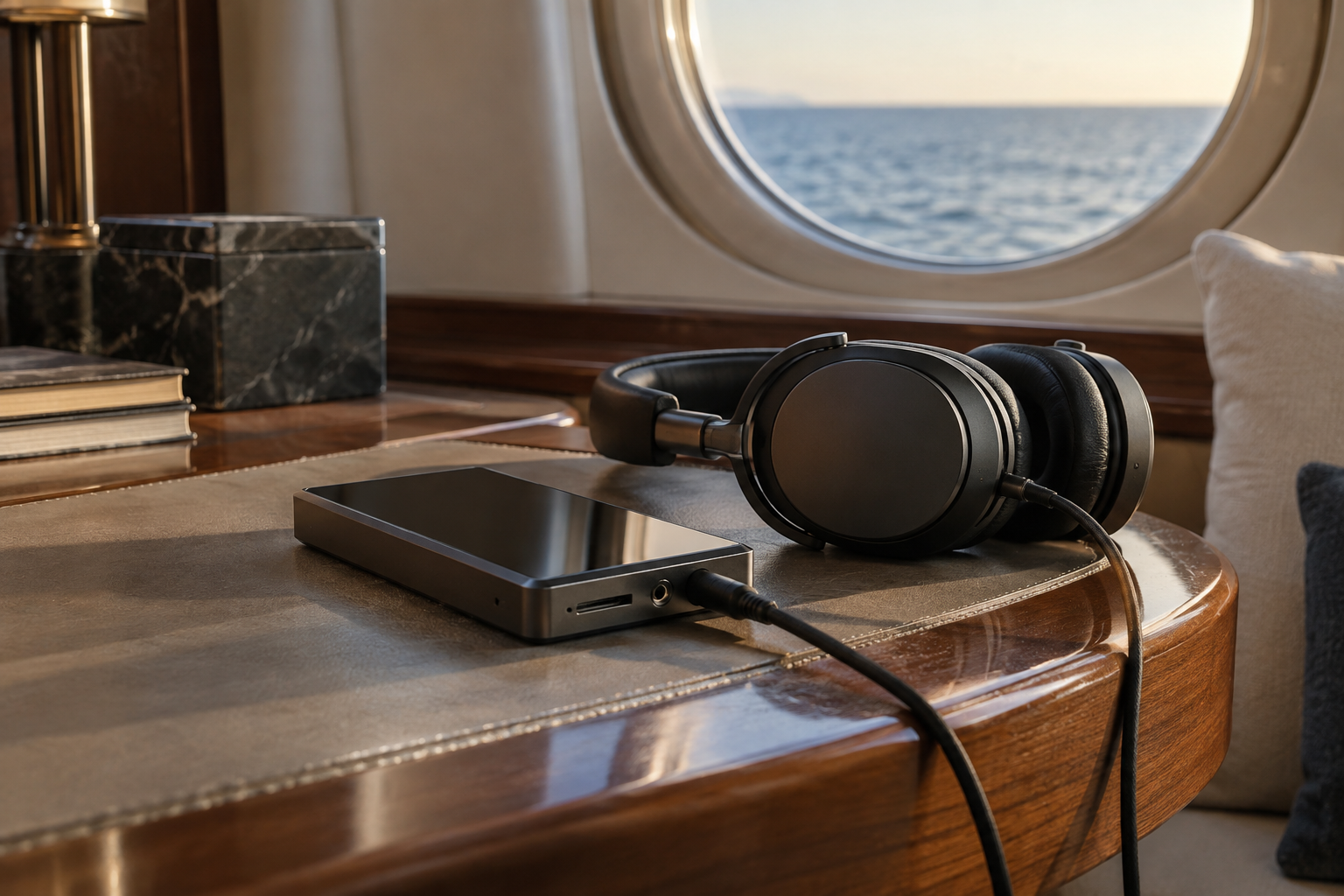
Astell & Kern’s A&norma SR35 combines a portable music library, streaming access and USB digital-to-analogue conversion in one dedicated player. With 64GB of internal storage, microSD expansion of up to 1TB and three headphone outputs, its relevance extends from travel to private listening in a well-equipped home.
What happened
The SR35 replaces the A&norma SR25 MKII within Astell & Kern’s range. It sits above Sony’s more affordable NW-A306 and below the considerably more expensive A&ultima SP3000, making it a useful reference point for buyers weighing convenience against the capabilities of a dedicated audio source.
Its wired connections cover 3.5mm, 2.5mm and 4.4mm headphone plugs. That breadth matters for owners who already have several pairs of headphones: the physical connection is less likely to dictate which pair travels with the player. It is still necessary to check electrical suitability, rather than treating a matching socket as proof of an ideal partnership.
File support includes PCM at up to 32-bit/384kHz, DSD256 and native MQA playback. These are compatibility limits, not promises that every recording will sound better. Their practical value is that owners with a mixed collection of CD rips and high-resolution downloads can accommodate a wide range of material without first converting it.
The SR35 also supports Roon and provides access to Tidal, Qobuz, Amazon Music and Apple Music. Two-way Bluetooth allows it both to send audio to wireless headphones or speakers and to receive music from another source; aptX HD and LDAC are among the supported codecs.
A further role is available over USB: the player can act as a DAC between a laptop and wired headphones. For someone moving between a study, a second home and a hotel room, that makes the device an alternative to carrying a separate computer-audio interface alongside a portable music player.
The background
The case for a dedicated player is no longer simply that it holds more songs than a phone. Modern smartphones already provide extensive streaming access. The distinction lies in allocating storage, audio conversion, headphone amplification and the listening interface to a device whose principal purpose is music.
Local files also separate playback from the availability of an internet connection. On a flight or aboard a yacht beyond reliable shore connectivity, an album stored on the player does not depend on a live streaming session. Streaming applications remain useful, but owners should distinguish access to a service from possession of an offline library.
Storage therefore deserves more attention than the largest number on the specification sheet. Sony’s NW-A306 has 32GB internally, but roughly half is occupied by its Android system. It offers microSD expansion, while its USB-C connection handles charging, file transfer and DAC duties; a 3.5mm socket serves wired headphones.
The Sony illustrates a different balance of priorities. Its full Android operating system allows users to download their preferred streaming applications, and Bluetooth support includes LDAC and aptX. Buyers gain a familiar software environment, but should budget for additional memory rather than assume the advertised internal capacity is wholly available for music.
At the other end, the Astell & Kern SP3000 provides 256GB of internal storage and expansion by up to 1TB. Its AK4499EX DAC technology from Asahi Kasei supports PCM up to 32-bit/768kHz and DSD512. Those higher ceilings are relevant to particular libraries; they do not, by themselves, establish a reason to replace an otherwise suitable player.
A portable source also changes a different part of the listening chain from a loudspeaker upgrade. Our examination of PMC Prophecy speaker placement and room size concerns the relationship between speakers and their surroundings. Headphone listening largely removes that room interaction, making headphone selection and source compatibility the more immediate decisions.
What people are saying
For owners, the SR35 is best read as a way to maintain a consistent personal listening setup across locations. Its storage, headphone sockets and computer-DAC function address different circumstances without requiring the listener to rebuild a system at every destination. Whether that warrants another device depends on how often those circumstances arise.
Integrators should view Roon support as a reason to investigate the player’s precise role in an existing music environment, not as evidence of comprehensive home-automation compatibility. The available specifications do not establish control-system drivers, docked operation or multiroom synchronisation. Those requirements need separate verification before the player appears in a residential equipment schedule.
For captains and yacht managers, locally stored music offers an option that need not draw on the vessel’s internet service during playback. It should nevertheless remain distinct from a marine installation: the information available establishes no water-resistance rating or suitability for exposed deck use. A portable personal source is not a substitute for specified onboard audio equipment.
The distinction between private and shared entertainment is equally important at home. A system such as the Epson QS100 living-room projection setup serves a room and its occupants. A dedicated player instead gives one listener access to a separate collection without occupying the main entertainment system.
What happens next
There is no new SR35 launch date or announced upgrade timetable established by the available information. The immediate decision is therefore one of selection and verification, rather than waiting for a promised feature. Buyers should confirm current availability, firmware support and streaming-service compatibility before committing.
The premium comparison needs particular care. The SP3000 has an identified successor, the A&ultima SP4000, but the available material supplies neither a firm release date nor a confirmed recommended retail price. It would be premature to make an October 2026 purchasing recommendation on the assumption that the older player remains the current flagship.
An audition should use the intended headphones and familiar recordings, not merely a demonstration pair chosen to flatter the source. Useful checks include comfortable listening level, adjustment range and the behaviour of sensitive earphones. Neither the number of sockets nor the maximum supported sample rate answers those questions.
Library preparation is another concrete step. Check the player against the file formats actually owned, establish how much space that collection occupies and allow room for additions. A microSD card can extend capacity substantially, but file organisation and a separate backup remain the owner’s responsibility.
Battery endurance is an unresolved comparison here: no model-specific runtime figures are established in the supplied specifications. Anyone buying for long-haul travel should verify endurance under the intended combination of wired or wireless playback, screen use and streaming, rather than rely on general claims about portable players lasting a day.
Why this matters
For a luxury-home or yacht owner, the SR35’s strongest proposition is the combination of a substantial offline library and several useful connection options in a personal source. Specify it around the headphones, recordings and journeys it must serve—not around the highest-resolution file it can decode—and it becomes a considered addition to an audio collection rather than another screen to manage.
Questions answered
+How much storage does the Astell & Kern SR35 have?
The SR35 has 64GB of internal storage and supports expansion with a microSD card of up to 1TB.
+What headphone outputs does the SR35 have?
The SR35 provides 3.5mm, 2.5mm and 4.4mm headphone outputs. Buyers should check headphone compatibility beyond the physical plug size.
+Can the Astell & Kern SR35 stream music?
Yes. The SR35 provides access to Tidal, Qobuz, Amazon Music and Apple Music. It also supports Roon.
+Can I use the SR35 as a USB DAC?
Yes. The SR35 can function as a USB DAC between a laptop and wired headphones.
+Does the SR35 work with Bluetooth headphones?
Yes. Its two-way Bluetooth supports sending audio to wireless headphones or speakers and receiving audio from another source. Supported codecs include aptX HD and LDAC.
+What audio formats does the SR35 support?
The SR35 supports PCM up to 32-bit/384kHz, DSD256 and native MQA playback. These specifications describe compatibility, rather than guaranteeing the quality of a recording.
+Can a portable music player work without Wi-Fi?
Yes. Music files stored locally on a portable player can be played without an internet connection. Online streaming remains a separate use case.
More in Cool Stuff
 Cool Stuff
BMW 3 Series brings panoramic iDrive to its 2027 cabin
BMW’s next petrol saloon combines a windscreen-wide information display with touchscreen-led controls, revised driver assistance and a performance feature arriving after launch.
7 October 2026 · 5 min
 Cool Stuff
Epson QS100: what a 140-inch living-room system demands
A household evaluation of Epson’s projector and EPV’s rising screen highlights the installation decisions behind convincing large-screen viewing in a shared living room.
7 October 2026 · 5 min
 Cool Stuff
PMC Prophecy speakers put room size before cabinet size
PMC’s replacement for its Twenty 5i range highlights why bass loading, listening distance and placement deserve as much attention as a loudspeaker’s dimensions.
7 October 2026 · 5 min