PMC Prophecy speakers put room size before cabinet size
PMC’s replacement for its Twenty 5i range highlights why bass loading, listening distance and placement deserve as much attention as a loudspeaker’s dimensions.
By Oliver Pembrook · · 5 min read
Key facts
- 01PMC’s Prophecy loudspeaker range replaces its established Twenty 5i domestic series.
- 02PMC Prophecy 1 combines a 12.5cm mid/bass driver, 27mm tweeter and transmission-line bass loading.
- 03PMC Prophecy 7 is a three-way floorstander better suited to medium-sized rooms than very large spaces.
- 04Epos ES-7N includes a rear-panel switch to adapt its response for shelving or near-wall placement.
- 05Fyne Audio F502S combines a 25mm tweeter with separate 20cm mid/bass and bass drivers.
PMC’s Prophecy loudspeakers replace its established Twenty 5i range, bringing transmission-line bass loading to models including the compact Prophecy 1 and three-way Prophecy 7. For owners specifying a premium music system, the distinction is not simply between standmount and floorstanding speakers: the Prophecy 7 is better suited to a medium-sized room than a vast entertaining space.
What happened
The Prophecy family takes over from a series that occupied a central position in PMC’s domestic loudspeaker offering for years. Two models illustrate the breadth of the replacement: the Prophecy 1 standmount and the Prophecy 7, which sits in the middle of the range’s floorstanding line-up.
The Prophecy 1 combines a 12.5cm mid/bass driver with a 27mm soft-dome tweeter, the latter also used in the Prophecy 7. Its bass system channels sound from the rear of the mid/bass driver through a folded, damped passage inside the cabinet, rather than allowing that energy to escape directly through a conventional reflex port.
Most higher-frequency energy is absorbed along that passage. The lowest frequencies emerge through a vent at the base, supporting the driver where its own output begins to diminish. That arrangement helps explain why cabinet dimensions alone are an incomplete guide to a speaker’s low-frequency capability.
The Prophecy 7 uses a three-way configuration and also employs transmission-line loading for its bass driver. Its reported strengths include clarity, coherent integration between drivers and a spacious stereo presentation, but those qualities should not be mistaken for unlimited output in a much larger room. No room-area threshold or launch date is specified in the available product information.
The background
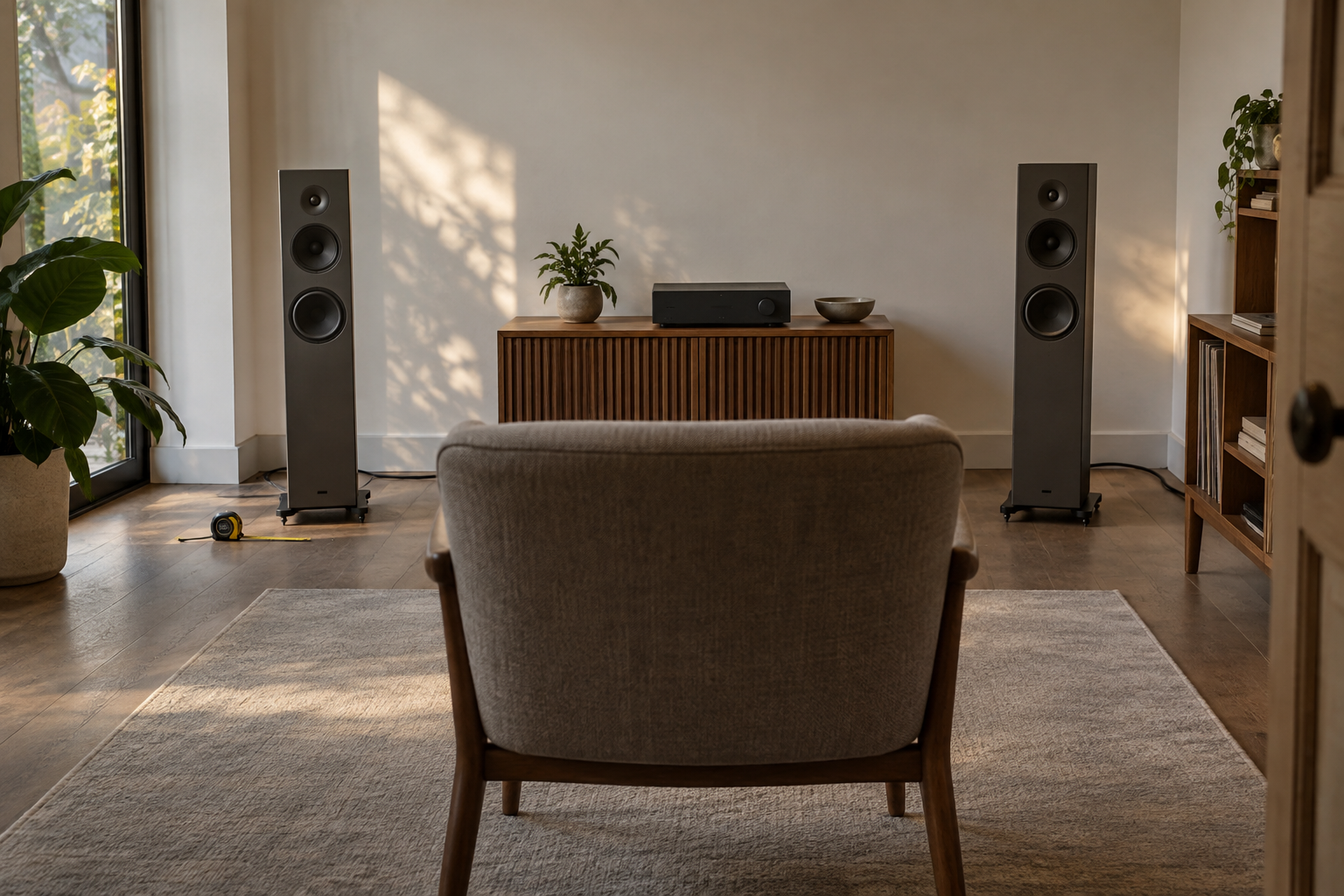
A standmount speaker is not necessarily a space-saving installation once its support is included. Dedicated stands occupy floor area, need stable positioning and place the speaker away from convenient furniture surfaces. For a furnished drawing room, the useful comparison is therefore the complete installed footprint, not simply the volume of the cabinet.
Epos addresses that constraint directly with the ES-7N. A rear-panel switch changes its response for positioning close to a wall or within shelving, giving owners an alternative to the usual assumption that a premium compact loudspeaker must stand clear of furniture to perform properly.
That adjustment has a practical acoustic purpose. Nearby boundaries can reinforce low frequencies and alter tonal balance; designing a selectable response around that condition is different from placing an ordinary standmount inside a bookcase and hoping for the best. Listening assessments of the ES-7N found that shelf placement retained much of its capability, although clarity and stereo imaging were slightly reduced.
Wharfedale’s Diamond 12.3i demonstrates the opposite planning risk: a familiar external form can conceal a changed placement requirement. The updated floorstander retains its predecessor’s dimensions and 2.5-way arrangement, but revisions to internal damping and the rear-facing reflex port make positioning more consequential. A reported listening setup used approximately 70cm of clearance into the room to improve stereo imaging; that is a starting reference, not a universal installation prescription.
The Diamond update was documented on 3 July 2026. Its unchanged tweeter and headline specifications underline why a specification sheet cannot fully explain how a revised speaker will behave in an existing room. Owners replacing an older pair should still budget time for repositioning rather than treating familiar cabinet measurements as a guarantee.
What people are saying
The available listening assessments favour the Prophecy 1 for precision, dynamic control and its ability to remain composed during demanding passages. These are reported impressions, not Primal Wire listening-test findings. They support an audition shortlist, but do not establish how the speaker will interact with a particular room, amplifier or listening level.
The Prophecy 7 is similarly characterised as tonally balanced and well integrated, with its medium-room suitability an important qualification. An owner should read that as a system-design constraint rather than a criticism: a loudspeaker that works persuasively at a sensible distance need not also energise an extensive open-plan interior.
For larger spaces, Fyne Audio’s F502S offers a different proposition. Part of the F500S range introduced in February 2025, it uses a 25mm magnesium-dome tweeter, a 20cm mid/bass driver and a separate 20cm bass driver. Its substantial cabinet makes the physical accommodation question more explicit than with PMC’s smaller models.
Fyne’s Isoflare arrangement places the tweeter concentrically within the mid/bass driver. Reported listening observations emphasise consistent dispersion and a stable central image across different listening positions. For a room with several seats, that is a useful reason to audition beyond the central chair, rather than assessing everything from one carefully chosen position.
Integrators are likely to distinguish those acoustic considerations from the wider task of making a system convenient to use. The scope of luxury-home technology integration extends beyond choosing individual components: amplifier location, cable routes and the intended use of each room should be resolved before loudspeaker positions become fixed by joinery.
What happens next
The immediate decision for a prospective PMC buyer is an audition, not an assumption that the larger cabinet is automatically the better purchase. Compare the Prophecy 1 and Prophecy 7 at the intended listening distance, with demanding music and quieter material, and establish whether the floorstander’s additional scale is useful in the available space.
Amplifier matching also deserves more scrutiny than a single impedance figure. Acoustic Energy’s AE300 Mk2 provides a useful comparison: despite a relatively low nominal impedance, its impedance behaviour was found manageable with appropriately matched amplifiers, including the Arcam A5 and Rega Brio Mk7. Those pairings relate to the Acoustic Energy model and should not be transferred to the PMCs without checking suitability.
Finish choices can constrain an otherwise suitable shortlist. Fyne’s sub-£1,000 F501E is available in black ash only, while using a concentric Isoflare driver and downward-firing bass system with Basstrax dispersion. For an interior designer, the lesson is concrete: establish both acoustic requirements and acceptable finishes before committing furniture layouts around a particular speaker.
A yacht installation adds a separate suitability assessment. Neither domestic transmission-line loading nor wide dispersion establishes marine suitability, secure mounting or resistance to the onboard environment. Owners considering freestanding hi-fi alongside integrated yacht entertainment should treat specialist superyacht AV integration as a distinct engineering discipline, not an extension of a successful showroom demonstration.
The remaining questions are project-specific: usable wall clearance, normal seating positions, desired playback levels and the amplifier already installed. Pricing and availability for the Prophecy models are not established here, so a dealer quotation and confirmation of the proposed system remain necessary before procurement.
Why this matters
For a luxury-home owner, the strongest loudspeaker choice is the one whose acoustic requirements survive the realities of the finished interior. PMC’s Prophecy range, Epos’s placement adjustment and Fyne’s concentric-driver approach offer different tools for that task; none removes the need to test the actual arrangement. Making that assessment before cabinetry, power and speaker cabling are finalised protects both the listening experience and the architectural scheme.
Questions answered
+What does the PMC Prophecy range replace?
The Prophecy range replaces PMC’s Twenty 5i series, which formed a central part of the company’s domestic loudspeaker offering.
+What drivers does the PMC Prophecy 1 use?
The Prophecy 1 uses a 12.5cm mid/bass driver and a 27mm soft-dome tweeter. Its cabinet incorporates a folded, damped transmission line to support low-frequency output.
+Is the PMC Prophecy 7 suitable for large rooms?
The Prophecy 7 is better suited to medium-sized rooms than very large spaces. No specific room-area threshold is provided, so an audition at the intended listening distance is advisable.
+How does a transmission-line speaker work?
A folded, damped passage carries sound from behind the bass driver through the cabinet. Most higher frequencies are absorbed, while the lowest frequencies emerge through a vent to support bass output.
+Can Epos ES-7N speakers go inside a bookshelf?
Yes. The ES-7N has a rear-panel switch that adjusts its response for shelving or near-wall placement. Reported listening assessments found a small reduction in clarity and stereo imaging compared with freestanding placement.
+How far from the wall should Wharfedale Diamond 12.3i speakers be?
A reported listening setup positioned the Diamond 12.3i approximately 70cm into the room to improve stereo imaging. That is a reference point rather than a universal rule; the appropriate distance depends on the installation.
+When was the Fyne Audio F500S range introduced?
Fyne Audio introduced the F500S range in February 2025. It includes the F502S floorstander, which uses a 25mm magnesium-dome tweeter and two 20cm drivers.
More in Cool Stuff
 Latest Tech
Lumene Coliseum Silent screens add smarter cinema control
Due in the UK in November, Lumene’s motorised screen range combines revised movement control with five materials for dedicated cinemas and shared living spaces.
7 October 2026 · 5 min
 Cool Stuff
Epson QS100: what a 140-inch living-room system demands
A household evaluation of Epson’s projector and EPV’s rising screen highlights the installation decisions behind convincing large-screen viewing in a shared living room.
7 October 2026 · 5 min
 Awards
Yacht Intelligence wins Crestron marine award for Valor
The Feadship project takes the above-60-metre installation award, recognising an approach to onboard AV, control and IT centred on discreet operation.
7 October 2026 · 5 min