Yacht Intelligence wins Crestron marine award for Valor
The Feadship project takes the above-60-metre installation award, recognising an approach to onboard AV, control and IT centred on discreet operation.
By Amara Okafor · · 5 min read
Key facts
- 01Yacht Intelligence won the Ultimate Yacht Installation Above 60 Metres category at the 2026 Crestron Marine Technology Awards.
- 02The winning Yacht Intelligence project was aboard Feadship’s Valor.
- 03The 2026 Crestron Marine Technology Awards were presented during the Superyacht Technology Show in Barcelona.
- 04Yacht Intelligence’s disclosed work on Valor encompassed AV, control and IT infrastructure.
- 05Yacht Intelligence says Valor’s owner prioritised discreet technology and simple interaction.
Yacht Intelligence has received the Ultimate Yacht Installation Above 60 Metres award for its work aboard Feadship’s Valor at the 2026 Crestron Marine Technology Awards. Presented during the Superyacht Technology Show in Barcelona, the accolade recognises a project bringing together AV, control and IT infrastructure around an owner’s preference for discreet technology.
What happened
The award places Valor in Crestron’s category for installations aboard yachts longer than 60 metres. It recognises Yacht Intelligence’s integration work rather than the vessel’s naval architecture or exterior design: the relevant achievement is how onboard technology is organised and experienced.
Crestron’s marine awards cover projects delivered by its partners internationally. Yacht Intelligence describes the assessment as encompassing technical precision, innovation, user experience and the ability to create a cohesive onboard environment. Those criteria give the recognition a broader remit than the specification of individual entertainment products.
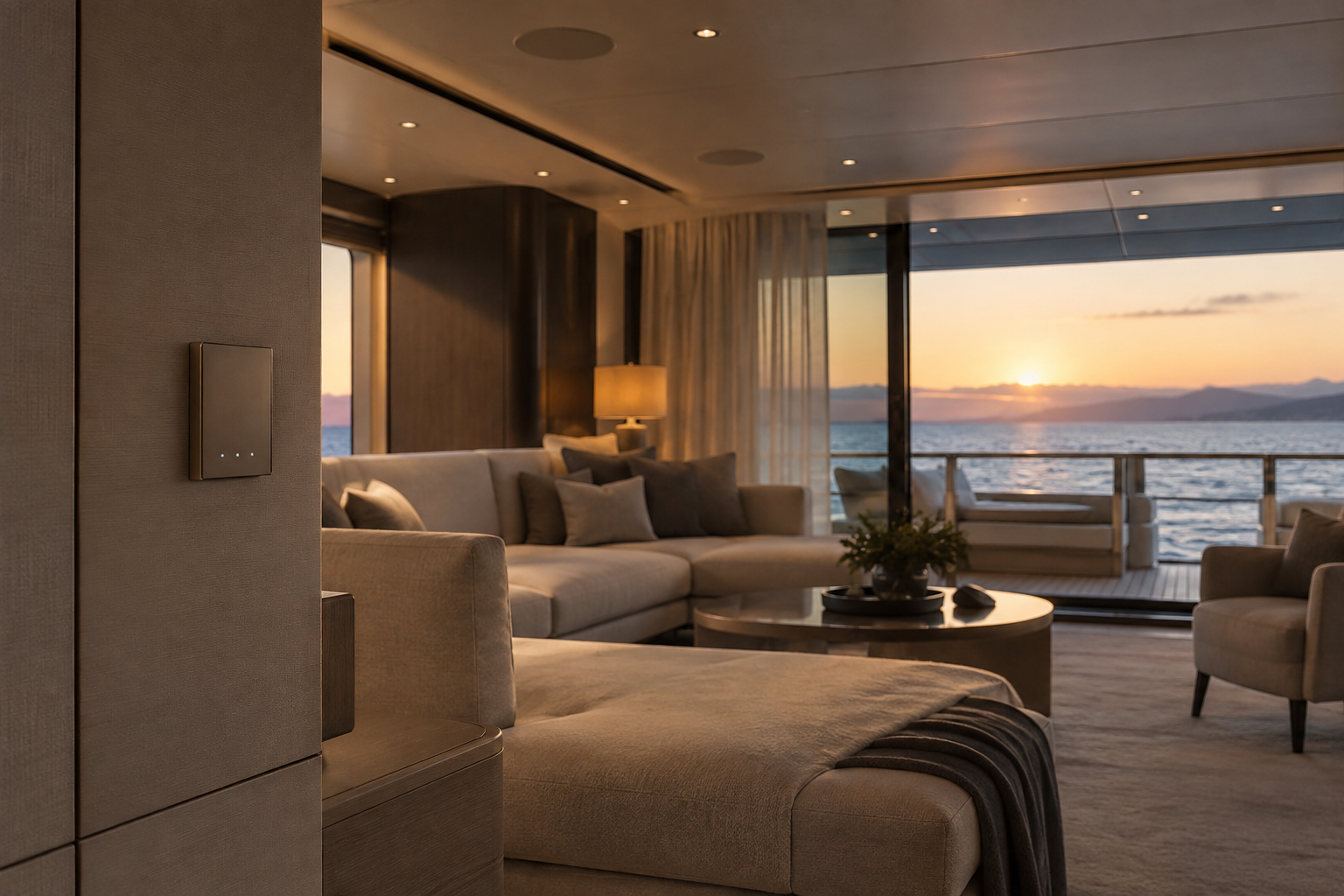
On Valor, Yacht Intelligence’s stated scope encompassed advanced AV, control and IT across a large, highly personalised vessel. The company says the owner wanted spaces to feel calm and considered, with technology supporting that atmosphere rather than becoming a conspicuous feature of the interior.
The announcement does not identify equipment models, network architecture, the number of controlled spaces or the project’s value. Nor does it provide judges’ comments or scores. The award and the broad integration scope are therefore the concrete news; a detailed technical assessment of the installation would require further disclosure.
The background
A superyacht integration project connects systems that occupants experience as one environment but that may operate on very different principles. AV equipment handles content and playback, the IT infrastructure supports connectivity, and the control layer translates a user’s request into actions across connected equipment. Weakness in any one layer can affect the apparent quality of the whole.
That distinction matters when assessing an installation award. A premium display or loudspeaker has its own performance characteristics, but the integrator must also make sources accessible, commands predictable and everyday operation understandable. Equipment quality and integration quality are related, not interchangeable.
Scale introduces another challenge. On a yacht in the above-60-metre category, maintaining a consistent operating approach across separate spaces requires deliberate design. A guest should not need to learn a different interaction pattern whenever they move between rooms, even where the equipment and intended use differ.
Marine conditions add practical constraints to that interface problem. Equipment installation and servicing must accommodate the vessel’s physical environment, while support arrangements need to work around its movements. The source announcement identifies demanding marine conditions as part of the category’s context, but provides no environmental testing or resilience data for Valor itself.
The preference for unobtrusive technology also has a clear residential parallel. Primal Wire’s coverage of Newland Solutions’ work across luxury home technology addresses the same custom-integration sector. In either setting, the useful design question is not simply what can be automated, but which interactions genuinely deserve the occupant’s attention.
What people are saying
Yacht Intelligence presents the award as recognition of its team’s craftsmanship and collaboration with project partners. Its account emphasises the relationship between engineering and the owner’s interior brief, rather than positioning the installation as a demonstration of the largest possible technology inventory.
The company reports that the owner wanted a restrained experience, with few unnecessary points of interaction. That is an important qualification: discreet technology is not necessarily technology with fewer capabilities. It can instead mean keeping routine functions immediately accessible while removing complexity from the normal user journey.
For owners, that distinction suggests a useful way to read the recognition. The relevant promise is ease of use, not simply the presence of sophisticated systems. An award can help identify a project worth examining, but it does not establish whether another owner’s entertainment preferences, connectivity needs or operating habits would suit the same approach.
Captains and technical crew are likely to examine a different side of the proposition. A simplified guest interface is valuable only if authorised staff can still diagnose faults, recover services and understand dependencies. Yacht Intelligence has not described those provisions aboard Valor, so the announcement should not be taken as evidence of any particular maintenance or recovery arrangement.
For integrators, the disclosed brief makes coordination with the wider project team especially significant. Decisions about visible controls, equipment access and room use affect more than programming. The company’s thanks to its collaborators is consistent with that shared responsibility, although individual partners and their contributions are not identified.
What happens next
Yacht Intelligence says it intends to continue developing onboard technology around this restrained, user-focused approach. It has not announced a new product, a follow-on Valor installation or a dated development programme in connection with the award. There is therefore no disclosed delivery milestone for owners or yards to track.
The recognition sits alongside a separate business development: Yacht Intelligence’s expansion of its Florida team for yacht and home technology. The two stories concern different things—one an awarded installation, the other the company’s operational footprint—and the award announcement does not establish a connection between the expansion and Valor’s delivery.
A fuller technical account would be useful for anyone considering a comparable commission. Relevant questions include which functions sit within the control system, how the network is divided between different uses, and what remains operable if an individual component fails. None of those answers can be inferred from the award category alone.
Prospective clients should also distinguish a reference installation from a transferable specification. Valor’s disclosed brief was highly personalised; another vessel may place greater emphasis on different entertainment spaces or crew workflows. The practical next step is to translate those requirements into an explicit scope rather than request an identical technology package.
For procurement, the missing detail points towards demonstrations and documentation. A meaningful evaluation would show typical guest tasks alongside crew-level troubleshooting, then establish responsibility for commissioning and ongoing support. These are general due-diligence considerations for complex marine systems, not claims about shortcomings aboard Valor.
Why this matters
For owners and project teams, Valor’s recognition puts the emphasis on the relationship between technical capability and everyday use. The useful lesson is to make that relationship part of the brief: define how spaces should operate, who must support them and which interactions should remain simple. Yacht Intelligence’s award identifies a relevant reference project, while leaving the detailed engineering questions for a more substantive technical conversation.
Questions answered
+What award did Yacht Intelligence win in 2026?
Yacht Intelligence received the Ultimate Yacht Installation Above 60 Metres accolade at the 2026 Crestron Marine Technology Awards for its work aboard Valor.
+Which yacht won Yacht Intelligence the Crestron award?
The awarded installation was aboard Valor, a Feadship yacht. Yacht Intelligence’s disclosed work covered AV, control and IT infrastructure.
+Where were the 2026 Crestron Marine Technology Awards presented?
The awards were presented during the Superyacht Technology Show in Barcelona.
+What technology did Yacht Intelligence install on Valor?
Yacht Intelligence describes its scope as advanced AV, control and IT integration. The announcement does not identify equipment models, network architecture or the number of controlled spaces.
+What did Valor’s owner want from the technology?
According to Yacht Intelligence, the owner wanted calm, considered spaces supported by discreet technology, with simple operation and few unnecessary points of interaction.
+How are the Crestron Marine Technology Awards judged?
Yacht Intelligence describes the assessment as covering technical precision, innovation, user experience and a cohesive onboard environment. The awards recognise installations delivered by Crestron partners internationally.
+How much did Valor’s AV installation cost?
The announcement does not disclose the installation’s value or provide an equipment-level specification.
More in Awards
 Latest Tech
Lumene Coliseum Silent screens add smarter cinema control
Due in the UK in November, Lumene’s motorised screen range combines revised movement control with five materials for dedicated cinemas and shared living spaces.
7 October 2026 · 5 min
 Cool Stuff
Epson QS100: what a 140-inch living-room system demands
A household evaluation of Epson’s projector and EPV’s rising screen highlights the installation decisions behind convincing large-screen viewing in a shared living room.
7 October 2026 · 5 min
 Cool Stuff
PMC Prophecy speakers put room size before cabinet size
PMC’s replacement for its Twenty 5i range highlights why bass loading, listening distance and placement deserve as much attention as a loudspeaker’s dimensions.
7 October 2026 · 5 min