AMD World Labs deal puts spatial AI on the home-tech agenda
AMD’s announced $8.2 billion acquisition targets spatial intelligence, but its relevance to private homes depends on applications, privacy safeguards and integration tools still to be detailed.
By Amara Okafor · · 5 min read
Key facts
- 01AMD announced an approximately $8.2 billion all-stock agreement to acquire World Labs on 28 September 2026.
- 02World Labs specialises in 3D spatial intelligence and world models.
- 03Dr Fei-Fei Li agreed to join AMD as executive vice president and chief scientist, reporting to Lisa Su.
- 04AMD announced the $665 million Silo AI acquisition in July 2024 and a $4.9 billion ZT Systems agreement that August.
- 05The World Labs announcement details supplied no residential product, integration partnership or transaction completion date.
AMD, the semiconductor company headquartered in Santa Clara, California, announced an agreement on 28 September 2026 to acquire spatial-intelligence specialist World Labs in an all-stock transaction valued at approximately $8.2 billion. World Labs co-founder Dr Fei-Fei Li agreed to become AMD’s executive vice president and chief scientist, reporting directly to chief executive Lisa Su. For residential technology specialists, the announcement concerns the potential foundations of future applications, not an available home-control system.
What happened
The proposed acquisition brings a business specialising in 3D spatial intelligence and world models into AMD’s planned organisation. Those disciplines concern computational representations of environments and spatial relationships, rather than simply answering questions in text. Their potential relevance spans design, visualisation and systems that need to interpret physical surroundings.
The transaction’s stated value is approximately $8.2 billion, with payment structured in shares rather than cash. That describes the proposed consideration; it does not establish a completion date, the eventual value at closing or when any combined offering might reach customers. None of those milestones is specified in the available announcement details.
Li’s proposed reporting line is a substantive part of the agreement. A chief scientist reporting directly to Su would place the World Labs co-founder close to AMD’s executive leadership, rather than identify her solely with a standalone subsidiary. The announcement does not, however, set out her future remit or identify a residential technology programme.
There is no disclosed smart-home launch, custom-integration partnership or marine application attached to the transaction. An owner commissioning a residence should therefore treat it as a supplier-strategy development: potentially relevant to future software choices, but not a specification that can be priced, installed or accepted today.
The background
AMD was incorporated on 1 May 1969 by Jerry Sanders and seven colleagues from Fairchild Semiconductor. Its business now spans personal computing, gaming, data centres and embedded systems. That breadth explains why a corporate move at AMD can matter beyond conventional desktop computing, without implying that every acquisition produces a household application.
Two earlier deals provide more immediate context for the World Labs agreement. In July 2024, AMD announced a $665 million cash acquisition of Finnish artificial-intelligence company Silo AI. In August 2024, it signed a $4.9 billion agreement to acquire ZT Systems, a business developing custom computing infrastructure for AI workloads.
Those transactions address different parts of the AI market: software expertise in the case of Silo AI, and computing infrastructure in the case of ZT Systems. World Labs adds a distinct research specialism. Read together, the announcements indicate ambitions extending beyond the supply of individual computing components, although they do not establish a single, integrated product roadmap.
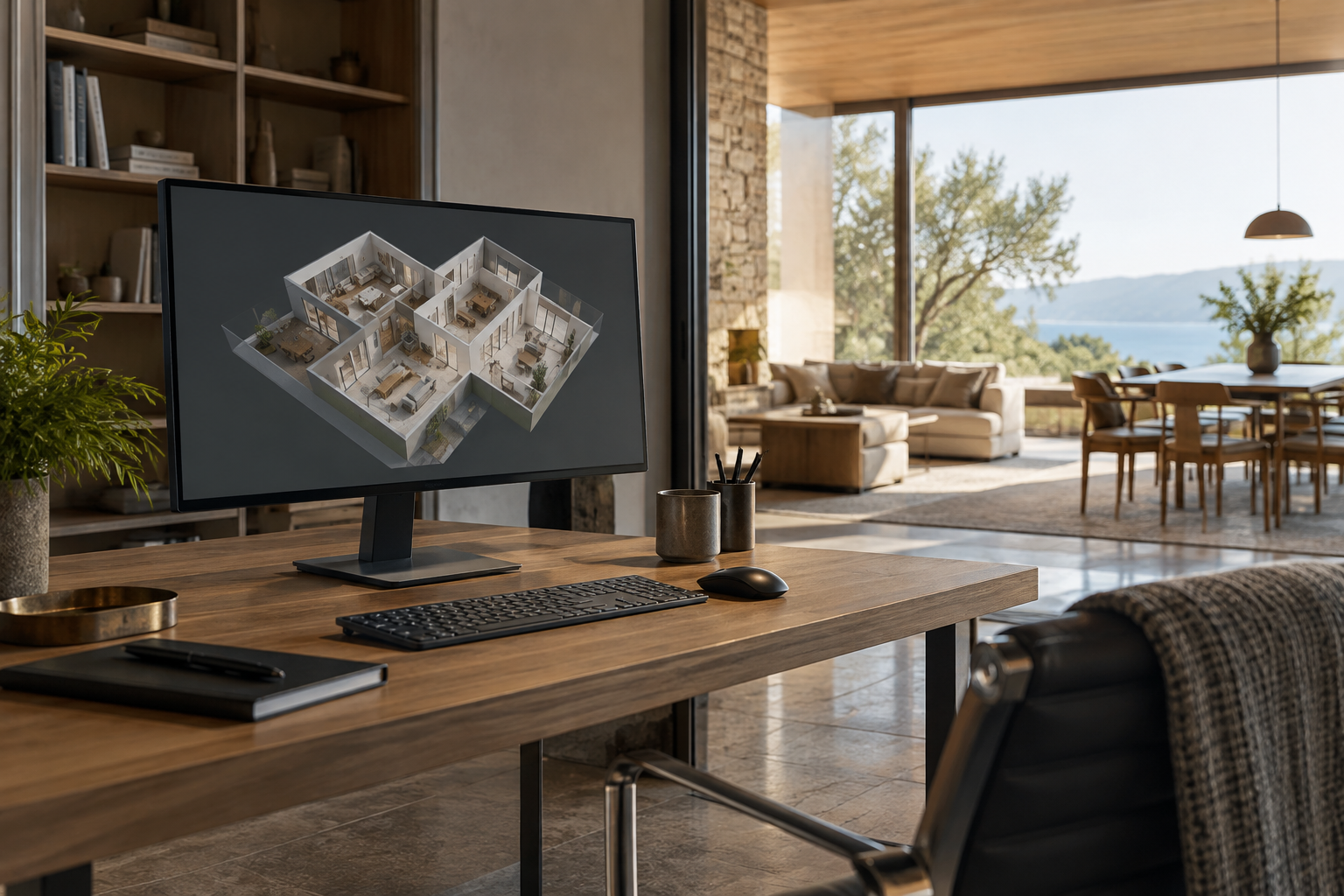
For a luxury property, spatial intelligence has a plausible role in interpreting the relationship between rooms, objects and routes. A design application might use a representation of a residence to support visualisation or answer location-based questions. These are possible uses of the technology category, not capabilities AMD has announced for this transaction.
A spatial representation also differs from the information required to operate building services. Recognising a doorway does not establish its access permissions; identifying a luminaire does not reveal its control address or electrical circuit. Integrators would still need an authoritative mapping between the physical property and its commissioned systems, a distinction closely related to the evidence needed before AI enters home control.
What people are saying
The available announcement details establish AMD’s proposed purchase and Li’s agreed appointment, but contain no residential deployment commitments or customer testimony. The useful industry reading is therefore about what different project participants should examine, rather than an endorsement attributed to unnamed installers or owners.
For architects and developers, a central question is whether spatial models could become dependable working information rather than persuasive visual presentations. Renovation decisions require dimensions, provenance and current conditions. An attractive reconstruction should not be treated as a measured survey unless its accuracy has been demonstrated for the intended task.
For custom integrators, the likely attraction is a more intuitive way to describe locations and equipment. The corresponding burden would be maintaining consistency when rooms are renamed, furniture moves or equipment is replaced. Any future application would need a defined source of truth and a clear process for updating its representation after practical changes on site.
Owners and household managers have a different concern: the sensitivity of a detailed model of a private residence. Room layouts, circulation routes and the location of valuable equipment can be confidential even without identifying an individual. A future procurement brief should specify who may access such information, where it is processed and how copies are deleted.
That privacy question is narrower than a general promise that an AI service is secure. A project team would need to distinguish the permissions of family members, visiting contractors and permanent staff. The same separation between useful assistance and excessive access informs the private-household boundary for AI memory.
What happens next
The first outstanding milestone is transaction completion. The supplied details do not identify a closing timetable or establish that the acquisition has closed. Nor do they provide a schedule for Li taking up her announced position, so neither the ownership change nor the appointment should be described as completed on this evidence.
For the integration market, the next meaningful disclosure would be an application or developer offering with documented interfaces. Supported operating environments, licensing terms and access to technical support would determine whether a specialist installer could responsibly include it in a project. Research capability alone supplies none of those contractual assurances.
Processing location would also shape the installation brief. If a future service required remote processing, its usefulness would depend partly on connectivity and the handling of uploaded property information. If processing were available locally, the project would instead need to account for the computing resources, maintenance and recovery arrangements involved; neither model is confirmed here.
Testing should follow the proposed use rather than the sophistication of a demonstration. A visualisation assistant could be assessed against survey information and known room layouts. An application permitted to request changes to building systems would require additional checks covering permissions, ambiguous instructions and safe rejection of unsupported actions.
Project documentation should preserve the distinction between announced capability, demonstrated behaviour and accepted performance. That makes subsequent software changes easier to assess and prevents a speculative feature becoming an unwritten client expectation. The need for a traceable record mirrors the evidence trail required when AI supports home AV research.
Why this matters
AMD’s proposed World Labs acquisition makes spatial intelligence worth watching as a potential input to residential design and technology services. For owners and integrators, its present value is in identifying a developing supplier capability—not in promising an autonomous home. Any eventual purchasing decision should turn on measurable accuracy, controlled access to property information and supportable connections to installed systems, rather than the scale of the acquisition.
Questions answered
+What is the AMD World Labs acquisition?
AMD announced an agreement on 28 September 2026 to acquire World Labs, a specialist in 3D spatial intelligence and world models, in an all-stock transaction valued at approximately $8.2 billion.
+How much is AMD paying for World Labs?
The announced transaction is valued at approximately $8.2 billion and is structured as an all-stock deal. That is the stated agreement value, not a confirmed final value at closing.
+What will Fei-Fei Li do at AMD?
World Labs co-founder Dr Fei-Fei Li agreed to become AMD’s executive vice president and chief scientist, reporting directly to chief executive Lisa Su. The supplied details do not establish when she takes up the role.
+Has AMD completed the World Labs acquisition?
The available details establish an acquisition agreement, not completion. They do not provide a closing timetable or confirmation that the transaction has closed.
+What could spatial AI do in a smart home?
Potential uses include interpreting room layouts and supporting design visualisation or location-based questions. These are possible applications of spatial intelligence, not residential capabilities announced by AMD.
+Has AMD announced a World Labs smart-home product?
No smart-home product, custom-integration partnership or marine application is identified in the available transaction details.
+Why does spatial AI raise privacy questions for homeowners?
A detailed property model can expose room layouts, circulation routes and equipment locations. Any future application would need clear rules for access, processing and deletion of that information.
More in Latest Tech
 Latest Tech
AMD’s manufacturing split and the home-tech supplier chain
AMD’s evolution from chip manufacturer to semiconductor designer offers a useful distinction for residential technology buyers: component pedigree is not the same as system accountability.
14 November 2026 · 5 min
 Latest Tech
Rako Controls adds Dubai office for Middle East lighting projects
The British lighting-control manufacturer’s Business Bay office will support Middle East projects from specification through commissioning and after-sales care.
13 November 2026 · 5 min
 Latest Tech
Google’s search monopoly ruling and home-tech choice
The US search monopoly judgment raises a practical question for private-home procurement: how independently are technology shortlists assembled?
13 November 2026 · 5 min