Tesla Roadster targets 2028 with thrusters and a track-only Rocket
Tesla’s redesigned Roadster promises fan-assisted grip and compressed-gas acceleration, but its aerial flagship is track-only and final prices remain unclear.
By James Whitcombe · · 5 min read
Key facts
- 01Tesla plans three Roadster variants: Performance, Thrust and the invitation-only Rocket.
- 02Tesla claims acceleration-thruster-equipped Roadsters can reach 60mph in 0.81 seconds.
- 03Tesla’s single-seat Rocket is designed for aerial manoeuvres and will not be road-legal.
- 04Elon Musk targets Roadster production for 2028, eight years after the original manufacturing timetable.
- 05Tesla’s stated reservation payments total US$50,000 for Performance and US$250,000 for Thrust; final prices remain unclear.
Tesla has presented a redesigned Roadster range with three variants, cold-gas thrusters and a claimed 0–60mph time of 0.81 seconds when equipped with acceleration thrusters. Elon Musk says production will begin in 2028, while the most specialised version, the single-seat Rocket, is intended for private tracks rather than public roads.
What happened
The new Roadster combines electric propulsion with several systems more commonly associated with specialist competition cars or aerospace engineering. Active aerodynamic surfaces, an underbody suction fan and cold-gas thrusters have distinct jobs: managing grip, assisting acceleration and, on the Rocket, enabling brief aerial manoeuvres.
Tesla’s demonstrations showed a Roadster ascending a steep curved ramp and performing an airborne rotation over other vehicles. These displays should not be confused with sustained flight: the proposition is short jumps, rotations and momentary hovering, not travelling through the air between destinations. Whether a driver occupied the demonstration vehicle or it was controlled remotely remains unclear.
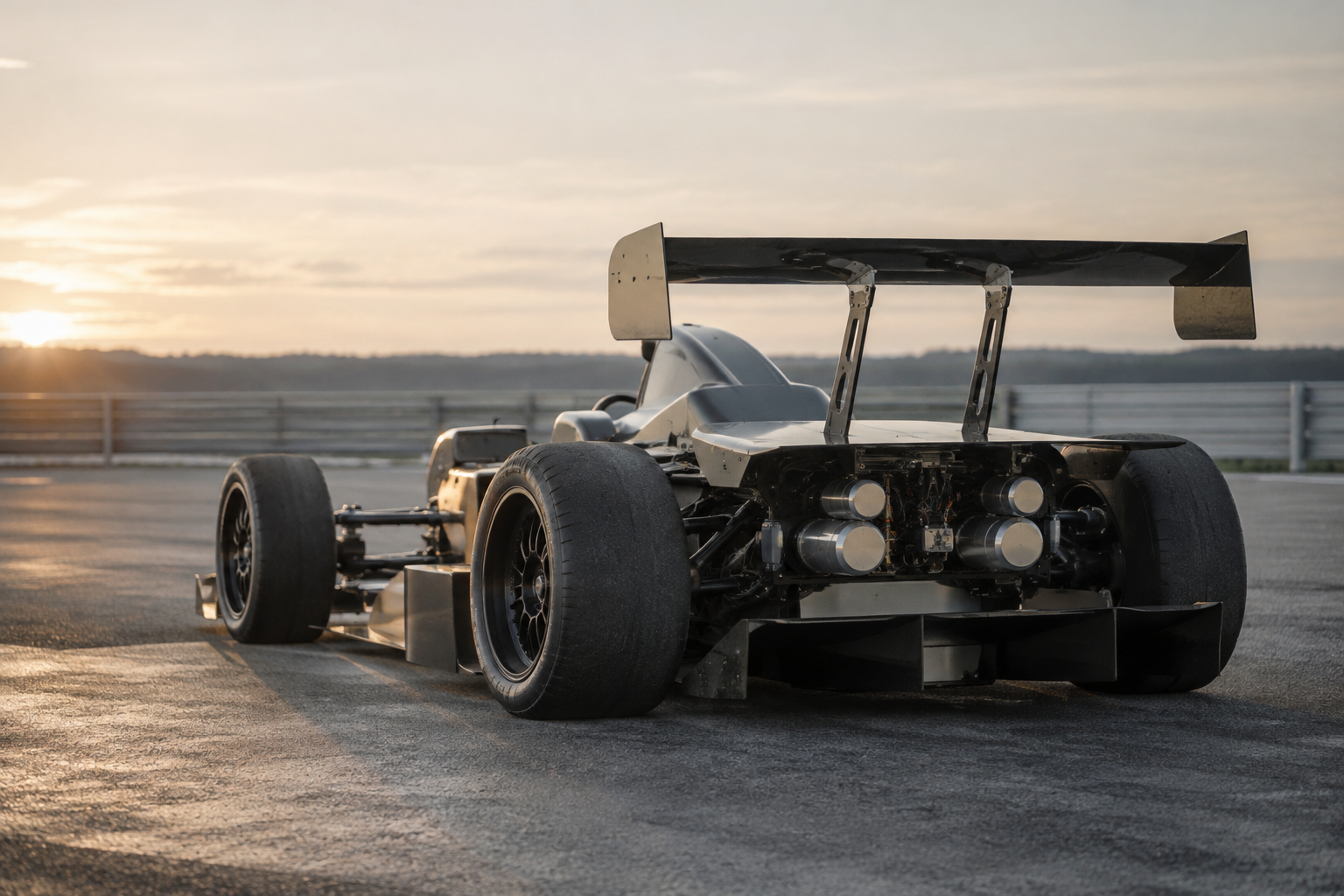
The range starts with Performance, which receives active aerodynamics and the suction system. Thrust adds rear-mounted thrusters for the claimed sub-second acceleration. Rocket extends the arrangement with thrusters around the vehicle’s perimeter, plus a multi-mode fan and ground-sealing system; it is invitation-only and will not be road-legal.
Tesla claims the fan system can generate suction equivalent to 2g, while its thrusters produce more than 80 kilonewtons of force. Those are manufacturer claims rather than independently established results. Their significance lies in separating some of the car’s grip and acceleration capability from the conventional relationship between tyre traction and electric motor output.
A motorised rear wing extends upwards and beyond the tail, changing its angle automatically to manage downforce. Active suspension lowers the car. Tesla says the prototype can already reach 230mph, but its stated ambition is 383mph: the latter is a development target, not an achieved speed.
The background
This is a substantially different design from the Roadster prototype unveiled in 2017. Tesla describes its appearance as aerospace-inspired, with titanium exterior accents, tinted glazing referencing spacesuit visors and white paint associated with spacecraft protection against ultraviolet exposure and cryogenic conditions. Those references describe the design intent; they do not establish the vehicle’s suitability for aerospace use.
Upward-opening doors reveal a deliberately sparse cabin with microsuede trim, a central infotainment display, fixed-position seats and a steer-by-wire yoke. For prospective owners, the fixed seating makes a physical fitting particularly important. A dramatic performance specification does not answer questions about driving position, visibility or ease of entry.
Fan-assisted downforce addresses a familiar limitation of conventional aerodynamic devices: wings depend heavily on airflow generated by vehicle speed. Extracting air from beneath a car offers another way to create a pressure difference. Maintaining that effect makes the relationship between the floor, ground clearance and track surface an engineering consideration, rather than merely a styling choice.
Cold-gas thrusters are also different from rocket engines that burn propellant. They generate thrust by releasing pressurised gas, and Tesla attributes their development to SpaceX expertise. Their presence creates ownership questions around replenishment, inspection and service procedures that do not arise in the same form with a battery-electric drivetrain alone.
The Roadster’s emphasis is markedly different from the Jaguar Type 01’s combination of electric performance and Meridian audio. Where an electric grand tourer must accommodate sustained travel and cabin experience, Tesla’s Rocket concentrates on manoeuvres that require a controlled venue. Buyers should distinguish those purposes before treating the cars as interchangeable expressions of electric luxury.
What people are saying
Musk’s central commitment is a 2028 production start. That would be eight years after the original manufacturing timetable, making delivery credibility a material part of the purchasing decision. The new presentation establishes a revised vehicle proposition, but it does not remove the history of delay.
Tesla’s own performance narrative rests on two different kinds of evidence: demonstrations of unusual manoeuvres and numerical claims about acceleration, suction and thrust. Owners should keep those categories separate. An airborne display does not, by itself, validate a repeatable acceleration time or establish the operating conditions needed to reproduce it safely.
For collectors, invitation-only access to Rocket may be as consequential as its specification. That places it alongside other tightly controlled ownership propositions, such as the Brabus Urban E Fragment Edition’s emphasis on collectible design, although Tesla’s track restriction adds a practical constraint. Access to suitable facilities becomes part of the ownership brief rather than an occasional convenience.
For an estate manager or private collection adviser, the relevant questions extend beyond garage space. A non-road-legal vehicle needs transport to an appropriate venue, while any intended aerial use would require explicit agreement on operating conditions, supervision and insurance. None of those arrangements should be assumed to follow automatically from securing an invitation.
What happens next
Reservation payments are specified, but final purchase prices are not clear. Performance requires an initial US$5,000 followed by US$45,000 within ten days, bringing the stated commitment to US$50,000. Thrust requires US$5,000 initially and a further US$245,000, for a total of US$250,000.
These are reservation amounts, not confirmed all-in prices. It remains unclear whether another payment will be required before delivery. The US$200,000 price attached to the 2017 Roadster is therefore historical context, not a reliable guide to the cost of this redesigned range.
Before placing money, a buyer should establish the applicable reservation terms, including cancellation rights, refund provisions and how a production slot will be allocated. The distinction matters particularly for Thrust, where the stated reservation commitment is five times that of Performance. No equivalent Rocket reservation figure is provided.
The engineering questions are equally specific. Tesla has not established here how many thrust-assisted launches or aerial manoeuvres the system can support before replenishment, what that process involves, or how its performance varies with conditions. Those details would determine whether the technology is practical for a full track session or primarily suited to isolated demonstrations.
For UK buyers, local availability and approval of the intended variant also need confirmation; Rocket’s exclusion from road use is already explicit. The 2028 production target does not establish a British delivery date. Nor should the 383mph ambition be used as a delivered specification when assessing the purchase.
Why this matters
For owners of significant car collections, the Roadster introduces a more complex acquisition brief: conventional electric-car considerations now sit alongside pressure-system servicing, specialist venue access and a potentially substantial reservation exposure. The sensible next step is to assess the precise variant against its intended use, obtain clear contractual terms and wait for repeatable performance evidence—not to treat an aerial demonstration as proof of a finished flying car.
Questions answered
+Can the new Tesla Roadster fly?
Tesla demonstrated brief aerial manoeuvres, including a rotation over other vehicles. The Rocket variant is intended for jumps and momentary hovering, not sustained flight between destinations.
+When will the new Tesla Roadster go into production?
Elon Musk says production will begin in 2028. That is a target rather than a confirmed delivery date, and no British delivery timetable is established.
+What are the new Tesla Roadster variants?
Performance has active aerodynamics and fan-assisted suction. Thrust adds rear acceleration thrusters. Rocket adds perimeter thrusters and a multi-mode fan and ground-sealing system for aerial manoeuvres.
+Is the Tesla Roadster Rocket road-legal?
No. The single-seat Rocket is invitation-only and intended for private tracks rather than public roads.
+How much is a Tesla Roadster reservation?
Performance requires US$5,000 followed by US$45,000 within ten days. Thrust requires US$5,000 followed by US$245,000. These total US$50,000 and US$250,000 respectively, but final purchase prices remain unclear.
+How fast is the new Tesla Roadster?
Tesla claims 0–60mph in 0.81 seconds with acceleration thrusters. It says the prototype can reach 230mph and is targeting 383mph. The higher figure is an ambition, not an achieved speed.
+How do Tesla Roadster thrusters work?
Cold-gas thrusters release pressurised gas to generate thrust. Thrust uses rear-mounted units for acceleration; Rocket adds units around the vehicle’s perimeter to support brief aerial manoeuvres.
More in Cool Stuff
 Cool Stuff
Brabus Urban E Fragment Edition puts exclusivity before speed
Limited to 10 hand-built motorcycles, the US$50,000 collaboration combines DAB electric engineering with bespoke Brabus components and Hiroshi Fujiwara’s monochrome design.
16 October 2026 · 5 min
 Cool Stuff
Jaguar Type 01 electric GT pairs 1,000hp with Meridian audio
Jaguar’s £120,000 electric grand tourer combines an unusual battery layout, seat-integrated bass and rapid charging, with orders due to open in early 2027.
8 October 2026 · 5 min
 Cool Stuff
Ctrl Energy Zero makes the 100W power bank repairable
Replaceable cells and magnetic accessories give Ctrl Energy’s crowdfunded power bank an unusually serviceable design, with worldwide deliveries planned for June 2027.
14 October 2026 · 5 min