TSUN brings solar kits and retrofit batteries to UK homes
TSUN’s UK offering combines small-scale solar, DC-side storage and retrofit batteries, with wired export control among the details worth examining.
By Eleanor Hart · · 5 min read
Key facts
- 01TSUN’s UK ESK solar family includes Pop-Up, Universal and Air Vertical options.
- 02TSUN’s MAU AC-coupled storage options include 2.5 kW / 5 kWh and 3.6 kW / 7.68 kWh systems.
- 03TSUN’s DCU architecture places battery storage on the DC side, before the grid-connected microinverter.
- 04TSUN offers wired RS485 communication alongside wireless options for export limitation.
- 05TSUN’s wider portfolio includes single-phase microinverters rated up to 3 kW.
TSUN has outlined a UK residential solar and storage offering at Solar and Storage Live in Birmingham, combining its Easy Solar Kit family with batteries for new and existing installations. The portfolio includes AC-coupled storage configurations rated at 2.5 kW / 5 kWh and 3.6 kW / 7.68 kWh, alongside a DC-coupled approach that places storage before the microinverter.
What happened
The company is bringing its ESK, or Easy Solar Kit, range to British households after supplying European balcony-solar markets, particularly Germany. Rather than presenting a single panel-and-inverter package, TSUN describes a family spanning Pop-Up, Universal and Air Vertical options, intended to accommodate different homes and installation arrangements.
TSUN says relevant products have completed G98 compliance and are listed with the Energy Networks Association. Those statements matter to the grid-connection assessment, but they should not be read as blanket approval for every mounting arrangement, electrical connection or combined solar-and-battery installation. A project specification still needs to identify the exact equipment and applicable installation requirements.
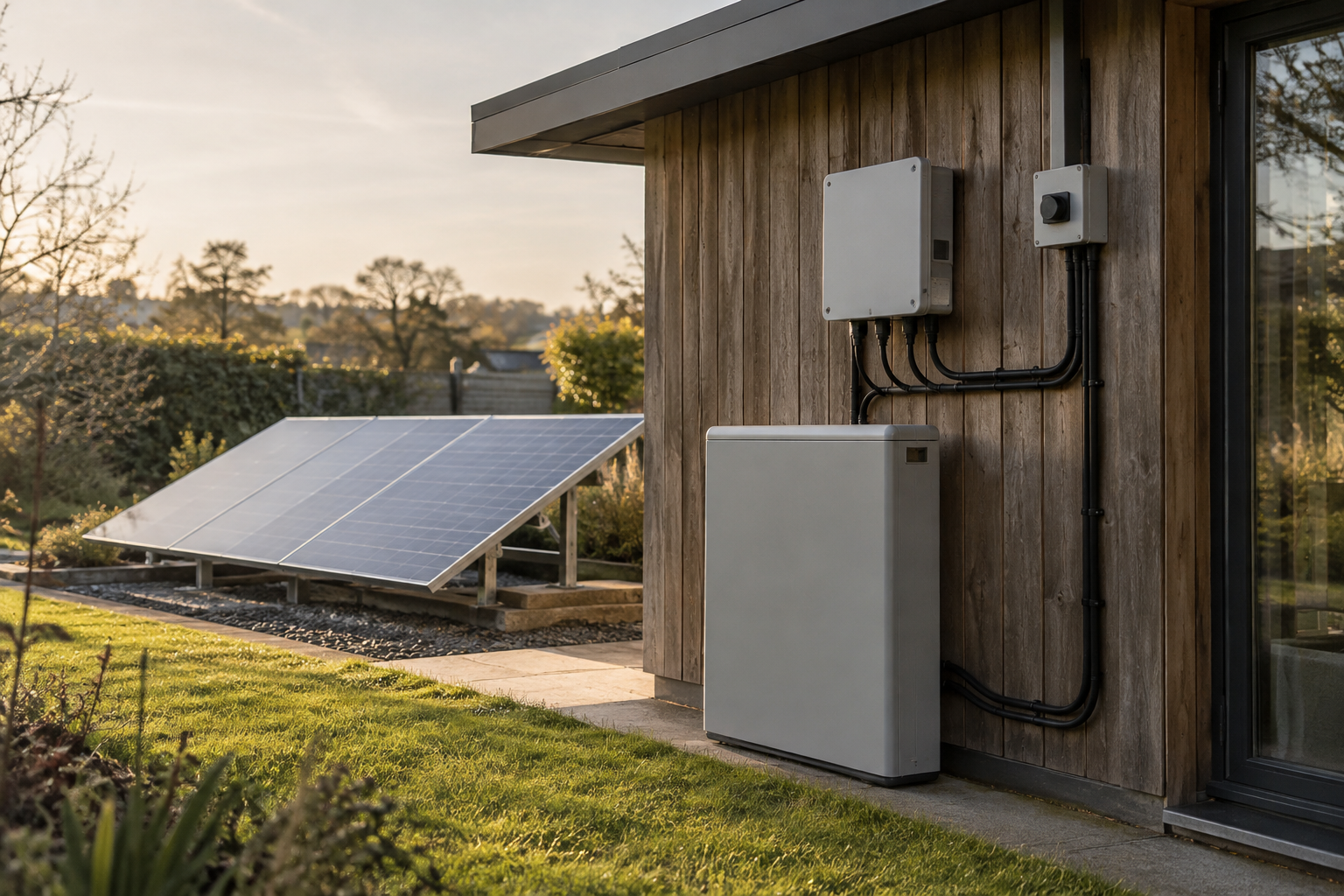
For storage paired with small-scale solar, TSUN offers its DCU architecture. Electricity from the photovoltaic modules is managed on the DC side, where it can charge a battery before being supplied through a microinverter to the home and grid. The microinverter remains the grid-connected device; the battery sits upstream of it.
Existing solar owners are addressed separately through the MAU AC-coupled storage portfolio. Alongside the two stated power-and-capacity combinations, TSUN describes modular and stackable options for greater requirements. It has not supplied pricing, detailed UK delivery dates or the maximum capacities of those expandable configurations in the announcement.
The background
DC coupling and AC coupling answer different project questions. With DC-coupled storage, the battery is integrated into the solar generation path before conversion to household alternating current. AC-coupled storage connects on the AC side, allowing a battery installation to coexist with an existing photovoltaic inverter rather than necessarily replacing it.
That distinction is especially relevant when a substantial residence already has functioning rooftop solar. Replacing a serviceable inverter can expand the scope of a battery project, while a separate AC-coupled installation may preserve more of the existing system. Compatibility, metering and control still require assessment; AC coupling is an architecture, not a guarantee of effortless retrofit.
The published figures also describe two different attributes. Kilowatts indicate power, while kilowatt-hours indicate stored energy capacity. Owners comparing the 2.5 kW / 5 kWh and 3.6 kW / 7.68 kWh options should therefore assess both the loads they want to support and the duration of that demand, rather than selecting on battery capacity alone.
TSUN’s microinverter proposition adds another design choice. The company says individual modules can operate independently, with module-level monitoring and optimisation, while reducing rooftop high-voltage DC exposure compared with a traditional string arrangement. This is relevant where panels occupy different positions or encounter uneven shading, although the announcement provides no comparative yield measurements.
Its wider portfolio includes single-phase microinverters rated up to 3 kW for larger residential and small commercial applications. That figure describes the broader product range, not an established rating for every ESK configuration. Keeping those product boundaries explicit prevents a compact solar kit from being specified on the basis of capabilities belonging to a different system.
What people are saying
Ellen Xue, TSUN’s sales vice-president, presents the UK expansion as an opportunity to transfer experience from established European plug-in solar markets. Her stated emphasis is on complete systems: mounting choices, storage, installation simplicity and energy management, rather than microinverter efficiency alone. The company’s proposition is therefore as much about packaging an installation as supplying conversion hardware.
Xue identifies daisy-chain AC connections between microinverters as one way to reduce cabling, connection points and installation effort. For British projects, where access and labour can materially affect cost, that is a practical selling point. TSUN has not provided measured installation-time reductions or a cost comparison, so the benefit remains something to test against the actual layout.
Export limitation is another area where the technical detail deserves attention. TSUN says it offers wired RS485 communication as well as wireless options. For an integrator, the useful question is which connection the proposed export-control configuration actually uses, and how that complete control arrangement is commissioned and verified.
The presence of RS485 should not be confused with confirmed compatibility with a home automation platform. It identifies a communication interface, not an announced KNX integration or an open control specification. The division between energy equipment and supervisory home controls is explored further in our analysis of where KNX and building management systems should divide responsibility.
Xue also says selected smaller systems can communicate directly without an additional external DTU, or data transfer unit. That could reduce the number of separate devices required, but the qualification matters: owners should establish which models support the arrangement and what monitoring functions remain available before removing a communications component from the equipment schedule.
What happens next
The immediate issue for a UK buyer is the installation route. TSUN frames its offer around the opening of the plug-in solar market while acknowledging that the framework for plug-in battery storage is still developing. Its DC-side battery design explains how the equipment is arranged; it does not, by itself, settle every regulatory question about a proposed installation.
For MAU systems, the company says a smart meter and energy management system can enable operation with dynamic electricity tariffs, charging at lower prices and using stored energy when prices rise. No supported tariff providers or detailed control requirements are identified. Those dependencies should be confirmed before tariff savings become part of an investment calculation.
Household integration also needs a clear operating brief. A battery scheduled around electricity prices may need coordination with other significant loads, such as vehicle charging or electric heating. The practical value of coordinating generation, storage and demand is illustrated by the MAC1010 barge’s KNX energy-management installation, although that separate project establishes no compatibility with TSUN equipment.
Further information needed for procurement includes usable battery capacity, warranty terms, installation clearances, environmental limits and any backup capability. None should be inferred from the headline storage figures. In particular, a battery intended for tariff management should not be specified as an outage-resilience system without explicit confirmation of its supported operating modes and associated electrical equipment.
Why this matters
For owners of high-specification homes, TSUN’s offer introduces distinct routes for a small new solar installation and a battery retrofit, rather than requiring both projects to follow the same architecture. The important purchasing decision is to match the route to the property: retain worthwhile existing equipment, verify grid and installation requirements, and commission energy controls around actual household demand. The breadth of the range is useful only when the chosen configuration is documented as a complete working system.
Questions answered
+What is the TSUN Easy Solar Kit?
ESK stands for Easy Solar Kit. It is TSUN’s solar product family, with Pop-Up, Universal and Air Vertical options intended for different homes and installation arrangements.
+What sizes are TSUN home batteries?
TSUN identifies MAU AC-coupled configurations rated at 2.5 kW / 5 kWh and 3.6 kW / 7.68 kWh. It also describes modular and stackable options, without stating their maximum capacities in the announcement.
+Can TSUN batteries work with existing solar panels?
TSUN’s MAU AC-coupled storage range is intended to add batteries without necessarily replacing an existing photovoltaic inverter. The proposed system still requires compatibility, metering and control assessment.
+How does TSUN DC-coupled storage work?
Solar electricity is managed on the DC side and can charge a battery before passing through a microinverter to the home and grid. The battery remains upstream of the grid-connected microinverter.
+Can TSUN batteries use dynamic electricity tariffs?
TSUN says MAU systems can operate with dynamic tariffs when combined with a smart meter and energy management system. Supported tariff providers and detailed control requirements were not identified.
+Are TSUN solar kits G98 compliant?
TSUN says relevant UK products have completed G98 compliance and are listed with the Energy Networks Association. Buyers should verify the exact model and installation requirements rather than assume that statement covers every configuration.
+How much do TSUN solar kits cost in the UK?
TSUN did not provide UK pricing in the announcement. Detailed delivery dates and maximum capacities for its expandable storage configurations were also not supplied.
More in KNX, Energy & Solar
 KNX, Energy & Solar
ChatGPT energy use belongs in the smart-home brief
Cloud-based AI moves computing beyond the property’s meter, creating a distinction between household electricity demand and the infrastructure supporting a connected home.
15 October 2026 · 5 min
 Latest Tech
Artificial intelligence in smart homes: beyond the chatbot
Advances in language and reasoning are changing expectations of home technology, but useful intelligence also depends on sensing, reliable information and clearly defined objectives.
9 October 2026 · 5 min
 KNX, Energy & Solar
KNX and BMS: where luxury homes should draw the control line
As residential heating and cooling grow more complex, the important decision is not which control platform wins, but where responsibility sits.
7 October 2026 · 5 min