Victron targets 400kW microgrids and smarter solar use
Victron’s latest power architecture combines independent battery systems, while new GX controls direct surplus solar towards charging, hot water and pool equipment.
By Priya Raman · · 5 min read
Key facts
- 01Victron Microgrid supports mixed-size independent Power Banks sharing an AC bus, with combined capacity up to 400kW.
- 02Victron says its microgrid requires no central controller or data communication wiring between Power Banks.
- 03GX Opportunity Loads coordinates Victron EV Charging Stations and Shelly-switched equipment to use surplus solar.
- 04SolarSense 750 supplies real-time irradiance data to GX devices for solar-potential assessment and load coordination.
- 05Victron’s VM-3P5A supports standard 5A current transformers and theoretical measurement up to 6,000A per phase.
Victron Energy outlined an off-grid microgrid architecture scalable to 400kW and new controls for using surplus solar ahead of Intersolar Europe, held in Munich on 23–25 June 2026. The announcements pair independent battery-backed power systems with automation intended to direct unused solar capacity towards electric vehicles, hot water and pool equipment.
What happened
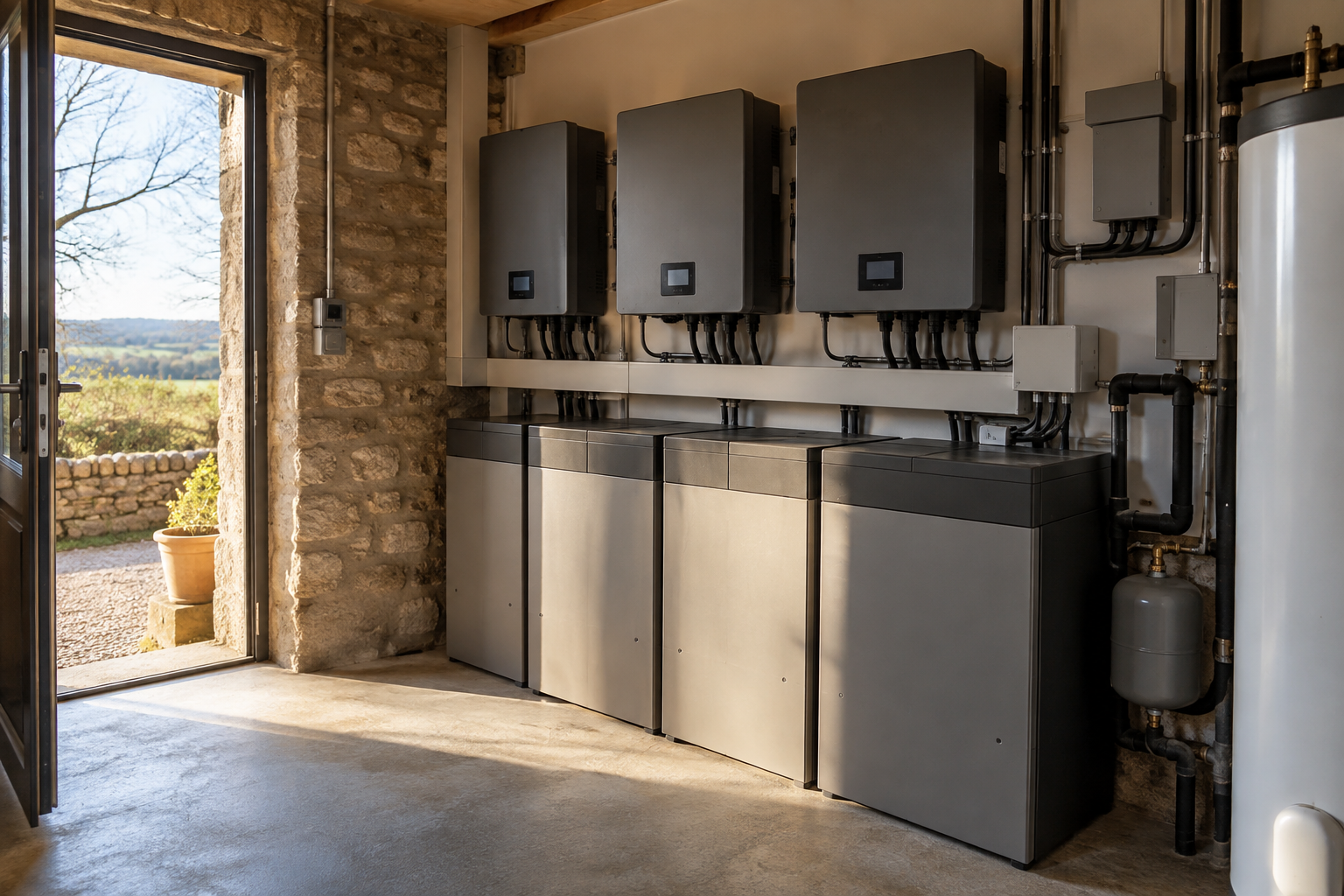
The central development is Victron Microgrid, which connects multiple independent inverter/charger installations to a shared AC bus. Victron calls each installation a Power Bank: a complete system with its own inverter/chargers, batteries and monitoring. Banks of different sizes can operate together and automatically share the electrical load.
According to Victron, this arrangement needs neither a central controller nor data communication wiring between the banks. Units can be added or removed as requirements change, with the combined installation scaling to 400kW. The company scheduled a live load-sharing demonstration for its Intersolar stand; the announcement does not establish what performance was subsequently demonstrated.
A separate development, GX Opportunity Loads, addresses solar generation that would otherwise go unused when batteries are full and existing demand is satisfied. A GX device coordinates prioritised flexible loads, activating Victron EV Charging Stations and Shelly switches connected to controllable equipment. Where sufficient power is available, several loads can run simultaneously.
Victron also introduced SolarSense 750, a standalone, self-powered wireless irradiance monitor supplying real-time information to a GX device. Its purpose is to reveal available solar potential when panel output is being limited, support Opportunity Loads and compare potential generation with actual output. Victron also identifies assessment before panel installation as a use.
Metering expands with the VM-3P5A, which accepts standard 5A current transformers rather than the supplied transformers required by the existing VM-3P75CT. The earlier meter measures up to 75A per phase; the new model supports a theoretical 6,000A per phase, depending on transformer selection. Ethernet and VE.Can connections support measurement of PV inverter output, generators, AC loads or the grid connection in an energy storage system.
The background
Large residential energy projects involve more than choosing a battery capacity. An estate may combine several buildings, vehicle charging, leisure facilities and backup generation, with demand changing as accommodation or amenities are added. Independent power banks offer a potential route to staged expansion rather than treating every increase in capacity as a replacement project.
That modularity should not be confused with electrical simplicity at site level. A shared AC bus still requires appropriately designed distribution, protection and isolation. The absence of inter-bank communications changes the control architecture; it does not remove the engineering needed to connect substantial power sources safely or establish how faults will be contained.
Surplus-solar control tackles a different limitation. Once storage and immediate consumption can absorb no more energy, additional available PV output has little practical value unless another useful demand can be introduced. Hot-water storage and pool heating can shift some consumption in time, making them candidates for this kind of coordination rather than requiring every spare unit of energy to enter a battery.
The irradiance sensor is relevant because measured inverter output alone does not necessarily describe the sunlight available to the array. If generation is deliberately constrained, low output need not mean poor solar conditions. Comparing potential and actual production can inform control decisions, although that comparison is not itself a diagnosis of any particular panel or inverter fault.
The supporting hardware also reflects distinct installation requirements. Victron’s new Nucleo GX retains core monitoring, control, remote access, configuration and firmware-update functions, but omits VE.Bus connectivity, HDMI output for GX Touch displays, and tank and temperature sensor inputs. Victron positions it as a lower-cost option for systems that do not need those interfaces, particularly installations built around Multi RS.
What people are saying
Victron presents its microgrid approach as a way to build larger off-grid installations from self-contained units. For an estate owner, the useful implication is the possibility of matching investment to successive building phases. For the electrical designer, the important unanswered detail is how a proposed combination of differently sized banks behaves across the property’s actual load profile.
The company frames Opportunity Loads as an optimisation tool, with the GX device taking a coordinating role across flexible assets. Integrators are likely to focus on the boundary between that energy logic and the equipment being switched. A supported Shelly switch provides a control route, but connected heating, charging or treatment equipment must still be suitable for the intended operating schedule.
Victron’s lower-cost positioning for Nucleo GX requires similar attention to specification. Removing unused interfaces can be sensible in a narrowly defined energy installation; removing interfaces needed later can constrain expansion. Owners planning broader monitoring should therefore compare the required connections before choosing a GX device, rather than treating every member of the range as interchangeable.
These are manufacturer-described capabilities, not independently verified project results. The material provides no installed pricing, measured household savings or comparative operating data for the microgrid and Opportunity Loads combination. There is consequently no basis here for attaching a payback period to an estate installation or promising a particular reduction in generator use.
What happens next
Availability remains an important distinction within the announcements. Victron said the first arrivals of its Multi RS 48/6000 inverter/charger had sold out and that the next shipment could be pre-ordered. No subsequent delivery date is established by the material, so that statement should not be read as confirmation of stock availability in October 2026.
The Multi RS 48/6000 has no onboard MPPT solar trackers, allowing a separate solar inverter configuration or a retrofit around existing solar equipment. Victron says it switches to backup during a grid outage, supports off-grid operation and can control a generator. Battery power can cover demand above generator capacity, with spare generator output recharging the battery when loads fall; stationary applications also support Dynamic ESS.
A further announcement concerned a high-voltage, three-phase, rack-mountable 15kW inverter/charger, which Victron expected to stock during summer 2026. It has one AC input, two AC outputs and four onboard MPPT controllers, with a stated solar operating range of 650–1,000V and provision for an array of up to 30kW. The announced timetable does not confirm that deliveries occurred.
Before specification, buyers need current availability, compatible hardware and software requirements, and a project-specific design. Microgrid proposals also need clarity on expansion procedures and operating limits; Opportunity Loads installations need an agreed priority order for discretionary consumption. Those details determine whether the announced functions suit a particular property rather than simply appearing on its equipment schedule.
Why this matters
For luxury homes and private estates, Victron’s announcements connect two consequential decisions: how to expand independent power capacity and how to make useful consumption follow available solar energy. The opportunity is a more adaptable energy installation, but the value lies in matching that architecture to real building loads, essential services and future phases—not in specifying the largest available system.
Questions answered
+What is Victron Microgrid?
Victron Microgrid connects independent inverter/charger systems, called Power Banks, on a shared AC bus. Each bank has its own batteries and monitoring. Mixed-size banks automatically share loads, with combined capacity scaling to 400kW.
+Does Victron Microgrid need a central controller?
Victron says its microgrid architecture requires neither a central controller nor data communication wiring between Power Banks. The shared electrical installation still needs appropriate distribution, protection and isolation.
+What are GX Opportunity Loads?
GX Opportunity Loads uses a GX device to direct otherwise unused solar capacity towards prioritised flexible equipment. Supported control routes include Victron EV Charging Stations and Shelly switches, with multiple loads able to operate when sufficient power is available.
+What does SolarSense 750 do?
SolarSense 750 is a self-powered wireless irradiance monitor that supplies real-time data to a GX device. It helps assess available solar potential, supports Opportunity Loads and allows comparison between potential and actual PV output.
+What is the difference between Nucleo GX and other GX devices?
Nucleo GX retains core monitoring and control functions but omits VE.Bus, HDMI output for GX Touch displays, and tank and temperature sensor inputs. Victron positions it as a lower-cost choice for suitable systems, particularly Multi RS installations.
+Does the Multi RS 48/6000 include solar MPPT trackers?
No. The Multi RS 48/6000 described in the announcement has no onboard MPPT solar trackers. It allows a separate solar inverter configuration and can be used when retrofitting an installation with existing solar equipment.
+How much does a Victron 400kW microgrid cost?
The announcement provides no installed pricing for a 400kW microgrid. It also supplies no measured household savings or payback figures, so a project-specific design and quotation would be needed.
More in KNX, Energy & Solar
 KNX, Energy & Solar
KNX and BMS: where luxury homes should draw the control line
As residential heating and cooling grow more complex, the important decision is not which control platform wins, but where responsibility sits.
7 October 2026 · 5 min
 KNX, Energy & Solar
MAC1010 barge puts KNX energy management to a live test
Luke Newland’s floating residential test bed will combine solar, batteries and KNX control to explore lower-carbon living on a restricted shore supply.
7 October 2026 · 5 min
 Luxury
Newland Solutions marks 20 years in luxury home technology
The British custom installation firm reaches its 20th anniversary this October, with work spanning smart home automation, AV, lighting control and energy systems.
7 October 2026 · 2 min