Ctrl Energy Zero makes the 100W power bank repairable
Replaceable cells and magnetic accessories give Ctrl Energy’s crowdfunded power bank an unusually serviceable design, with worldwide deliveries planned for June 2027.
By Davy Currie · · 5 min read
Key facts
- 01Ctrl Energy Zero uses six replaceable 3,500mAh 18650 cells, giving a stated combined capacity of approximately 21,000mAh.
- 02Zero supports up to 100W USB-C input and output, 18W USB-A output and 15W wireless charging.
- 03Ctrl Energy says up to five Zero units can link for a stated aggregate capacity of 105,000mAh.
- 04Zero Kickstarter pledges start at US$89; the smaller 5,000mAh Subzero starts at US$39.
- 05Ctrl Energy plans worldwide shipping in June 2027, with delivery charges calculated after the campaign.
Paris-based Ctrl Energy is crowdfunding Zero, a modular power bank with six replaceable battery cells and up to 100W USB-C charging. As of 14 October 2026, Kickstarter pledges start at US$89, with worldwide shipping planned for June 2027; its principal distinction is that battery deterioration need not mean replacing the complete device.
What happened
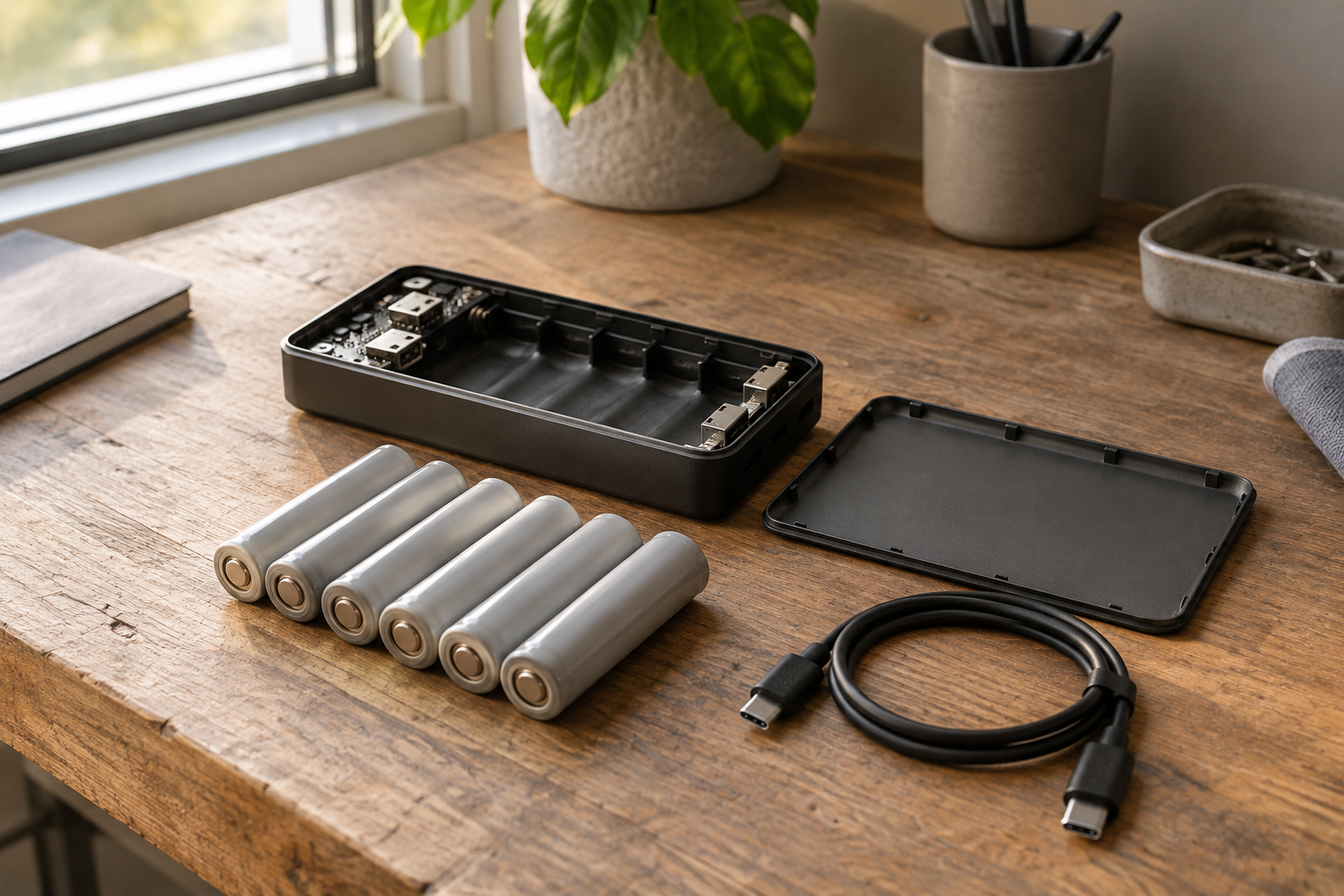
Zero puts access to its batteries at the centre of the design. A magnetic lid lifts off without tools, exposing six 3,500mAh 18650 lithium-ion cells with a combined stated capacity of approximately 21,000mAh. Instead of sending the unit away when those cells lose capacity, an owner can replace them.
Ctrl Energy recommends validated replacement cells from Samsung, LG or Molicel, and plans to supply refills itself. That qualification matters: the proposal is not simply to fit any battery that shares the same dimensions. Owners should follow the company’s compatibility guidance rather than treat physical fit as sufficient approval.
The USB-C connection supports both charging external devices and recharging Zero at up to 100W. A separate USB-A port offers 18W charging, while wireless charging reaches up to 15W. These are individual connection ratings; the available specifications do not establish that every output can deliver its maximum simultaneously.
A magnetic accessory interface extends the device beyond charging. Proposed attachments include a torch, extra USB ports, a video panel light and a face-tracking tripod that accommodates Zero and a magnetically attached phone. These are potential additions to the system, not a reason to assume that every accessory is included in the starting pledge.
A synchronising accessory allows up to five Zero units to be linked, giving a stated aggregate capacity of 105,000mAh. There is also support for a foldable 18W solar panel. Ctrl Energy’s smaller Subzero follows the replaceable-battery approach with a single 5,000mAh cell and a similar magnetic accessory interface.
The background
Portable batteries are often retired because their cells no longer hold enough charge, even though the casing and charging electronics remain useful. Making the cells accessible separates that consumable element from the rest of the product. It is a credible repairability measure, though not a guarantee that the electronics, connectors or magnetic fittings will last indefinitely.
The 18650 designation describes a cylindrical cell format rather than a complete specification of performance or suitability. For an owner maintaining Zero over several years, dependable access to approved cells would be more valuable than a broad claim that replacements are widely available. The manufacturer’s own refill option could simplify that process, subject to continued supply.
Capacity also needs careful interpretation. A 21,000mAh cell-capacity figure is not a promise to deliver that quantity at a laptop’s USB charging voltage: voltage conversion and electrical losses affect usable output. Buyers comparing Zero with other travel batteries should look for watt-hour ratings and measured charging results, not rank products by milliamp-hours alone.
The 100W USB-C ceiling puts Zero into consideration for more than topping up a phone. A compatible laptop could be a relevant load, but the power bank’s maximum rating does not establish compatibility with every computer or guarantee the charging speed a particular device will accept. Cable capability and the supported charging profiles remain important checks.
The physical design accepts bulk in exchange for access and flexibility. A cut-out works as a handle or hanging point, accommodates an iPhone camera module during magnetic wireless charging and can hold a user-printed cable winder. Those are tangible uses for the space, although owners wanting the smallest possible pocket battery may prefer a simpler form.
For portable entertainment, the attraction is carrying a serviceable shared power source rather than another sealed accessory. Owners building a travel kit around a dedicated portable hi-fi player or phone-based gaming controls would still need to check connectors, charging requirements and physical clearance for their particular equipment.
What people are saying
Ctrl Energy presents Zero as an answer to premature replacement: reduced battery performance should not make the whole product obsolete. Its approach combines user access to the cells with accessories that change what the power bank can do. The company has also documented development and testing on its campaign page, although those disclosures are not equivalent to independent long-term testing.
For owners, the likely appeal is control over maintenance. A battery that can be refreshed at home offers a different ownership proposition from one returned for service or discarded. The practical question is whether replacing cells remains straightforward once instructions, approved components and any necessary checks are taken into account.
For captains and integrators, this is portable personal equipment rather than installed energy infrastructure. Linking five units may create a useful charging arrangement for several devices, but the 105,000mAh figure does not establish combined output power, resilience or suitability for a permanent installation. No marine environmental protection rating is specified in the available details.
The accessories also introduce a distinction between battery independence and platform dependence. Replacement cells come from an established format, while the magnetic extensions depend on Ctrl Energy’s interface and accessory supply. Buyers principally interested in longevity should assess the usefulness of the base unit separately from the promised ecosystem.
What happens next
Zero’s US$89 campaign price sits below an expected US$128 retail price. Subzero is offered at US$39 against an expected US$56 retail price. These are dollar-denominated campaign figures, not confirmed delivered UK prices; shipping charges will be calculated after the campaign ends, so the eventual purchase cost is not yet settled.
Ctrl Energy has exceeded its funding target, but this is its first Kickstarter campaign. The announced June 2027 worldwide shipping schedule remains a plan rather than a delivery guarantee. Backers are funding a product’s route to fulfilment, not buying established stock with a demonstrated delivery record.
Before committing, buyers should seek clarity on accessory prices, supported USB-C charging profiles, simultaneous output limits and replacement-cell procedures. For the modular system, useful evidence would include how linked units share power and what happens when their charge levels differ. Those details determine whether the larger arrangement is convenient in daily use.
The optional 18W solar panel deserves particularly realistic expectations. Its rating is substantially below Zero’s 100W wired input ceiling, and actual solar production depends on conditions and positioning. It is better considered as a supplementary charging option for time outdoors than assumed to match a mains-powered recharge.
Why this matters
Zero offers a useful procurement test for owners choosing premium travel and yacht accessories: can a product’s wearing parts be renewed without replacing everything around them? Accessible cells are a meaningful answer, but the buying decision should rest on verified charging performance, safe maintenance guidance and successful delivery—not the number of attachments. If Ctrl Energy fulfils those requirements, Zero could earn its place through serviceability rather than slimness.
Questions answered
+What is the Ctrl Energy Zero power bank?
Zero is a crowdfunded modular power bank with six replaceable 18650 battery cells, a tool-free magnetic lid and an interface for accessories including lights and extra USB ports.
+Can you replace the batteries in Ctrl Energy Zero?
Yes. Its magnetic lid provides tool-free access to six cells. Ctrl Energy recommends validated replacements from Samsung, LG or Molicel and plans to offer its own cell refills.
+How fast does Ctrl Energy Zero charge?
Zero supports up to 100W through USB-C for both input and output. Its USB-A port supports 18W, and wireless charging reaches 15W. Simultaneous maximum output across all connections is not established.
+How much does Ctrl Energy Zero cost?
Kickstarter pledges start at US$89, against an expected US$128 retail price. Delivery charges will be calculated after the campaign, so these figures are not confirmed delivered UK prices.
+When will Ctrl Energy Zero ship?
Ctrl Energy plans worldwide shipping in June 2027. This is its first Kickstarter campaign, and the schedule is not a delivery guarantee.
+Can Ctrl Energy Zero charge from solar?
Zero supports a foldable 18W solar panel. That rating is below its 100W wired input ceiling, and actual solar charging performance will depend on conditions and panel positioning.
+What is the difference between Zero and Subzero?
Zero holds six 3,500mAh cells for approximately 21,000mAh combined capacity. The smaller Subzero uses one replaceable 5,000mAh cell and a similar magnetic accessory interface. Campaign prices start at US$89 and US$39 respectively.
More in Cool Stuff
 Cool Stuff
Abxylute M5 and M6 bring sliding controls to phone gaming
Two magnetic phone controllers trade conventional gamepad bulk for sliding decks, with different connections, controls and charging requirements.
11 October 2026 · 5 min
 Cool Stuff
Elecrow CrowPi 3 puts sensors at the centre of AI learning
A portable Raspberry Pi learning station combines 41 modules with practical coding lessons, though buyers should distinguish its hardware capabilities from its online AI services.
11 October 2026 · 5 min
 Cool Stuff
Jaguar Type 01 electric GT pairs 1,000hp with Meridian audio
Jaguar’s £120,000 electric grand tourer combines an unusual battery layout, seat-integrated bass and rapid charging, with orders due to open in early 2027.
8 October 2026 · 5 min