Google Wiz deal puts home cloud security in focus
Google’s $32 billion agreement to acquire Wiz raises a practical question for connected properties: which parts of a home’s technology does cloud security actually protect?
By James Whitcombe · · 5 min read
Key facts
- 01Google agreed in March 2025 to acquire cloud-security company Wiz for $32 billion in cash.
- 02Alphabet reportedly pursued a $23 billion Wiz transaction in 2024 before those discussions fell apart.
- 03Wiz was co-founded in 2020 by Assaf Rappaport and is based in New York.
- 04Google said the Wiz deal would support stronger security for AI companies using multiple cloud services.
- 05The Google–Wiz agreement does not establish a Nest upgrade or residential integration commitment.
Google agreed in March 2025 to acquire New York-based cloud-security company Wiz for $32 billion in cash. For luxury-home owners and integrators, the agreement concerns security behind online services, not a new protective feature for Nest devices or residential networks.
What happened
The proposed transaction would be Google’s largest acquisition. Wiz was co-founded in 2020 by Assaf Rappaport and focuses on cloud computing security, placing the agreement in a different category from a consumer-hardware purchase or a home-automation product launch.
Alphabet had reportedly pursued a $23 billion transaction in 2024, but those discussions fell apart amid concerns including regulatory hurdles. The subsequent agreement increased the proposed consideration by $9 billion; that difference describes the commercial scale of the transaction, not a measurable improvement in security for any particular customer.
Google said the acquisition would help artificial-intelligence companies improve security while using more than one cloud service. Wiz also lists partnerships with Amazon and Microsoft. Those relationships matter because the stated ambition extends beyond protecting workloads hosted solely within Google’s own environment.
The distinction for a residential project is straightforward: buying expertise in cloud security does not establish compatibility with an installed control system. The agreement provides no basis for specifying Wiz as a domestic security appliance, promising a Nest upgrade or changing the protection claimed for an existing property.
The background
Google’s relevance to a high-end residence is much broader than a single thermostat or screen. Its portfolio includes Nest, Android, YouTube, Workspace, Drive and Gemini, spanning smart-home equipment, operating systems, entertainment, productivity, storage and AI. A household can therefore depend on several Google services without having commissioned a deliberately Google-led installation.
Corporate structure adds another distinction. Google became a wholly owned subsidiary of Alphabet following the restructuring announced on 10 August 2015, and Sundar Pichai became chief executive of Alphabet as well as Google in 2019. Shared ownership helps explain the supplier landscape, but does not make separate services interchangeable or give them identical support commitments.
Cloud security addresses a different problem from securing the equipment inside a property. An integrator may control the local network, device configuration and remote-maintenance arrangements while having no authority over the infrastructure running an external service. A credible security brief should identify those boundaries rather than treating every connected component as one managed system.
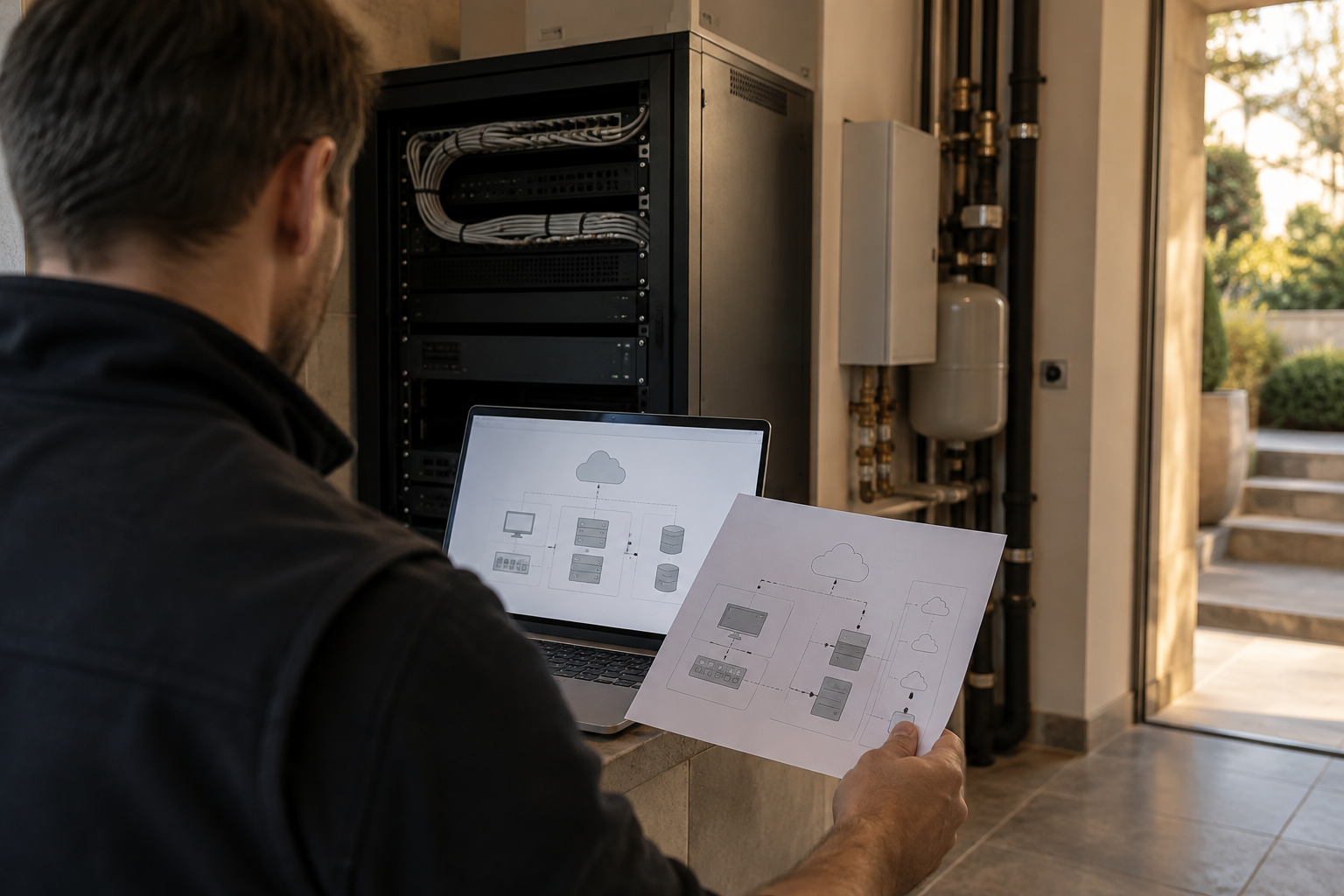
Consider a house with internet-delivered cinema content, cloud-stored household documents and an app-based control interface. Each function can involve different accounts, providers and recovery procedures. The useful commissioning document is a dependency map showing which service supports each function, who administers it and what the occupants retain if that service becomes inaccessible.
Security must also be separated from availability. Google experienced service outages in 2020, including disruption affecting Drive in August and a wider application outage in December; these were resolved within hours. That history does not indicate a security breach, but it explains why connected-home resilience planning remains necessary alongside cybersecurity measures.
For integrators developing software, another Google initiative sits closer to the code they may actually maintain. OSV-Scanner, introduced in December 2022, checks open-source software for known vulnerabilities. The software-security responsibilities around custom integration are distinct from an acquisition intended to strengthen protection in cloud environments.
What people are saying
Google’s stated rationale links the Wiz agreement to two priorities: stronger security for AI companies and the ability to operate across multiple clouds. Read narrowly, that is a position about how organisations build and protect online services. It is not a commitment to deliver a particular residential feature, subscription or integration interface.
For owners, the likely question is whether a supplier’s investment in security changes the risk attached to the services they use. The answer requires product-level evidence: which service is covered, what protections apply and what responsibilities remain with the account holder. The purchase price alone cannot answer any of those questions.
Integrators are more likely to read the agreement through the practical issue of shared responsibility. If a service provider protects its infrastructure, the installer still needs to manage the permissions it grants, the credentials it holds and the access it leaves behind after handover. Upstream investment cannot substitute for those project-level controls.
The Amazon and Microsoft relationships also make the multi-cloud ambition relevant to mixed-supplier properties. A residence may use services from competing technology groups for entirely sensible reasons. However, partnerships between cloud businesses should not be interpreted as evidence that their consumer devices, accounts or automation platforms will work together.
There is a separate expectation problem around AI. Google’s portfolio includes Gemini, while the stated Wiz rationale refers to AI companies more broadly. Neither fact establishes that a conversational assistant can safely administer building services. As with the limits of smart-home AI, security infrastructure and permission to control a physical system need separate assessment.
What happens next
The material available establishes the March 2025 agreement, but does not establish completion or a subsequent rollout affecting residential customers. No home-specific delivery date, price or compatibility commitment can be drawn from it. Procurement decisions should therefore distinguish the announced transaction from any future service changes that require their own documentation.
For an owner’s representative, the immediate next step is to ask each technology supplier to identify the cloud services on which its installation depends. The response should connect a named function to a provider and an accountable support contact. A generic assurance that a system uses a major technology company is insufficient for fault diagnosis or contractual accountability.
The handover should also identify who owns the administrative accounts. Household staff changes, a replacement integrator or the sale of a property can all require access to be transferred without exposing private information. Recording those arrangements gives the owner a usable recovery route rather than leaving operational knowledge with one individual.
Acceptance testing can address the availability side without making assumptions about Wiz. Owners can ask installers to demonstrate the agreed behaviour when internet access is interrupted and record which functions continue locally. That produces evidence about the commissioned property, whereas an acquisition announcement supplies only information about a corporate strategy.
Future claims should be checked against the exact service being purchased. If a supplier later cites Wiz or a related security capability, the relevant questions will concern coverage, contractual terms and the customer’s remaining obligations. Until those details exist, there is no sound basis for adding the proposed acquisition to a residential system’s security specification.
Why this matters
For PRIMAL WIRE readers, the Google–Wiz agreement is a reason to make cloud dependencies explicit in the property brief, not to buy additional equipment. The useful deliverable is a clear division of responsibility between the household, integrator and service provider, supported by account records and tested recovery procedures. That makes a supplier’s future security improvements easier to evaluate without confusing corporate scale with protection for a particular home.
Questions answered
+How much did Google agree to pay for Wiz?
Google agreed in March 2025 to pay $32 billion in cash. The proposed transaction would be its largest acquisition.
+What does Wiz do?
Wiz focuses on cloud computing security. It is based in New York and was co-founded in 2020 by Assaf Rappaport.
+Why does Google want to buy Wiz?
Google said the acquisition would help artificial-intelligence companies improve security while using more than one cloud service.
+Has Google completed the Wiz acquisition?
The information available for this article establishes the March 2025 agreement, but does not establish completion or a subsequent residential service rollout.
+Will the Google Wiz deal improve Nest security?
The agreement does not establish a Nest security upgrade. It concerns cloud security rather than an announced protective feature for residential devices or networks.
+Did Google try to buy Wiz in 2024?
Alphabet reportedly pursued a $23 billion transaction in 2024. Those discussions fell apart amid concerns including regulatory hurdles.
+Does Wiz work with Amazon and Microsoft?
Wiz lists partnerships with Amazon and Microsoft. Those relationships support the relevance of Google’s stated multi-cloud ambition, but do not establish interoperability between consumer devices.
More in Latest Tech
 Latest Tech
Google Android and the hardware behind home control
Google’s hardware acquisitions help explain its Android strategy, but luxury-home control specifications still need evidence at the device, application and support level.
14 October 2026 · 5 min
 Latest Tech
Google DeepMind and the limits of smart-home AI
Google’s AI research pedigree is substantial, but owners and integrators need to distinguish computing breakthroughs from the evidence required to automate a private home.
14 October 2026 · 5 min
 Latest Tech
Google Nest ownership and the luxury-home supplier brief
Google’s place within Alphabet explains who sits behind Nest, but owners and integrators still need to establish who supplies, supports and administers each home technology service.
14 October 2026 · 5 min