Google cloud outages and the connected home’s resilience plan
Google’s historical service interruptions offer a practical lesson for luxury homes: internet access, cloud availability and local control need separate resilience plans.
By Callum Reid · · 5 min read
Key facts
- 01Google’s August 2020 service outage affected Drive among other services.
- 02Google’s December 2020 disruption affected its application suite and was resolved within hours.
- 03Google’s portfolio includes Nest, Android, YouTube, Gmail, Workspace and Drive.
- 04Google announced its Alphabet restructuring on 10 August 2015.
- 05The documented 2020 incidents do not establish that Nest devices or residential building controls failed.
Google experienced service outages in August and December 2020, with the August incident affecting Drive among other services and December’s disruption extending across its application suite. The interruptions at the Mountain View, California-based company were resolved within hours, but they illustrate a distinction that matters in connected homes: a working internet connection does not guarantee that a remote service is available.
What happened
The incidents form part of Google’s operational history, not a newly announced disruption. Their relevance to residential technology lies in the company’s breadth: its portfolio includes Nest, Android, YouTube, Gmail, Workspace and Drive, putting one supplier behind several otherwise distinct household activities.
The documented interruptions concerned Google services and applications. They do not establish that Nest devices, residential heating or lighting controls stopped operating, and should not be used as evidence of such failures. A useful assessment therefore starts with the services actually used in a property, rather than assuming that every Google-associated product shares the same failure behaviour.
A home office might depend on Drive for documents, Meet for video calls and Gmail for correspondence. A cinema might use YouTube for viewing. These are different workloads, but a service incident can make their common supplier operationally significant even when the household’s router, wireless network and display equipment remain healthy.
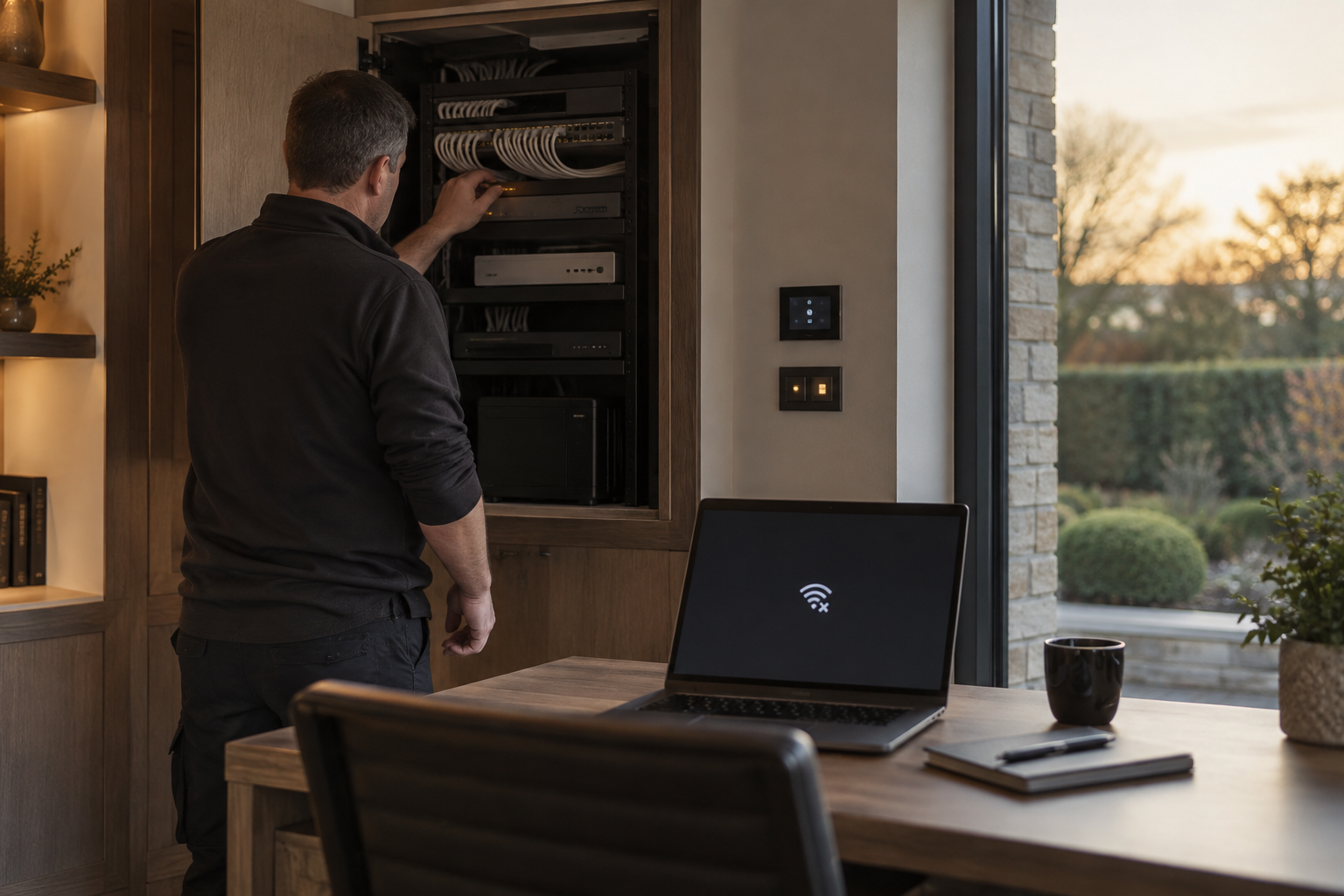
For an integrator diagnosing a complaint, that distinction changes the first questions. Establishing whether the problem affects one application, one device or every internet service can prevent unnecessary changes to a functioning installation. Rebooting the house’s network is not a remedy for an unavailable application upstream.
The background
Google announced its Alphabet restructuring on 10 August 2015, with Sundar Pichai becoming Google’s chief executive as Larry Page moved to lead the parent company. Pichai also became Alphabet’s chief executive in 2019. That corporate structure matters when identifying the supplier, but it does not tell an installer which individual services a residential system requires.
The product portfolio spans several technical layers. Android is an operating system; Nest is Google’s smart-home business; Drive provides cloud storage; YouTube distributes video; and Gemini addresses artificial intelligence. Treating these simply as one ecosystem can conceal the different account, connectivity and operational requirements of each component.
In residential systems generally, resilience has at least three separate dimensions: power to the equipment, a functioning communications path and an available application. A battery-backed router addresses the first. A secondary broadband connection can address some failures of the second. Neither, by itself, repairs an interruption within the remote application provider.
This is why a specification for resilient connectivity should identify the failure it intends to cover. Two connections may help when one access service fails, but the household can still lose access to an application reached through either connection. Purchasing redundancy without defining its scope risks promising more continuity than the equipment can deliver.
Local building control introduces a different design question. Where an installation supports independent local operation, essential functions need not rely on the same remote services used for entertainment or office work. The division between supervisory interfaces and underlying plant is explored in our analysis of KNX and BMS responsibilities in luxury homes; the appropriate arrangement must be checked against the actual design.
What people are saying
The available account of the 2020 incidents contains no residential customer testimony or detailed Google explanation of their causes. There is consequently no basis for attributing a particular household failure to those events. The defensible industry reading is narrower: large providers can experience interruptions, and a property’s support plan should accommodate that possibility.
Google’s pandemic-era decisions underline how important remote working had become within its own organisation. In April 2020, the company announced measures including slower hiring and adjustments to investment, marketing and travel; it subsequently planned to make some jobs permanently home-based. For residential clients, home-office availability is therefore a distinct operational requirement, not merely another entertainment preference.
An owner is likely to judge an interruption by the task it prevents: joining a meeting, retrieving a document or playing a programme. A support agreement should reflect those differences. Restoring access to working files may warrant a different response from investigating an unavailable video service, even if both complaints initially arrive as a report that the internet is down.
Integrators should also distinguish supplier scale from a project-specific service commitment. Google’s extensive portfolio says little about the recovery time promised under an individual customer’s contract. The applicable terms, support route and account ownership need checking separately; a familiar consumer brand is not a substitute for an agreed residential support responsibility.
What happens next
No new residential resilience programme, outage deadline or recovery guarantee is established by this material. The practical next step is a dependency review of the installed property, beginning with a list of cloud services and the household functions that use them. Each entry should identify the account owner, support contact and consequences of temporary unavailability.
For a home office, that review should ask whether essential working documents are accessible under the intended offline arrangements and whether those arrangements have been tested. Keeping an authorised local copy can introduce its own security and version-control obligations. Availability should not be improved by casually scattering confidential files across unmanaged devices.
Commissioning should distinguish a lost broadband connection from an unavailable application. A planned, authorised disconnection can reveal how local controls and interfaces behave without internet access, but it cannot prove how every remote-provider incident will unfold. Test reports should record that limitation rather than presenting a single successful demonstration as comprehensive assurance.
The response plan also needs a communications route that remains usable during the incident it describes. Support numbers, essential instructions and account-recovery responsibilities should not exist solely inside the service being investigated. At handover, the owner or household manager should know where to find that information without requiring an installer to reconstruct the project remotely.
Temporary interruption and permanent withdrawal deserve separate treatment. Google’s discontinued services include Stadia, Reader and Play Music, but those closures pose a migration problem rather than a short-term recovery problem. Our examination of Google service-retirement planning addresses that longer horizon; an outage procedure should not be mistaken for an exit strategy.
New integrations should likewise be assessed at the feature level. Adding a cloud-connected interface may provide convenience without changing the underlying control system, or it may introduce a new dependency; the distinction requires technical confirmation. Our wider analysis of Google’s role in smart-home control provides context for deciding where that responsibility should sit.
Why this matters
For owners commissioning a prime residence, resilience should be specified as an observable outcome: which functions remain available, under which failure conditions, and who takes responsibility when they do not. Google’s historical outages offer no verdict on a particular home’s reliability, but they do show why backup broadband alone cannot answer those questions. A well-documented separation of local operation, connectivity and cloud services gives the owner a more useful assurance than an undifferentiated promise of a connected home.
Questions answered
+When did Google have service outages in 2020?
The documented incidents include an August 2020 outage affecting Drive among other services and a December disruption affecting Google’s application suite. These interruptions were resolved within hours.
+Did the Google outages affect Nest devices?
The available account does not establish that Nest devices failed. Disruption to Google applications should not be treated as evidence that residential heating, lighting or other building controls stopped operating.
+Will backup broadband protect against a Google outage?
Not by itself. A secondary connection can address some access failures, but it cannot restore an unavailable remote application. Connectivity and cloud-service availability require separate consideration.
+Can a smart home work without the internet?
Where an installation supports independent local operation, essential functions need not depend on remote services. The actual behaviour must be checked against the system design and tested during commissioning.
+What should a smart-home outage plan include?
It should identify cloud dependencies, affected household functions, account owners, support contacts and recovery responsibilities. Essential instructions should remain accessible without relying solely on the service being investigated.
+Is a Google outage the same as a service shutdown?
No. A temporary interruption requires a recovery response, while permanent withdrawal requires migration planning. Google’s discontinued services include Stadia, Reader and Play Music.
More in Latest Tech
 Latest Tech
Google Android ruling puts home interface choices in focus
The US decision left Android and Chrome with Google, but luxury-home specifications still need to distinguish familiar interfaces from dependable building control.
13 October 2026 · 5 min
 Latest Tech
Google OSV-Scanner and the smart-home software security gap
Google’s open-source vulnerability tool offers a useful reference point for integrators assessing the software behind bespoke home technology.
13 October 2026 · 5 min
 Latest Tech
Google advertising puts smart-home product research in focus
Advertising supplied 73% of Google’s revenue in 2025, making the distinction between product discovery and technical verification important for luxury-home projects.
13 October 2026 · 5 min