Google smart homes need a plan for service retirement
Google’s discontinued services and expanding technology portfolio make lifecycle planning an essential part of specifying connected systems for a long-lived luxury home.
By Callum Reid · · 5 min read
Key facts
- 01Google announced Stadia on 19 March 2019; the cloud-gaming platform was subsequently discontinued.
- 02Google’s discontinued products also include Reader, Play Music, Hangouts and Inbox by Gmail.
- 03Google experienced service outages in August and December 2020; the incidents were resolved within hours.
- 04Google became an Alphabet subsidiary in 2015; Sundar Pichai also became Alphabet chief executive in 2019.
- 05Google’s residentially relevant portfolio includes Nest, Android, YouTube, YouTube Music, Workspace and Drive.
Google announced its Stadia cloud-gaming platform on 19 March 2019; the service subsequently joined a substantial list of discontinued Google products. For the Mountain View, California-headquartered company, whose portfolio includes Nest, Android and YouTube, that history raises a practical question for luxury homes: how should an installation outlive an individual online service?
What happened
Stadia is not an isolated example of Google withdrawing a service. Other discontinued products include Reader, Google+, Play Music, Hangouts and Inbox by Gmail. These were different kinds of software, serving different audiences, but together they establish a useful distinction for residential specification: the continued existence of a supplier does not guarantee the continued existence of everything it supplies.
There is also a separate question of temporary availability. Google experienced service outages in 2020, including an August disruption affecting Drive and a December incident affecting its wider application suite. Those incidents were resolved within hours. They demonstrate an interruption risk, not a permanent withdrawal, and the two require different responses from an installer.
Google’s relevance to the home extends well beyond a single control device. Nest covers smart-home technology; Android provides a mobile operating system; YouTube and YouTube Music supply entertainment; and Workspace and Drive support work and document storage. A household can therefore depend on one company in several places without having deliberately selected a single-brand installation.
None of this establishes that a particular Nest product is due to be withdrawn, or that a specific residential installation was affected by those outages. The defensible conclusion is narrower: supplier strength and service continuity are different specification questions. Each connected function needs its own assessment rather than inheriting an assumption of permanence from the Google name.
The background
Founded by Larry Page and Sergey Brin in 1998, Google became a wholly owned subsidiary of Alphabet following a restructuring announced on 10 August 2015. Sundar Pichai became Google’s chief executive during that transition and also became Alphabet’s chief executive in 2019. The corporate structure helps explain how a familiar consumer brand sits within a much broader technology business.
That breadth matters because residential equipment is only part of Google’s activity. Its operations span advertising, cloud computing, consumer electronics and artificial intelligence. An integrator specifying a connected home is buying into a product’s particular development and support arrangements, not obtaining a commitment from every other business operating under the same corporate umbrella.
Google’s investment history illustrates the range. It announced an agreement to acquire London-based DeepMind Technologies on 26 January 2014, while its May 2022 acquisition of California-based Raxium brought MicroLED display expertise into its Devices and Services team. Neither transaction, by itself, establishes a support period or upgrade path for equipment already installed in a residence.
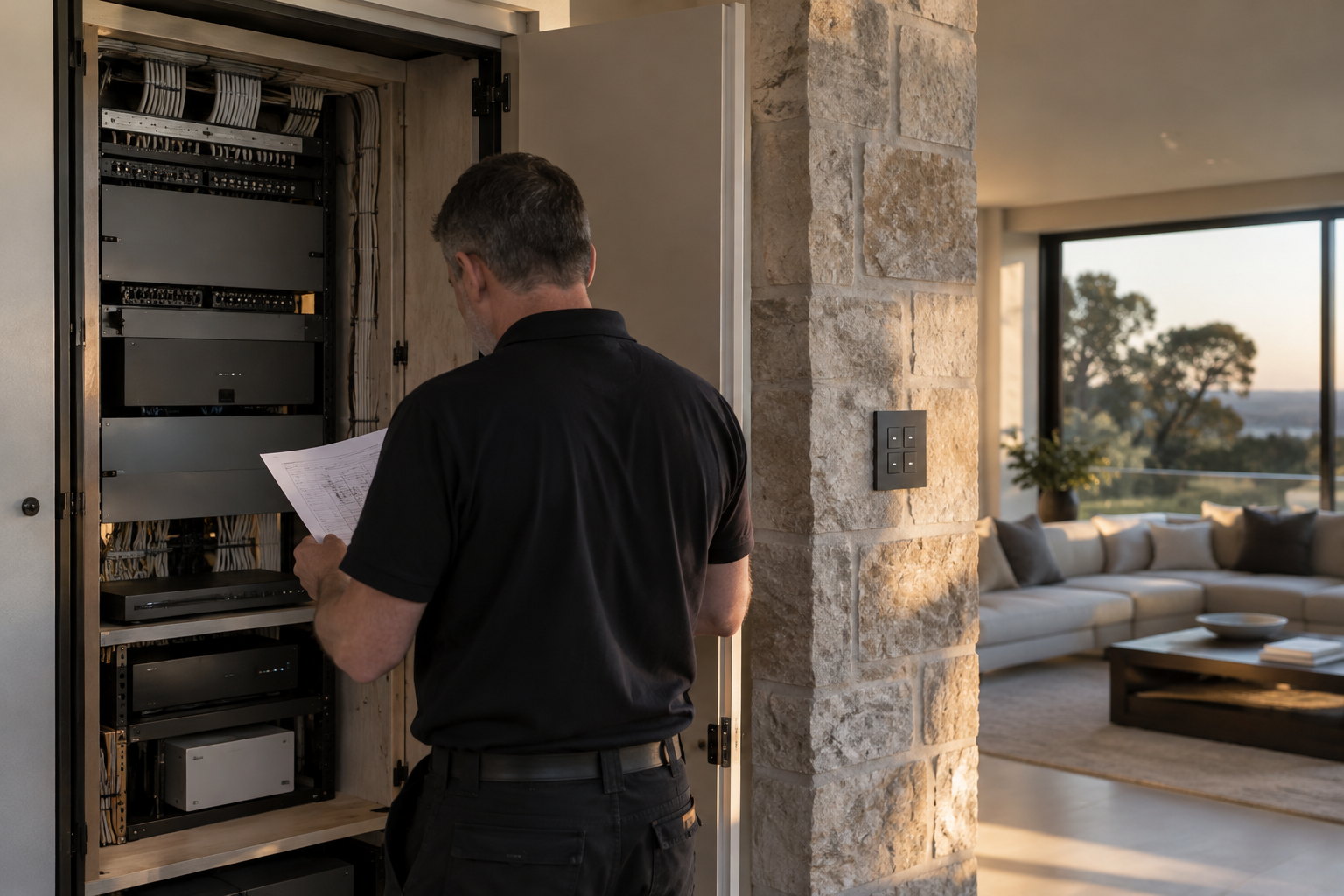
The architectural issue is that a luxury property’s finishes, wiring and plant can remain in use through several generations of software. If a short-lived online feature is embedded too deeply in a permanent installation, changing it can become a building project rather than a straightforward equipment replacement. Accessible cabling, replaceable interfaces and documented connections reduce that exposure.
The same principle informs the distinction between KNX and BMS responsibilities in luxury homes. A convenient household interface and the underlying operation of heating, ventilation or lighting need not be the same layer. Separating their responsibilities gives designers a way to change the former without unnecessarily disturbing the latter.
What people are saying
There is no new Google announcement here promising a common lifespan across its home, entertainment and cloud services. For owners, the useful reading of the company’s history is therefore a procurement question rather than a prediction: what exactly has been promised for the product being purchased, and which parts of the proposed experience depend on something outside the property?
Google’s stated rationale for its March 2025 agreement to acquire cloud-security company Wiz was to improve security for AI businesses and support the use of multiple cloud services. The announced price was US$32 billion. That is a substantial cloud-business commitment, but it should not be interpreted as a residential maintenance pledge or evidence that particular household devices have gained new protection.
For integrators, discontinuation and interruption call for separate conversations with the client. A temporary outage requires an agreed level of operation until connectivity or service returns. Retirement requires a replacement route, potentially involving new hardware, different software or the loss of a feature. Describing both simply as reliability obscures the work and cost involved.
Owners should also distinguish an account convenience from a building capability. A familiar login may make entertainment and personal services easier to access, while creating complications when staff change or a property is sold. Our examination of Google’s role in smart-home platform control addresses that wider governance question; lifecycle planning adds the responsibility for eventual migration.
What happens next
No new residential launch date, retirement schedule or universal support term follows from this company history. The immediate next step is project-specific due diligence. Before approval, the technology schedule should identify the installed product, the associated service and any published support commitment, with unanswered questions recorded explicitly rather than converted into optimistic assumptions.
A dependency register should then describe the consequence of losing each external service. Losing a music catalogue is materially different from losing access to an essential household function. The register should identify what remains usable, whether an alternative interface exists and who is responsible for restoring the agreed experience. This is more actionable than a general assurance that the house is connected.
Commissioning should include a controlled loss-of-connectivity test, where safe and appropriate. The purpose is to observe the actual installation, not to assume that every product from a particular manufacturer behaves alike. Results should record which commands still work, which require a remote service and whether normal operation resumes without an engineer attending.
Handover needs a migration record as well as an operating guide. Account ownership, recovery arrangements, configuration backups where available, subscriptions and installer responsibilities should be documented without exposing passwords in an unsecured file. A subsequent owner or service contractor should be able to establish what the house depends on without reconstructing the original design from memory.
AI features deserve their own entry in that record. Google’s portfolio includes Gemini, but the presence of a conversational service does not, by itself, establish supported control of installed equipment. As our analysis of artificial intelligence beyond smart-home chatbots explains, the useful question is what a system can demonstrably do. Any proposed automation should be assessed against its actual permissions and dependencies.
Why this matters
For a luxury homeowner, service retirement becomes expensive when it reaches beyond a replaceable device into bespoke joinery, essential controls or undocumented accounts. Google’s history provides grounds for disciplined specification, not a blanket argument against its products: buy the functions that are useful, verify the commitments attached to them, and ensure that replacing an online service does not require rebuilding the home around it.
Questions answered
+Which Google services have been discontinued?
Discontinued Google products include Stadia, Reader, Google+, Play Music, Hangouts and Inbox by Gmail. Their retirement does not establish that a particular Nest product is due to be withdrawn.
+When did Google announce Stadia?
Google announced its Stadia cloud-gaming platform on 19 March 2019. The service was subsequently discontinued.
+What happened during the Google outages in 2020?
An August outage affected Drive among other services, while a December incident affected Google’s wider application suite. The incidents were resolved within hours.
+Does Google guarantee a lifespan for all smart home products?
This company history contains no universal support term for Google’s home products. Buyers should check the published commitments for each specified product and its associated services.
+What should a smart home dependency register include?
It should identify external services, the consequences of losing them, functions that remain usable, alternative interfaces and responsibility for restoring operation.
+How can a smart home be prepared for service retirement?
Plan replaceable interfaces, accessible cabling and documented connections. Record account ownership, support commitments and migration responsibilities, and distinguish temporary outage arrangements from permanent replacement routes.
+Who owns Google?
Google is a wholly owned subsidiary of Alphabet. The restructuring was announced on 10 August 2015, and Sundar Pichai became Alphabet’s chief executive in 2019.
More in Latest Tech
 Latest Tech
Google smart home technology and the question of control
Google’s reach across Nest, Android, cloud computing and AI makes it influential in connected homes, but owners should distinguish platform capability from infrastructure resilience.
8 October 2026 · 5 min
 Latest Tech
ChatGPT plugins put home integration permissions in focus
OpenAI’s expanding connections to external tools give integrators more options, but access permissions and verified system information matter more than conversational fluency.
10 October 2026 · 5 min
 Latest Tech
Shelly door sensors add tilt monitoring indoors and out
Two wireless contact sensors bring opening and inclination data to household automation, with a compact indoor model and an IP55-rated option for external access points.
9 October 2026 · 5 min