Apple HomePad reports point to a new smart-home control screen
A reported October launch could give Apple’s home platform a shared screen, but integration, privacy and availability remain the questions for residential projects.
By Davy Currie · · 5 min read
Key facts
- 01Apple’s reported home-focused event is scheduled for 13 October 2026, with a press experience in New York’s Tribeca district.
- 02The unofficial Apple HomePad reportedly has a 6-inch display, with separate tabletop and wall-mounted configurations requiring mains power.
- 03A separate Apple display with a 9-inch screen and 360-degree robotic arm is reportedly in development.
- 04Apple TV reports suggest an A19 with 8GB memory or an A19 Pro with 12GB; neither configuration is confirmed.
- 05The reported HomePad price of about $350 remains unconfirmed; UK pricing and availability are not established.
Apple is reportedly preparing to introduce a smart-home display at a 13 October 2026 event, with a press experience in New York’s Tribeca district. Unofficially called HomePad, the proposed device has a 6-inch screen and could arrive alongside refreshed Apple TV 4K and HomePod mini hardware; a larger robotic-arm version is described as a separate development project, not a confirmed launch.
What happened
The reported event invitation uses the name Welcome home, pointing towards a household-focused presentation. None of the detailed hardware specifications, prices or delivery dates discussed in the advance reports should yet be treated as a purchasing commitment from Apple.
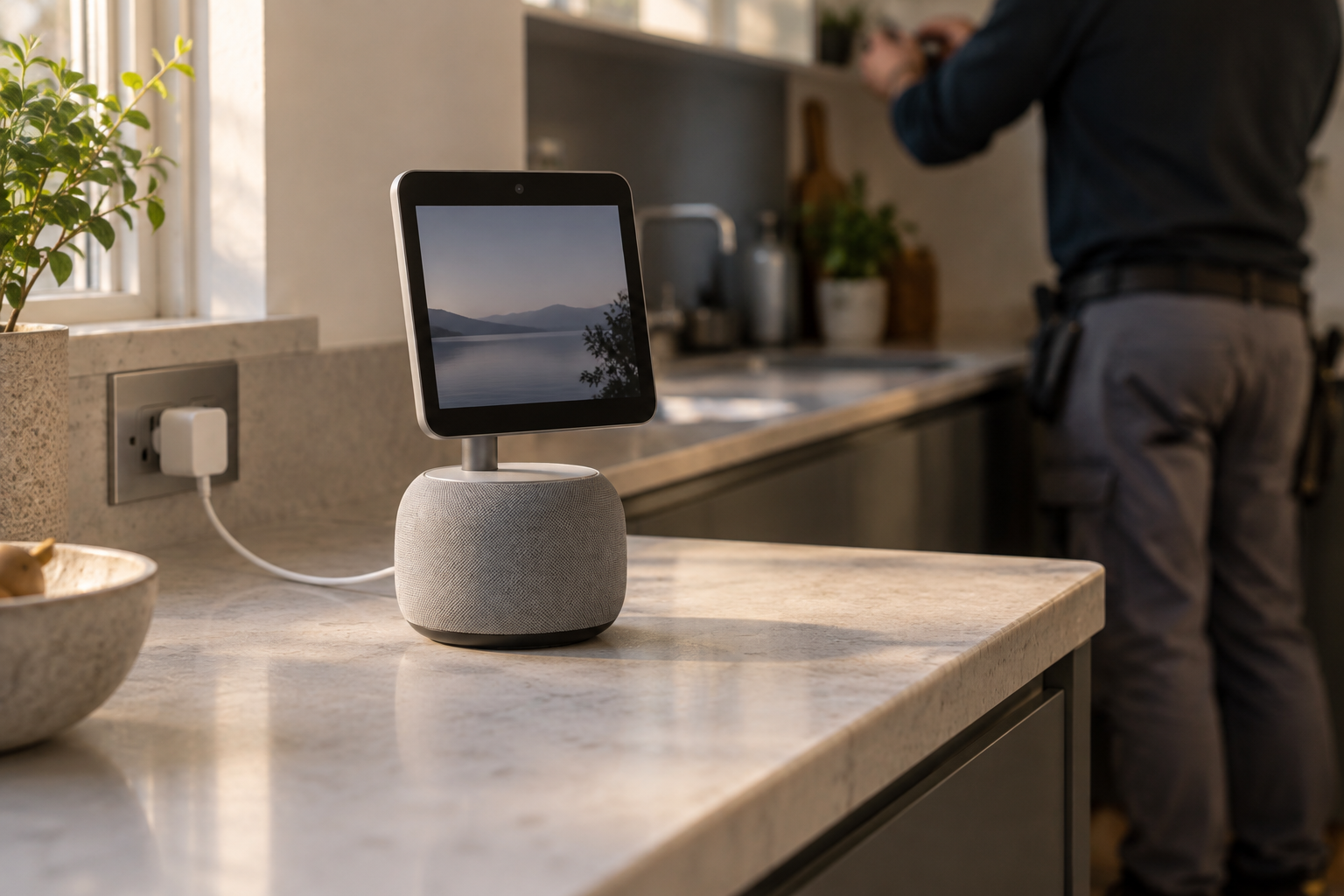
Two initial display configurations are described: a tabletop unit codenamed J490 and a wall-mounted version codenamed J491. The tabletop design reportedly places a square screen on a metal support above a circular speaker base. The wall version would instead use a shallow square assembly, with microphones and speakers beneath the display.
Both configurations reportedly require mains power. That is the first practical detail for residential installers: a wall-mounted screen needs an appropriate power provision, while a tabletop device needs an accessible socket. Neither description establishes support for Power over Ethernet, concealed installation accessories or the mounting details needed to finish a room neatly.
The interface is said to draw on Apple Watch and the iPhone’s StandBy mode, with widgets and a front-facing FaceTime camera. An iPhone would be required for setup. Household recognition would reportedly tailor content to the person speaking, while a visitor mode would conceal private information.
A third model is reportedly being developed with a 9-inch display and an arm capable of 360-degree movement. Its status matters: buyers should not assume that the smaller tabletop device has motorised tracking, or that the larger version will share its announcement or delivery schedule.
The background
Apple already has a place in many residential systems through television streaming, personal devices and HomeKit-compatible accessories. A shared display would add a different access point: something available to the household without first finding a phone. The distinction is between a personal interface and a communal one, particularly in kitchens and family rooms.
That does not automatically make it a substitute for a professionally commissioned control panel. Lighting scenes, heating permissions, access control and audiovisual routing depend on the connected systems and their supported interfaces. The broader question of who controls a smart-home platform remains relevant regardless of which company supplies the screen.
The proposed Apple TV refresh could also change the capabilities of the television endpoint. Reports suggest either an A19 processor with 8GB of memory or an A19 Pro with 12GB, compared with the A15 Bionic in the current model. Those competing specifications indicate that the final configuration is not established.
An N1 wireless chip is also rumoured, bringing Wi-Fi 7, Bluetooth 6 and Thread. Thread provides a low-power network for compatible smart-home devices; it is not a promise that every connected product will work together. Radio support, application-level compatibility and the functions exposed to an installer remain separate checks.
Reported references in tvOS 27.2 code suggest support for pairing four HomePods with Apple TV and displaying responses to relayed Siri requests on the television. For media rooms, that raises questions about speaker assignment, supported audio formats and calibration. A count of four speakers alone does not establish equivalence with a specified surround-sound installation.
The original HomePod mini launched in October 2020 at $99 and uses Apple’s S5 chip. Its reported successor would move to an S9, add N1 wireless hardware and receive a newer Ultra Wideband chip. The familiar fabric-covered spherical enclosure and illuminated touch surface are expected to remain, with revised colours.
What people are saying
The clearest public-facing signal attributed to Apple is the event’s home-focused name. Beyond that, the product narrative rests on advance reporting and purported software references rather than a published specification sheet. Claims that Siri AI will be central to the new devices, and potentially restricted to the refreshed Apple TV, therefore need confirmation.
Owners are likely to judge the display less by its processor than by whether it understands the household reliably. Reported speaker recognition and visitor privacy address real shared-device problems, but leave operational questions: how family members are enrolled, what guests can control and what happens when identification fails.
For integrators, the distinction between conversational assistance and dependable automation is more consequential. A screen may make commands easier to issue without changing the underlying control architecture. Our examination of artificial intelligence beyond the smart-home chatbot sets out why a more capable assistant should not be confused with a fully engineered automation system.
LG is reportedly involved in a wider accessory programme covering a smart lock, thermostat, temperature sensor, video doorbell and indoor, outdoor and floodlight cameras. These products are expected to carry LG branding. References attributed to iOS 27.2 also identify a Schneider thermostat and temperature sensor with a second-party designation, although the practical meaning of that designation remains unclear.
What happens next
The immediate milestone is 13 October. Apple has not confirmed, in the available information, whether the presentation will be livestreamed. US pricing and availability remain unannounced, and no UK pricing or release schedule is established. An earlier suggested HomePad price of about $350 remains unconfirmed and is not a sound basis for a project allowance.
The reported LG accessories are expected to arrive later than the main home devices, even if they appear during the presentation. That potential gap argues against specifying a complete Apple-centred security or environmental-control package before the individual products, regional availability and supported functions are documented.
Heating deserves particular care. The appearance of a compatible thermostat would not, by itself, establish suitability for a residence with multiple heating and cooling circuits. The division between KNX room control and building-management plant control remains a useful design boundary: a convenient household interface need not become the authority for complex mechanical services.
Before incorporating the display into a live project, installers should seek answers on mounting, power, account ownership, guest permissions, software support and behaviour during an internet outage. For the camera-equipped models, privacy settings and camera-disable options also need scrutiny. These are commissioning requirements, not reasons to assume the reported hardware will fall short.
Why this matters
For luxury homeowners, Apple’s reported display could make everyday interaction with connected rooms more accessible without requiring a phone in hand. For developers and integrators, its value will depend on whether that convenience can sit alongside durable control systems, clear household permissions and maintainable infrastructure. The sensible opportunity is an additional interface; replacing an established control strategy would require evidence that the announcement has yet to provide.
Questions answered
+What is Apple HomePad?
HomePad is the unofficial name for a reported Apple smart-home display. Advance descriptions specify a 6-inch screen, household recognition, widgets and a FaceTime camera, with tabletop and wall-mounted versions.
+When is the Apple HomePad launch?
The device is expected at Apple’s reported 13 October 2026 home-focused event. A product release date has not been established, and UK availability remains unannounced.
+How much will Apple HomePad cost?
An earlier report suggested about $350, but that figure remains unconfirmed. No confirmed US or UK price is available.
+Does Apple HomePad have a robotic arm?
The reported 6-inch tabletop model has a metal support arm, not confirmed motorised tracking. A separate 9-inch model with a 360-degree robotic arm is reportedly in development.
+Does Apple HomePad need an iPhone?
The reported specifications say an iPhone is required for setup. Both the tabletop and wall-mounted versions would also need mains power.
+What is changing in the HomePod mini 2?
Reports suggest an S9 processor, N1 wireless hardware, a newer Ultra Wideband chip and Siri AI. The spherical fabric-covered enclosure is expected to remain, with revised colours. Final specifications are unconfirmed.
+Will the new Apple TV support four HomePods?
Reported references in tvOS 27.2 code suggest four-HomePod pairing. Apple has not confirmed the feature, speaker assignments, supported audio formats or calibration arrangements in the available information.
More in Latest Tech
 Latest Tech
Artificial intelligence in smart homes: beyond the chatbot
Advances in language and reasoning are changing expectations of home technology, but useful intelligence also depends on sensing, reliable information and clearly defined objectives.
9 October 2026 · 5 min
 Latest Tech
Google smart home technology and the question of control
Google’s reach across Nest, Android, cloud computing and AI makes it influential in connected homes, but owners should distinguish platform capability from infrastructure resilience.
8 October 2026 · 5 min
 Latest Tech
ChatGPT agents and the limits of smart-home control
OpenAI’s move from conversation to computer-based action creates useful tools for residential integrators, but does not make ChatGPT a building-control system.
7 October 2026 · 5 min