YouTube’s $60bn-plus business puts home cinema access in focus
YouTube’s financial scale underlines its place in residential AV, but subscriptions, account privacy and platform access need as much attention as the screen.
By Amara Okafor · · 5 min read
Key facts
- 01YouTube generated more than US$60 billion in total revenue in 2025.
- 02YouTube’s 2025 advertising revenue was US$40.4 billion, separate from its total revenue figure.
- 03Google announced its US$1.65 billion YouTube acquisition on 9 October 2006; completion followed on 13 November.
- 04YouTube began a broader ad-blocker crackdown in October 2023 and announced stronger third-party app enforcement in April 2024.
- 05Google announced an age-assurance trial for selected US users on 30 July 2025.
YouTube generated more than US$60 billion in revenue in 2025, according to Alphabet’s full-year results released on 4 February 2026. The Google-owned video platform, headquartered in San Bruno, California, recorded US$40.4 billion in advertising revenue that year—a business whose commercial decisions have practical consequences for connected televisions and home cinemas.
What happened
The distinction between those figures matters: US$40.4 billion represents advertising, not YouTube’s entire business. Alongside its advertising-funded service, the company operates paid offerings including YouTube Premium, which provides viewing without ads. For residential AV projects, the intended subscription arrangement belongs in the client brief rather than being left to whoever first signs into the television.
YouTube’s catalogue spans music videos, documentaries, films, news and live streams, with contributions from individuals and established media organisations. That breadth makes it relevant to more than a dedicated cinema: an owner might want a concert in a listening room, a tutorial in a kitchen or entertainment on a guest-room screen. Those uses need not share the same account arrangements.
This is not a new home-cinema hardware launch, and the financial results establish no new playback specification. Their significance is commercial: an enormous video service combines advertising and subscriptions, while integrators are asked to make access feel effortless. That requires decisions about devices, users and support responsibilities, not simply an app icon on a control interface.
The background
Google announced its US$1.65 billion acquisition of YouTube on 9 October 2006 and completed the transaction on 13 November. The announcement passed its twentieth anniversary this week. Over that period, YouTube expanded beyond its original website into mobile applications and a wider family of services, making it a platform dependency rather than a single-purpose video source.
The television interface has a substantial history of its own. In 2013, YouTube introduced changes intended to unify the experience across desktop computers, televisions and mobile devices. The integration implication is that the screen and the service have different development cycles: a carefully installed display may remain satisfactory while the application through which an owner watches changes around it.
Subscription experiments also predate today’s Premium offering. YouTube introduced Music Key in 2014, followed by YouTube Red in 2015, extending the proposition beyond advertising-funded viewing. Its product family now includes YouTube Music, YouTube Kids, YouTube Shorts and YouTube TV. A specification should identify the requested service precisely rather than treating everything carrying the YouTube name as interchangeable.
Access has not always been consistent across hardware ecosystems. During 2018–19, the YouTube app was unavailable on Amazon Fire products for more than a year. That history supports a practical commissioning principle: verify the service on the actual playback device being supplied, rather than assuming that a familiar platform name guarantees availability throughout a property.
Device availability and service longevity are separate questions. An integrator can recommend an alternative playback route where appropriate, but cannot promise permanent compatibility on another company’s behalf. The wider issue of planning for changes to Google-connected home services is relevant here: handover documentation should distinguish installed equipment from externally operated services and explain who supports each.
YouTube’s range also differs from a tightly defined concert subscription. The work by Sony and Berlin Phil Media on concerts for home viewing illustrates a more specialised production context. Owners should therefore demonstrate the material they actually watch during system evaluation, rather than judging a mixed-source entertainment system solely through a curated demonstration sequence.
What people are saying
YouTube’s clearest relevant public position concerns advertising avoidance. In late October 2023, it began a broader crackdown on ad blockers, telling affected viewers to permit advertising or consider Premium. The company says ad blockers breach its terms of service. In April 2024, it announced stronger enforcement against third-party applications that violated those terms, specifically including ad-blocking apps.
For an integrator, the defensible reading is straightforward: an unofficial advertising workaround should not underpin a promised viewing experience. If an owner wants ad-free viewing, the brief should address YouTube’s paid route and its applicable terms. Network configuration is not a substitute for agreeing how a commercial content service will be used.
There is also evidence that television advertising presentation remains subject to experimentation. In 2022, YouTube tested grouping numerous short, unskippable advertisements at the beginning of longer videos watched on televisions, before ending that experiment on 19 September. Owners commissioning an expensive cinema should understand that the integrator controls the installation, not the platform’s editorial or advertising interface.
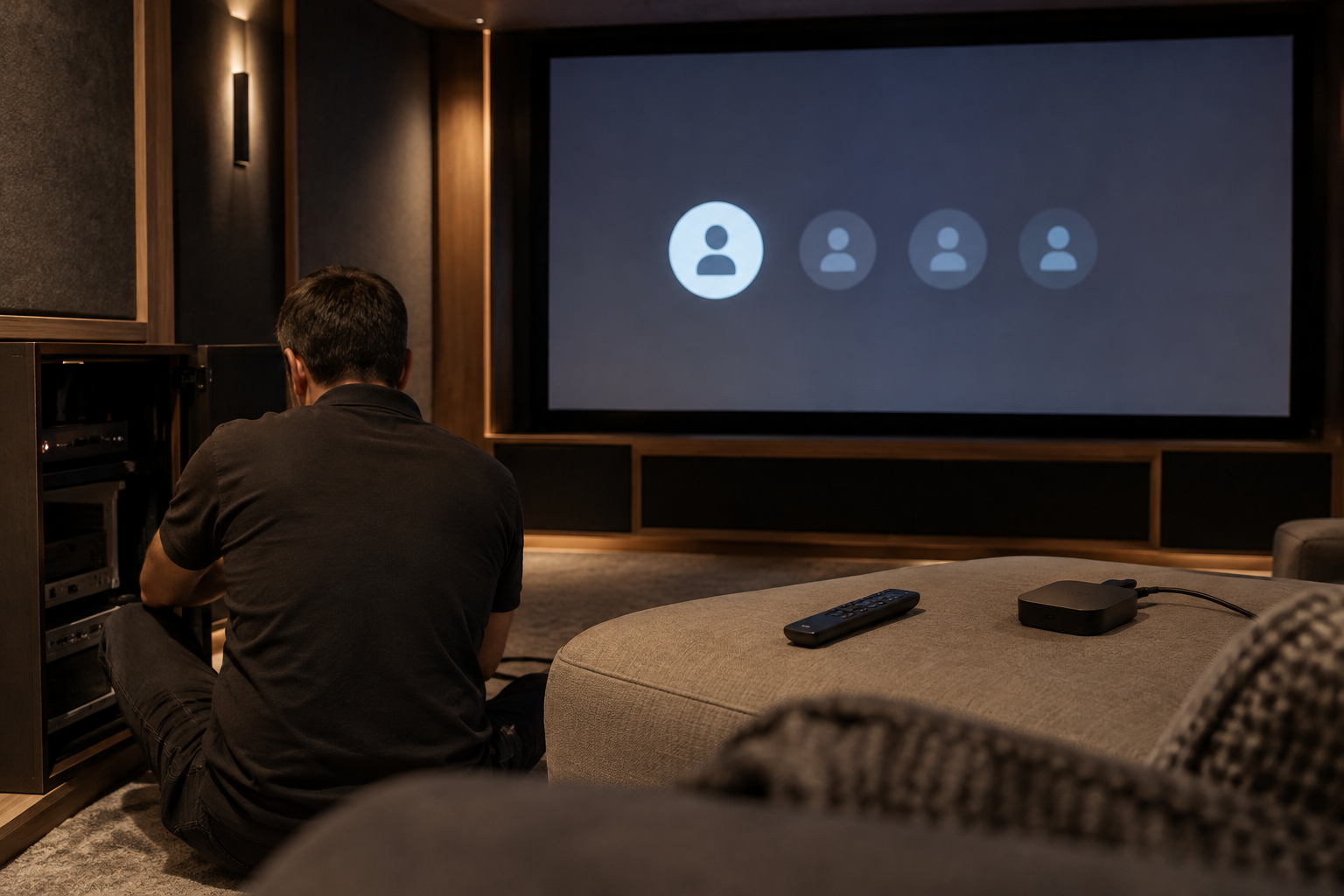
Account privacy creates a different boundary. Most YouTube videos can be watched without registration, while functions including creating playlists, commenting and viewing flagged adult material require it. An owner may want personal convenience in a private room without exposing the same account on a shared display; that choice should be explicit before credentials are entered across the house.
Children’s access requires its own discussion rather than an assumption that a family subscription resolves everything. YouTube launched Kids in 2015 with curated content, a simplified interface and parental controls, then introduced a supervised mode in 2021. These are distinct viewing arrangements, so the handover should demonstrate the intended setup on each relevant screen with the household present.
What happens next
The facts establish no forthcoming residential AV product or integration deadline. The immediate work is therefore specification and verification: record the chosen playback devices, which accounts will be used, who owns subscription administration and how access will be removed when equipment changes hands. A successful demonstration should include routine use, not merely prove that one video plays.
Age assurance is another development worth tracking without overstating its reach. On 30 July 2025, Google announced a trial for selected US users in which machine learning would infer age using signals including account age, searches and viewing history. Users identified as minors could face restrictions and need verification to regain full access. That announcement does not establish an equivalent rollout timetable for British households.
For shared residential screens, the practical question is whose behaviour and identity the account represents. The trial makes that question more consequential, but does not justify predictions about how a particular household will be classified. Integrators should avoid retaining personal verification material and leave identity checks with the account holder rather than making them part of routine technical support.
On yachts, YouTube’s availability must also be separated from connectivity planning. The service operates internationally except where blocked, but that does not establish access at every destination or dependable playback over every connection. Captains and AV teams should distinguish a functioning onboard installation from an external service or communications limitation when defining support expectations.
Why this matters
For owners, the useful measure is whether everyday viewing remains understandable after the installer leaves. YouTube’s scale makes it a consequential service, but scale does not confer control over its future interfaces, advertising or access rules. A well-specified home or yacht system should make those boundaries visible: the integrator is responsible for a usable installation, while accounts, subscriptions and platform policies remain separate parts of the experience.
Questions answered
+How much revenue did YouTube make in 2025?
YouTube generated more than US$60 billion in total revenue in 2025. Advertising accounted for US$40.4 billion. Alphabet released its full-year results on 4 February 2026.
+Who owns YouTube?
YouTube is owned by Google, within Alphabet. Google announced the US$1.65 billion acquisition on 9 October 2006 and completed it on 13 November 2006.
+Does YouTube Premium remove ads?
YouTube Premium is the platform’s paid subscription option for watching videos without ads. Residential AV specifications should address the intended subscription arrangement rather than rely on unofficial advertising workarounds.
+Do you need an account to watch YouTube?
Most videos can be watched without registration. An account is required for activities including creating playlists, commenting and viewing flagged adult material.
+Does YouTube allow ad blockers?
YouTube says ad blockers violate its terms of service. It began a broader crackdown in October 2023 and announced stronger enforcement against non-compliant third-party applications in April 2024.
+What should a home cinema installer check for YouTube?
The installer should verify access on the chosen playback device, agree account and subscription arrangements, demonstrate routine use and document support responsibilities. Shared screens and children’s viewing require separate consideration.
+Can you watch YouTube on a yacht?
YouTube operates internationally except where blocked. That does not guarantee availability at every destination or reliable playback over every connection; onboard equipment and external connectivity need separate assessment.
More in Latest Tech
 Latest Tech
Google Raxium acquisition puts microLED expertise in focus
Google’s acquisition of Raxium added specialist display engineering, but owners and integrators should distinguish that capability from a finished screen or an installation roadmap.
10 October 2026 · 5 min
 Latest Tech
Google AI Overviews change smart-home technology research
Google’s AI-generated search answers put greater emphasis on checking evidence before choosing technology for a luxury home.
10 October 2026 · 5 min
 Latest Tech
Google smart homes need a plan for service retirement
Google’s discontinued services and expanding technology portfolio make lifecycle planning an essential part of specifying connected systems for a long-lived luxury home.
10 October 2026 · 5 min