Google Android and the hardware behind home control
Google’s hardware acquisitions help explain its Android strategy, but luxury-home control specifications still need evidence at the device, application and support level.
By Davy Currie · · 5 min read
Key facts
- 01Google acquired Motorola Mobility for $12.5 billion in May 2012, partly to strengthen its mobile and wireless patent position.
- 02Google announced its acquisition of microLED specialist Raxium in May 2022.
- 03Google became an Alphabet subsidiary following the restructuring announced on 10 August 2015.
- 04Sundar Pichai became Google chief executive in 2015 and Alphabet chief executive in 2019.
- 05A September 2025 US ruling did not require Google to divest Android or Chrome.
Google’s $12.5 billion acquisition of Motorola Mobility in May 2012 brought mobile-phone and wireless patents into the US technology group, partly to defend Android against competing intellectual-property claims. For luxury-home projects considering Android-based interfaces, that history exposes an important distinction: protecting an operating-system platform is not the same as guaranteeing the life of an installed control device.
What happened
The Motorola transaction was driven in part by Google’s need to strengthen its position in patent disputes involving other technology companies, principally Apple and Microsoft. Acquiring Motorola’s patent portfolio was intended to help Google continue offering Android freely. It was therefore a strategic investment in the foundations of its mobile ecosystem, rather than simply an expansion into handset manufacturing.
That distinction matters when Android appears in a residential technology proposal. The operating system, the physical device and the application used to operate the home are separate specification decisions. A substantial investment by Google in the first does not establish who will maintain the other two, or for how long.
Google subsequently acquired another kind of hardware expertise. In May 2022, it announced the purchase of California-based microLED developer Raxium, which was to join its Devices and Services team and contribute capabilities in micro-optics, monolithic integration and system integration. Neither acquisition, by itself, establishes a supported route into a bespoke residential control installation.
These are historical transactions, not a newly announced home-automation range. Their relevance is in understanding the supplier behind Android, Pixel and Nest: Google has bought both defensive intellectual property and specialist engineering capabilities, but those investments answer different questions from the ones an integrator must resolve before commissioning a house.
The background
Google began in 1998 under Larry Page and Sergey Brin, initially building its business around search. Its subsequent expansion took it into operating systems, cloud services, consumer electronics and smart-home products. In a large residence, that breadth can place several Google services within the same project even when Google is not the supplier of the principal automation system.
Its portfolio includes Android and ChromeOS, Pixel smartphones, Nest smart-home products, YouTube, Workspace and Gemini. These are distinct product families, not evidence of a single commissioning or support framework. A proposal that groups them under one Google heading can obscure which service actually performs each function and which organisation must resolve a fault.
The corporate structure adds another distinction. Google announced its reorganisation under Alphabet on 10 August 2015, with Sundar Pichai becoming Google chief executive; he also became Alphabet chief executive in 2019. Corporate ownership identifies the group behind a product, but procurement still requires the specific contracting party, warranty terms and support responsibility to be recorded.
Motorola and Raxium illustrate why acquisition headlines need careful interpretation. Patent ownership can strengthen a company’s freedom to develop and distribute software, whereas display engineering can expand what future devices might achieve. Our examination of Google’s Raxium acquisition and microLED expertise considers that latter distinction without treating research capability as a finished display available for specification.
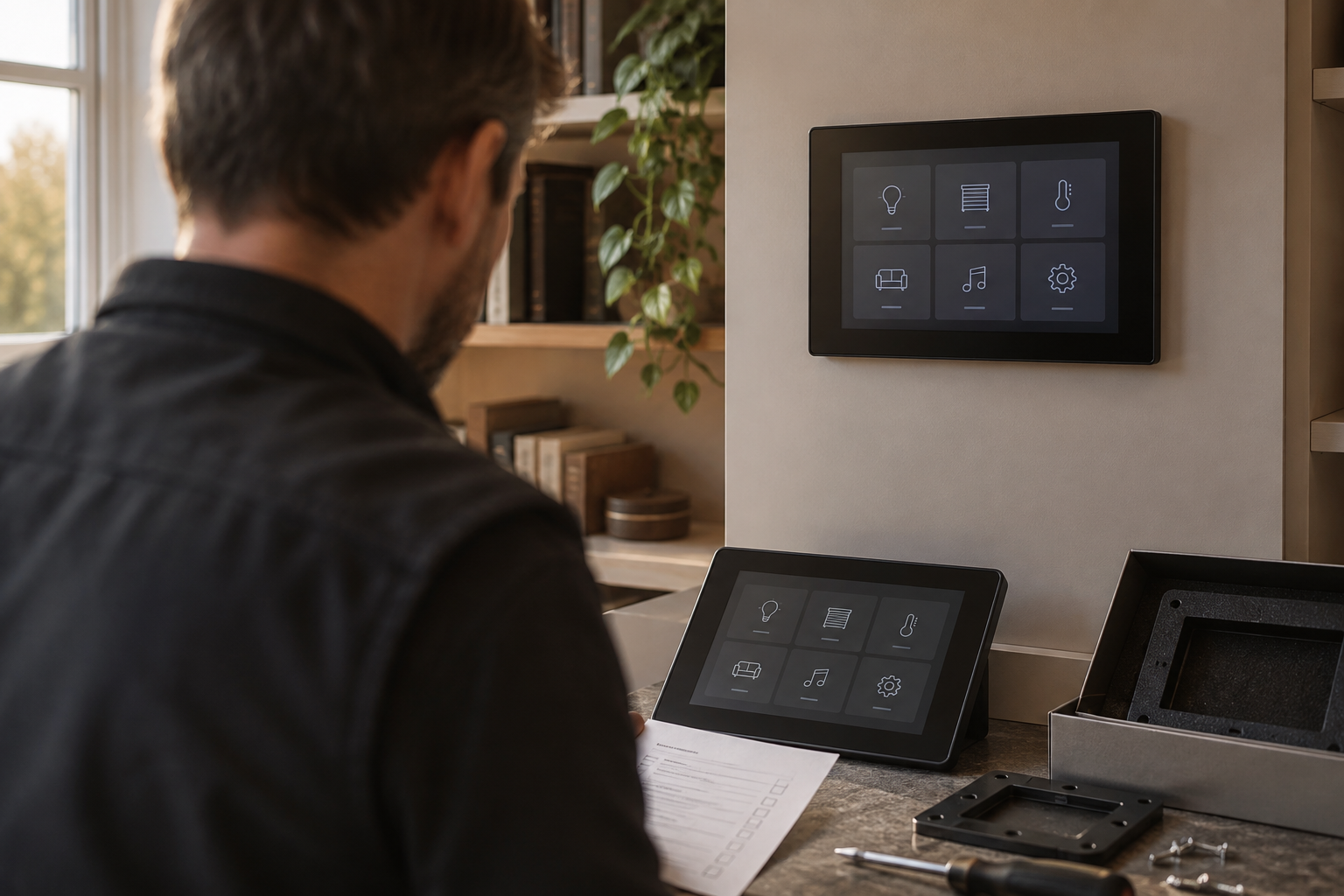
For an integrator, the practical consequence is to separate platform confidence from device approval. A tablet intended for occasional use has a different brief from a permanently mounted interface expected to remain powered and accessible every day. Mounting, charging, recovery after a restart and replacement availability need their own acceptance criteria, irrespective of the operating system’s commercial reach.
What people are saying
The rationale associated with the Motorola purchase was the protection of Android amid mobile-technology patent disputes. That supports a reading of Google as a company prepared to invest heavily in the ecosystem’s strategic position. It does not amount to a residential support commitment, and no promise of a particular home-control service life accompanies that transaction in the available facts.
Owners are likely to assess the issue in terms of continuity: whether a familiar interface can be repaired or replaced without changing how the house works. The useful question for their adviser is not simply whether Android will remain important, but whether the selected control application can be restored on a replacement device under documented conditions.
Integrators should read the same history through the division of responsibility. If an interface fails, the cause might sit with the device, its operating software or the control application. A service agreement should identify who diagnoses across those boundaries, rather than leaving the owner to establish which supplier’s component stopped responding.
There is also a distinction between legal continuity and technical suitability. In September 2025, US federal judge Amit Mehta ruled that Google would not be required to divest Android or Chrome, while barring exclusive Google Search contracts. As our coverage of the Android ruling and home-interface choices explains, the ownership question belongs alongside, rather than in place of, product-level assessment.
What happens next
The available facts contain no announced Motorola-derived residential controller, Raxium-based home-control screen or associated installation timetable. Neither acquisition should therefore be used to imply an imminent upgrade path for an existing home. Future products would need their own specifications, availability information and support terms before entering a project schedule.
For a live specification, the next useful document is a responsibility schedule. It should name the hardware supplier, control-application provider and integrator, with an agreed route for reporting faults. Where an owner supplies a personal device, the contract should distinguish that convenience interface from equipment included in the installation’s maintenance scope.
Commissioning should then test the selected device under the conditions it will actually face. Concrete checks include restarting it after loss of power, reopening the control application and confirming that agreed access restrictions remain in place. These are recommended acceptance tests, not claims that any particular Android device passes or fails them.
Software maintenance deserves a separate decision. The project team should establish who approves operating-system and application updates, how compatibility is checked and what happens if an update interrupts control. The distinction between identifying a software risk and maintaining a complete installation is also relevant to Google OSV-Scanner and smart-home software security.
Replacement planning should be agreed before the original interface becomes unavailable. Recording the device model, operating-system version, application version and required accessories gives the service team a starting point. A replacement unit should be tested against the same functional brief, rather than assumed equivalent because it also runs Android.
Why this matters
For a luxury residence, the value of Google’s Android strategy lies in understanding the platform’s origins and strategic backing—not in substituting corporate scale for an installation warranty. Motorola’s patents and Raxium’s engineering expertise belong in supplier due diligence; the owner’s contract should establish who restores room control, on what equipment and under which support obligations. That is the boundary between confidence in a technology company and confidence in the house itself.
Questions answered
+Why did Google buy Motorola Mobility?
Google acquired Motorola Mobility partly for its mobile-phone and wireless patents. The $12.5 billion transaction in May 2012 was intended to help defend Android in patent disputes and allow Google to continue offering it freely.
+How much did Google pay for Motorola Mobility?
Google acquired Motorola Mobility for $12.5 billion in May 2012.
+What is Raxium?
Raxium is a California-based microLED technology developer acquired by Google in May 2022. It was to join Google’s Devices and Services team, contributing expertise in micro-optics, monolithic integration and system integration.
+Does Google have to sell Android?
The September 2025 ruling by US federal judge Amit Mehta did not require Google to divest Android or Chrome. It did bar exclusive Google Search contracts.
+Who owns Google?
Google is a subsidiary of Alphabet. The restructuring was announced on 10 August 2015, when Sundar Pichai became Google chief executive.
+What should an Android home control specification include?
It should distinguish the device, operating system and control application, name the responsible suppliers, and establish update approval, commissioning tests and replacement arrangements. These are project recommendations, not guarantees supplied by Google’s acquisitions.
+Has Google announced a Raxium home control screen?
The available facts contain no announcement of a Raxium-based residential control screen or installation timetable. The acquisition establishes engineering capability, not a finished home-control product.
More in Latest Tech
 Latest Tech
Google Android ruling puts home interface choices in focus
The US decision left Android and Chrome with Google, but luxury-home specifications still need to distinguish familiar interfaces from dependable building control.
13 October 2026 · 5 min
 Latest Tech
Google Wiz deal puts home cloud security in focus
Google’s $32 billion agreement to acquire Wiz raises a practical question for connected properties: which parts of a home’s technology does cloud security actually protect?
14 October 2026 · 5 min
 Latest Tech
Google DeepMind and the limits of smart-home AI
Google’s AI research pedigree is substantial, but owners and integrators need to distinguish computing breakthroughs from the evidence required to automate a private home.
14 October 2026 · 5 min