BMW 3 Series brings panoramic iDrive to its 2027 cabin
BMW’s next petrol saloon combines a windscreen-wide information display with touchscreen-led controls, revised driver assistance and a performance feature arriving after launch.
By James Whitcombe · · 5 min read
Key facts
- 01BMW’s eighth-generation petrol 3 Series is scheduled to launch in early 2027, with US prices starting at $49,900.
- 02The 2027 BMW 3 Series combines panoramic iDrive with a 17.9-inch touchscreen controlling climate, driving modes and air vents.
- 03BMW 330 and 330 xDrive models produce 255hp and use an eight-speed Steptronic automatic gearbox.
- 04The BMW M350 xDrive replaces the M340i, producing 437hp and reaching 60mph in a stated 3.9 seconds.
- 05BMW schedules the M350 xDrive’s Drift Moment function for an over-the-air update during 2027, after launch.
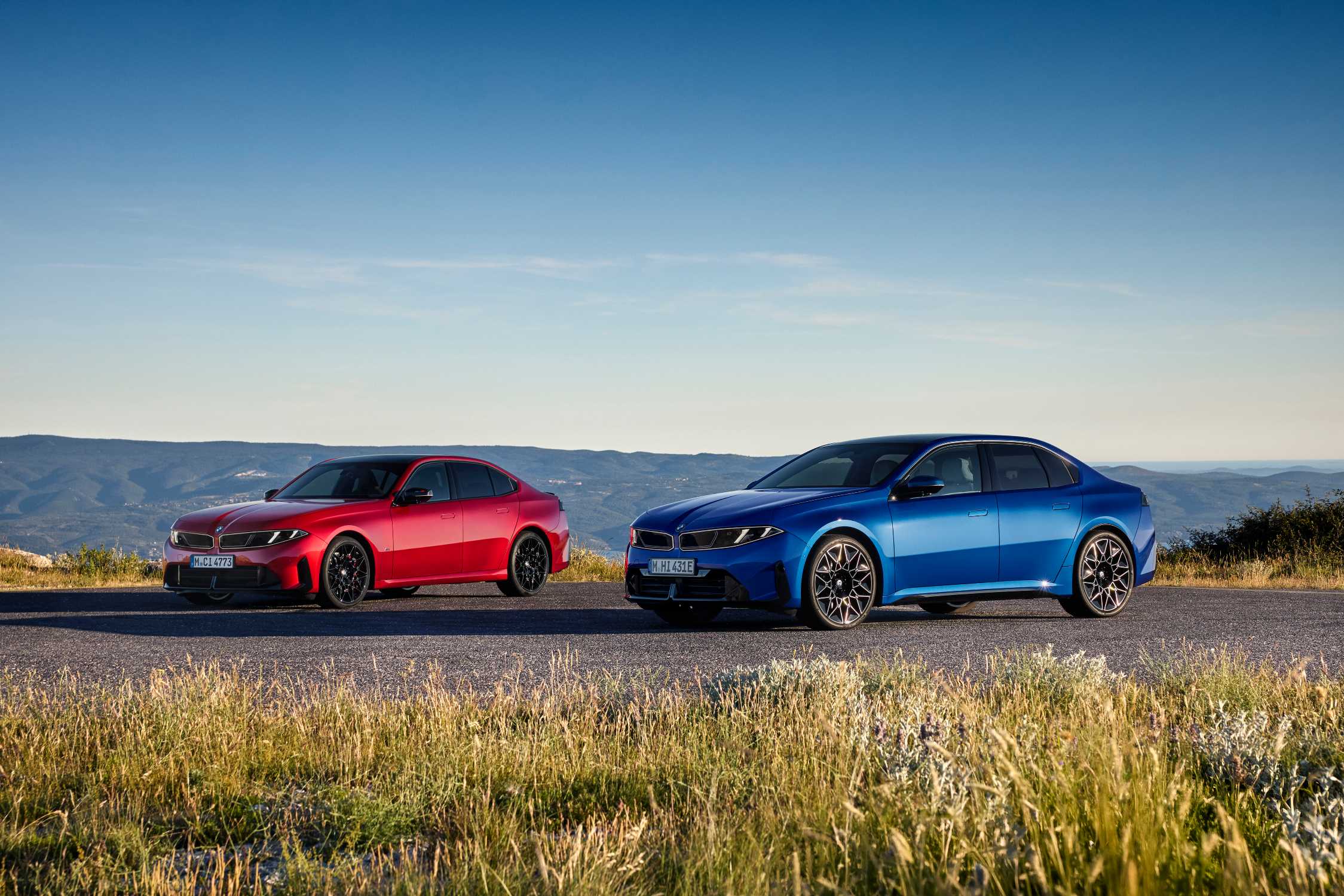
BMW has detailed the eighth-generation petrol 3 Series ahead of an early-2027 launch, with US prices starting at $49,900 and a cabin built around a 17.9-inch central touchscreen. The 330, 330 xDrive and M350 xDrive adopt Neue Klasse design and panoramic iDrive, bringing information across the base of the windscreen while moving more everyday controls into software.
What happened
The most consequential change is the division between information and operation. Panoramic iDrive projects onto a black band extending between the A-pillars, with the driver’s section showing speed, distance readings, engine revs, fuel level and assistance-system information. Other sections can be configured for music, weather or imagery from BMW’s Art Car collection.
The central screen handles climate settings, driving modes and even air-vent adjustment. Physical controls are substantially reduced, with retained functions including the hazard lights, gear selection and door controls. For buyers, the important distinction is that a more prominent information display does not necessarily mean fewer touchscreen interactions: the two systems perform different jobs.
The steering wheel also moves towards touch-sensitive operation. Its larger control surfaces provide haptic feedback and illuminate when the relevant functions are available. M Performance versions receive a separate steering-wheel treatment with dedicated toggles for M Mode and Boost, preserving direct access to those performance functions rather than placing every command on the central display.
Entertainment gains a TiVo-powered video app for watching television and films while stationary. This is parked-car viewing, not a claim of entertainment available to passengers throughout a journey. The distinction matters when assessing the feature’s usefulness for waiting at a marina, collecting passengers or taking a break between appointments.
US pricing is $49,900 for the rear-wheel-drive 330, $51,900 for the 330 xDrive and $65,900 for the M350 xDrive. Those are US-market figures, not an indication of British list prices or local equipment packages. UK buyers still need market-specific confirmation before making a meaningful specification comparison.
The background
Neue Klasse is not confined here to an electric drivetrain. The petrol 3 Series follows the design direction of the electric i3, whose i3 50 xDrive version has a stated US suggested retail price of $61,500. Series production of that electric model began in Munich in August; an i3 M60 xDrive is due to join the family in 2027.
That parallel development makes the cabin particularly significant. Buyers considering petrol and electric BMW saloons will encounter related design language rather than treating the digital interface as an exclusive benefit of the electric model. A powertrain decision and an interface decision are therefore becoming less tightly coupled, although equipment equivalence should not be assumed without comparing specifications.
Both 330 variants retain a turbocharged 2.0-litre four-cylinder engine producing 255hp and 400Nm, paired with an eight-speed Steptronic automatic gearbox. The stated 0–60mph time is 5.9 seconds for each. Their electronically limited maximum speed reaches 155mph when fitted with sport tyres, making the tyre qualification part of the specification rather than a footnote to ignore.
The M350 xDrive replaces the M340i with a 3.0-litre straight-six producing 437hp and 580Nm. Changes include a new turbocharger, revised intake ports and combustion chambers, and altered camshaft timing. Its stated 0–60mph time falls to 3.9 seconds, while the limited maximum remains 155mph: the performance premium primarily changes acceleration, not the quoted speed ceiling.
Outside, narrower kidney grilles, flush door handles and short overhangs establish the new shape. Wheels measure 19 inches as standard, with 20-inch alternatives offered, while yellow M lighting is optional. These are separate specification choices from the interface overhaul; the visual impact of a demonstrator should not be mistaken for its standard configuration.
What people are saying
The practical reading for owners is a change in how familiar tasks are reached. Temperature and vent adjustment now depend on the central interface, while instrument information sits higher in the cabin. A worthwhile demonstration should therefore cover routine operations with the car in use, not simply the clarity and scale of the displays when parked.
For custom integrators familiar with residential touchpanels, the steering wheel introduces a recognisable trade-off. Controls that appear only when available can reduce visual clutter, but they also make the interface state-dependent. Owners should check whether a desired function is consistently easy to locate; haptic confirmation tells a user that an input registered, not necessarily where to find it.
The TiVo app is best understood as an additional viewing location rather than a substitute for dedicated AV. The considerations explored in a large-screen living-room projection system—viewing position, screen environment and installation—remain different from those of a parked cabin. The announcement does not establish equivalent picture or sound performance, nor should a screen diagonal imply it.
There is also a distinction between entertainment embedded in the vehicle and media that travels with its owner. A dedicated portable hi-res audio player addresses listening beyond any one room or car; BMW’s video provision is tied to the dashboard and its permitted operating conditions. Neither proposition establishes compatibility with the other, and the supplied specifications give no basis for assuming it.
What happens next
The launch is scheduled for early 2027. Standard assistance equipment includes adaptive cruise control, speed-limit assistance, lane keeping and steering assistance. Buyers should pay particular attention to the revised adaptive-cruise behaviour: pressing the brake no longer switches the system off completely, but instead adjusts its set speed to the lower speed requested by the driver.
That change deserves a proper handover explanation because it alters the meaning of a familiar action. An owner accustomed to brake input cancelling cruise control should not have to discover the difference in traffic. It is a concrete example of why software behaviour can matter as much as the presence of an assistance feature on an equipment list.
Lane-keeping intervention is also revised. Eye-tracking and steering-angle information help the system assess whether an unsignalled movement across a lane appears deliberate, rather than immediately steering the car back. This remains assistance, not permission to omit signalling; the relevant test is whether intervention feels predictable without encouraging misplaced confidence in the car’s interpretation.
The M350 xDrive’s Drift Moment function will not be available at launch. Scheduled for an over-the-air update during 2027, it can reduce or disengage drive to the front axle to enable rear-drive-style behaviour. Buyers interested in that capability should distinguish a scheduled software addition from equipment they can demonstrate at delivery, and reserve any such use for an appropriate controlled environment.
Why this matters
For premium-car owners, the new 3 Series makes interface design a purchasing criterion alongside engine and chassis specification. The decisive showroom exercise is no longer merely selecting a preferred display layout: it is checking access to climate controls, understanding changed assistance behaviour and separating delivered functionality from promised updates. Those are the same disciplines that make sophisticated technology usable in a well-designed home.
Questions answered
+When does the 2027 BMW 3 Series launch?
BMW has scheduled the new petrol 3 Series for early 2027. The range comprises the 330, 330 xDrive and M350 xDrive.
+How much does the 2027 BMW 3 Series cost?
US prices start at $49,900 for the 330, $51,900 for the 330 xDrive and $65,900 for the M350 xDrive. These figures do not establish UK pricing.
+What is BMW panoramic iDrive?
Panoramic iDrive projects information onto a black band across the base of the windscreen. The driver’s section displays essential vehicle information, while other sections can show configurable content including music and weather.
+Does the 2027 BMW 3 Series have physical climate controls?
Climate settings and air-vent adjustment are operated through the 17.9-inch central touchscreen. Retained physical controls include hazard lights, gear selection and door controls.
+Can you watch films in the new BMW 3 Series?
A TiVo-powered video app allows television and film viewing while the car is stationary. The announced feature is not described as passenger video playback during driving.
+How powerful is the BMW M350 xDrive?
The M350 xDrive has a 3.0-litre straight-six producing 437hp and 580Nm. BMW states a 0–60mph time of 3.9 seconds and an electronically limited maximum speed of 155mph.
+When will BMW M350 xDrive Drift Moment be available?
Drift Moment is scheduled to arrive through an over-the-air software update during 2027, rather than at launch. The function reduces or disengages front-axle drive to enable rear-drive-style behaviour.
More in Cool Stuff
 Cool Stuff
Astell & Kern SR35 takes hi-res audio beyond the listening room
Expandable storage, three headphone connections and USB DAC functionality make Astell & Kern’s SR35 worth considering as more than a travelling music library.
7 October 2026 · 5 min
 Cool Stuff
Epson QS100: what a 140-inch living-room system demands
A household evaluation of Epson’s projector and EPV’s rising screen highlights the installation decisions behind convincing large-screen viewing in a shared living room.
7 October 2026 · 5 min
 Cool Stuff
PMC Prophecy speakers put room size before cabinet size
PMC’s replacement for its Twenty 5i range highlights why bass loading, listening distance and placement deserve as much attention as a loudspeaker’s dimensions.
7 October 2026 · 5 min