Astell & Kern PD5 brings streaming apps to portable hi-fi
The SR35’s replacement combines expandable local storage, Google Play access and two headphone outputs, with practical implications for listening at home and away.
By Callum Reid · · 5 min read
Key facts
- 01Astell & Kern PD5 replaces the A&norma SR35 in the company’s entry-level high-resolution player position.
- 02Astell & Kern PD5 has 64GB internal storage and supports microSD expansion by up to 1.5TB.
- 03Astell & Kern PD5 supports native DSD256 and PCM playback up to 32-bit/384kHz.
- 04Astell & Kern PD5 provides 3.5mm and 4.4mm balanced headphone outputs.
- 05Astell & Kern PD5 offers Google Play Store access and dual-band 2.4GHz/5GHz wi-fi.
Astell & Kern’s PD5 replaces the A&norma SR35 as the company’s entry-level high-resolution music player, combining 64GB of storage with streaming-app access and two wired headphone outputs. As of 13 October 2026, the model brings a broader set of listening options to buyers considering a dedicated source for home and travel, although the available information does not establish a UK launch date or exact price.
What happened
The PD5 supports native DSD256 playback and PCM files up to 32-bit/384kHz. Those specifications accommodate demanding high-resolution libraries, but the more immediately useful provision for many owners is its combination of a conventional 3.5mm headphone socket and a 4.4mm balanced output.
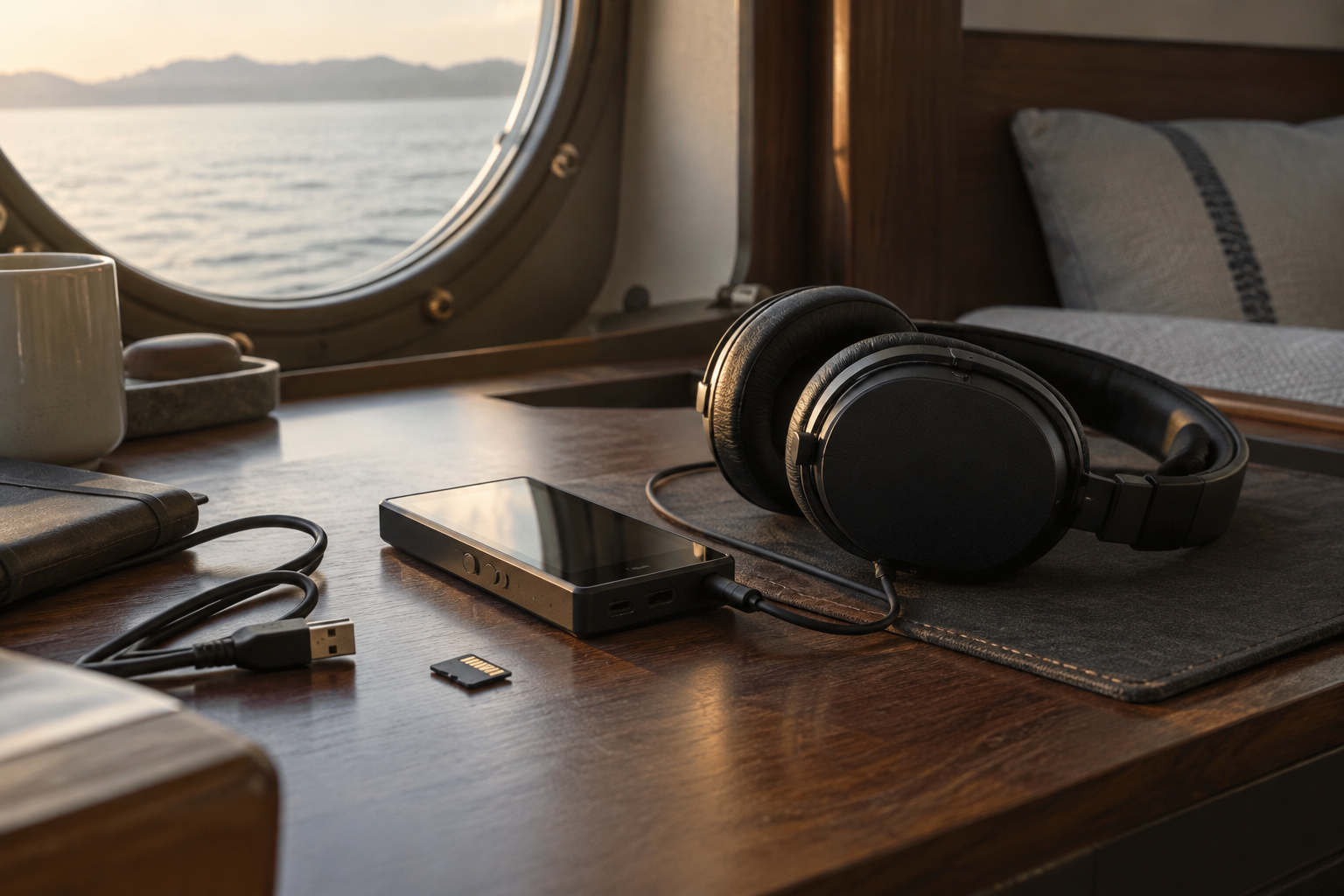
Internal storage can be supplemented with a microSD card of up to 1.5TB. That makes the PD5 a potential travelling library rather than merely a streaming terminal: owners can keep purchased or ripped music on the device without needing a live internet connection to play those files.
Dual-band wi-fi operates at 2.4GHz and 5GHz, while Google Play Store access allows the installation of services including Tidal, Qobuz, Amazon Music, Deezer and Apple Music. The player therefore accommodates both file collectors and subscribers, rather than requiring buyers to commit to one method of obtaining music.
Bluetooth support includes aptX HD, LDAC and LHDC. For a wired desktop arrangement, the PD5 can also serve as a digital-to-analogue converter between a laptop and headphones, giving it a second role when it is not being carried around.
The replacement carries a higher price than the SR35, although no precise figure is established in the supplied specifications. That prevents a meaningful calculation of its price premium or a firm value comparison with other players; entry-level here describes its position within Astell & Kern’s range, not an inexpensive purchase.
The background
Dedicated audio players now occupy a different position from the mass-market MP3 devices they once succeeded. Their argument is less about making music portable—phones already do that—and more about providing headphone connections, substantial local storage and a listening environment separate from messages, calls and other everyday interruptions.
The PD5 follows a player whose appeal centred on carrying a serious music library beyond the main system. Our examination of the Astell & Kern SR35 as a portable high-resolution source provides the relevant predecessor context, but existing owners should assess the replacement against their actual headphones and library rather than assume a newer model requires an upgrade.
A high maximum sample rate is a compatibility specification, not a guarantee of superior listening. Playing a 16-bit/44.1kHz recording through equipment capable of 32-bit/384kHz does not add information missing from the original file; recording quality, mastering and the headphone partnership remain important considerations.
The same distinction applies to balanced connections. A 4.4mm socket gives owners of appropriately wired headphones another connection option, but the connector alone says little about the amplifier’s suitability for a particular load. Output-power figures and headphone requirements matter more than choosing a socket by reputation.
Storage also deserves closer attention than the headline capacity suggests. Operating software and applications occupy part of a player’s internal memory, so 64GB should not be treated as an entirely available music allocation. For a substantial high-resolution collection, the memory card belongs in the initial purchasing plan rather than becoming an afterthought.
Sony’s NW-A306 illustrates a different compromise within the same category. It has 32GB of internal storage, of which roughly half is available to the user, a 3.5mm headphone connection and USB-C functions covering charging, file transfer and DAC use. Its Android platform similarly provides access to streaming applications.
At the other end of the range, Astell & Kern’s A&ultima SP3000 supports PCM up to 32-bit/768kHz and DSD512, with 256GB of internal storage. An SP4000 successor is also available. Those higher-tier models show why the PD5 should be judged on its own practical balance, not as a substitute for every capability offered above it.
What people are saying
For owners, the PD5’s combination of local files and streaming is likely to be more consequential than its largest resolution figures. A single device can hold a permanent personal collection while also providing access to subscription catalogues, reducing the need to maintain separate listening arrangements for each.
For headphone enthusiasts, the missing information is just as important as the advertised compatibility. The available material does not establish amplifier output, battery endurance under different listening conditions or performance with especially demanding headphones. A demonstration should therefore use the intended pair, not simply whichever headphones happen to be attached in a showroom.
Integrators are likely to see the USB DAC function as a useful personal-listening facility rather than evidence of whole-home integration. Nothing in the available specifications establishes a control-system interface, multiroom synchronisation or an automation API. A portable player should not be specified as an installed music server without checking those requirements separately.
Owners considering a connection to a room system should also distinguish personal-source flexibility from complete system design. The importance of matching components to their setting, explored in our coverage of PMC Prophecy speakers and room-size considerations, remains relevant: an impressive source specification does not resolve loudspeaker placement or room acoustics.
What happens next
The immediate purchasing questions are the UK selling price, stock availability and the conditions of local support. There is no confirmed dated rollout in the available information, so buyers should obtain those details directly before attaching the PD5 to a project budget or a travel deadline.
A useful audition would test locally stored files, the preferred streaming application and USB DAC operation separately. Those are distinct workflows, involving different software and connections; a player that performs well with a memory card may still need closer scrutiny for the way an owner intends to use a laptop or subscription service.
Wireless listening requires its own compatibility check. Bluetooth codec support must align between player and headphones, and the presence of LDAC, aptX HD or LHDC on the PD5 does not mean every wireless headset will use one of them. The intended pairing should be checked rather than inferred from either product’s headline specification.
For yacht and air travel, loading local files before departure is the clearest way to avoid dependence on connectivity. Subscription downloads are a separate matter governed by the relevant application and account, so owners should verify offline behaviour before relying on a playlist during a passage or flight.
Why this matters
The PD5 presents a useful procurement question for premium listening: whether a dedicated personal source can earn its place across travel, desk and headphone use. Its expandable storage, streaming access and DAC function make that proposition credible on features; the decision should turn on a verified price, suitable headphone drive and dependable everyday operation, rather than resolution figures alone.
Questions answered
+What is the Astell & Kern PD5?
The PD5 is a dedicated high-resolution portable music player that replaces the A&norma SR35 in Astell & Kern’s entry-level position. It supports local music files, streaming applications and use as a laptop-connected DAC.
+How much storage does the Astell & Kern PD5 have?
The PD5 has 64GB of internal storage and accepts a microSD card of up to 1.5TB. Software and applications use some internal capacity, so the full 64GB should not be assumed available for music.
+Can the Astell & Kern PD5 use Apple Music and Tidal?
Yes. Google Play Store access allows installation of Apple Music, Tidal, Qobuz, Amazon Music and Deezer. The PD5 has dual-band 2.4GHz and 5GHz wi-fi.
+Does the Astell & Kern PD5 have a balanced headphone output?
Yes. It provides a 4.4mm balanced headphone output alongside a conventional 3.5mm socket. Headphone suitability should still be checked against amplifier capability rather than inferred from the connector.
+What audio formats does the Astell & Kern PD5 support?
The stated high-resolution playback capabilities include native DSD256 and PCM up to 32-bit/384kHz. These limits describe file compatibility, not a guarantee that every recording will sound better.
+Can the Astell & Kern PD5 work as a USB DAC?
Yes. The PD5 can function as a DAC between a laptop and wired headphones, allowing it to serve as a desktop listening device as well as a portable player.
+Can the Astell & Kern PD5 play music without wi-fi?
Yes. Music files stored internally or on a microSD card can play without a live internet connection. Offline playback through subscription services depends on the relevant application and account.
More in Hi-Fi
 Cool Stuff
Astell & Kern SR35 takes hi-res audio beyond the listening room
Expandable storage, three headphone connections and USB DAC functionality make Astell & Kern’s SR35 worth considering as more than a travelling music library.
7 October 2026 · 5 min
 Cool Stuff
Neurable One brings EEG focus tracking to everyday headphones
Neurable’s US$499 headphones combine wireless audio with brain-signal tracking, offering a new kind of feedback for the home office—with important limits.
8 October 2026 · 5 min
 Latest Tech
Google Android ruling puts home interface choices in focus
The US decision left Android and Chrome with Google, but luxury-home specifications still need to distinguish familiar interfaces from dependable building control.
13 October 2026 · 5 min