Lutron and Homeplay put daylight-led lighting on show at Decorex
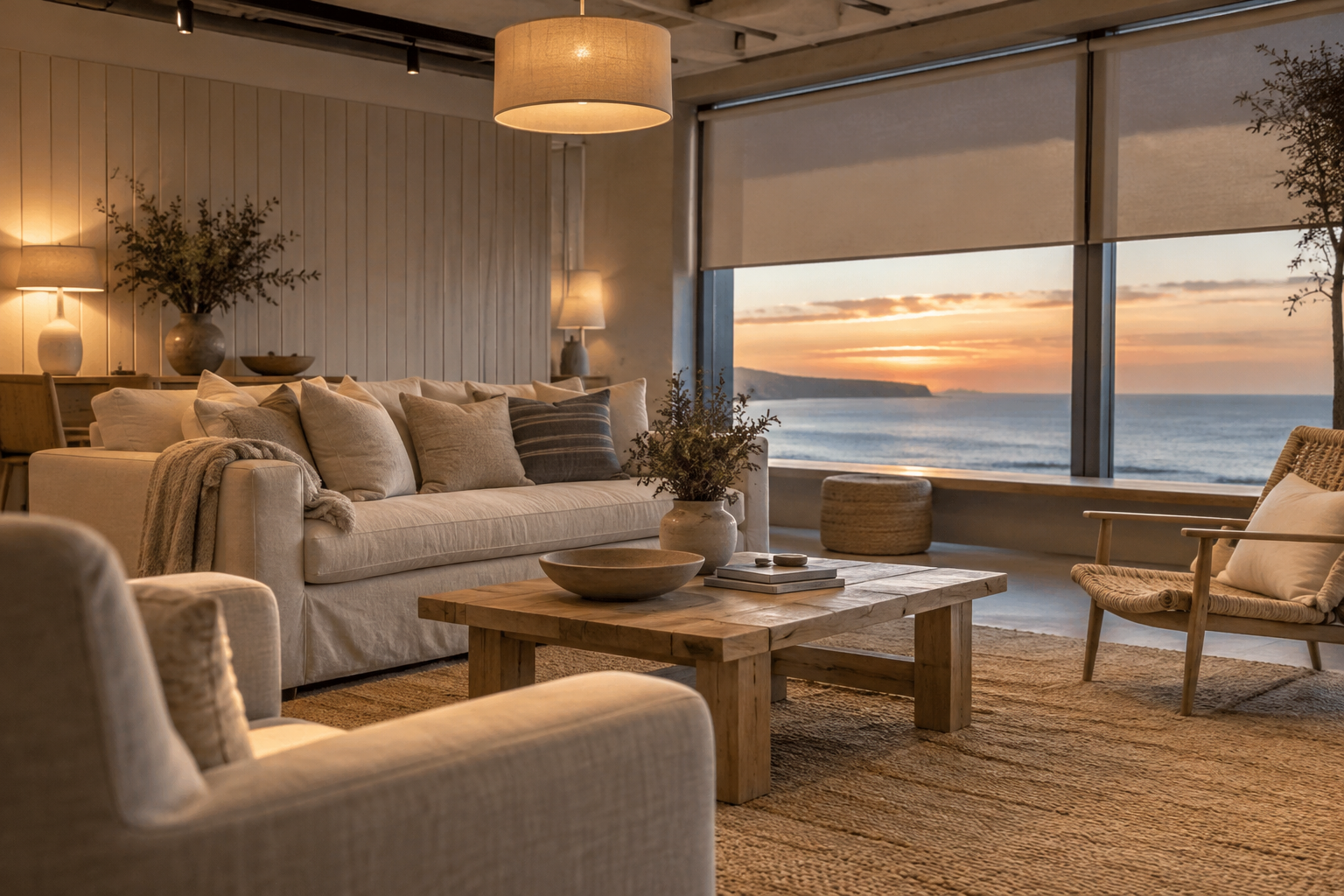
A coastal interior by Hill House Interiors uses Lutron Ketra lighting to demonstrate why lighting control belongs in the earliest stages of residential design.
By James Whitcombe · · 5 min read
Key facts
- 01Lutron, Homeplay and Hill House Interiors created The Beach House for Decorex 2026 at Olympia London.
- 02The Beach House compresses a full day of changing light into a three-minute demonstration.
- 03Lutron’s Intelligent Lighting platform, featuring Ketra, combines changing light tones and dimming within the installation.
- 04Hill House Interiors is responsible for The Beach House’s creative direction and interior design.
- 05Lutron features in three Decorex settings, including the Sustainability Stage and Claudia Dorsch’s VIP Lounge.
- 06Decorex 2026 runs from 11–14 October; no residential package pricing is provided for The Beach House.
Lutron, Homeplay and Hill House Interiors have created The Beach House at Decorex 2026, held at Olympia London from 11–14 October, using a three-minute lighting sequence to depict a full day. The coastal-themed installation brings lighting, shading and interior design together to show how a room can change without altering its furnishings.
What happened at Decorex
Hill House Interiors has taken responsibility for creative direction and interior design, working with luxury residential technology integrator Homeplay and lighting-control specialist Lutron. Rather than presenting equipment in isolation, the collaboration places it within a furnished setting where visitors can judge its effect on the room.
The demonstration follows an external scene from sunrise to sunset while the interior changes alongside it. Lutron’s Intelligent Lighting platform, featuring Ketra full-spectrum lighting, supplies a progression through cooler morning tones, brighter midday conditions and warmer afternoon settings. The final stage reduces the light to a low, candlelight-like appearance.
Shading forms part of the experience alongside the electric lighting and controls. That is a significant inclusion: in a real home, daylight entering through glazing can compete with a carefully programmed interior scene. Treating the window and the luminaires as parts of one design makes the demonstration more relevant to residential specification than a display of colour-changing lamps alone.
Lutron also appears in two other Decorex spaces. It is providing lighting and shading for the Sustainability Stage, a domestic-style discussion setting designed by interior commentator Kate Watson-Smyth. Its third presence is in Claudia Dorsch’s VIP Lounge, Back to the Future, The Chalet Reimagined, which combines an alpine-inspired interior with natural materials, changing soundscapes and sensory elements.
Those additional settings broaden the design context, but they do not establish measured sustainability or wellbeing outcomes. The announcement supplies no energy-use figures for the installations, and the Beach House sequence is a demonstration of changing ambience rather than a published performance test.
The background
The Beach House follows Homeplay’s Serengeti Living installation at Decorex 2025. The move from a savannah-inspired environment to a coastal interior gives the integrator a different architectural and decorative setting in which to demonstrate environmental control. Hill House Interiors’ involvement places a design practice directly within that process, rather than leaving the technology specialist to define the room alone.
The underlying distinction is between controlling how much light a room receives and controlling its character. Conventional dimming principally changes output; a tunable lighting scheme can also vary the apparent warmth or coolness of the illumination. Ketra’s role here is to combine those changes within a sequence intended to evoke daylight at different times.
For an interior designer, this introduces another variable into material selection. Timber, stone, fabrics and painted finishes are seen under the light that reaches them, not independently of it. Reviewing samples under only one lighting condition can therefore leave important evening or daytime appearances untested. A demonstration that moves between settings makes that relationship easier to assess.
The three-minute format also exposes a difference between exhibition storytelling and daily use. A rapid transition makes the system’s range obvious to a visitor; a residential programme would need to suit occupancy, activities and personal preferences. Owners may want stable task lighting for reading or cooking even when a scheduled scene is moving towards a softer evening setting.
There is a parallel with architectural audio designed to disappear into interiors: the experience can be prominent while the equipment is deliberately unobtrusive. For lighting, however, visual discretion still requires practical decisions about luminaire positions, glare, access and the location of control equipment. Concealment is a design task, not simply a product attribute.
At the wider systems level, lighting and shading also need a defined relationship with other building services. The questions explored in where KNX and building management systems divide responsibility are relevant to that planning discipline. Nothing in the Beach House announcement specifies a KNX connection or a particular whole-home integration architecture.
What people are saying
Homeplay founder and managing director James Ratcliffe describes intelligent lighting as something occupants register through the quality of a space rather than through conscious attention to the equipment. Drawing on his own use at home, he says the daytime effect can feel like daylight indoors. That is a personal account of the experience, not an independently measured equivalence to natural light.
Ratcliffe also presents Lutron as a longstanding partner and Ketra as a way of giving designers greater freedom to adapt illumination to the time of day and family routines. His emphasis is on the integrator supplying an adjustable design medium. For a client, the practical question is how those possibilities become a manageable set of everyday controls.
Shaun Gumbs, Lutron’s Residential Sales Manager, uses the company’s presence across the three Decorex settings to argue for lighting decisions at the beginning of a project. His position is that lighting should help establish the interior, rather than arrive after the principal design choices have been settled.
That argument has a concrete consequence for procurement. If the lighting designer, interior designer and integrator are appointed on disconnected schedules, decisions about ceilings, curtain pockets and wiring may be fixed before the desired scenes are understood. Early coordination gives the team an opportunity to resolve those dependencies before installation makes changes more disruptive.
What happens next
Decorex runs until 14 October. The announcement does not set out a subsequent tour for The Beach House, a packaged residential offering or UK project pricing. Nor does it identify a newly launched Ketra model; the news is the collaboration and its application of the platform in a designed environment.
For an owner considering a similar approach, the next useful step would be a project-specific demonstration using proposed finishes. A showroom sequence can establish an aesthetic preference, but it cannot determine the effect of a particular home’s glazing, orientation or room proportions. Those conditions belong in the lighting brief before equipment quantities are agreed.
The control brief needs equal attention. The installation description does not establish whether its sequence uses a timer, sensors, manual triggering or a combination. Buyers should distinguish between a programmed presentation and a system that responds to actual conditions, then specify which behaviour they want in each room.
Commissioning questions should include how occupants interrupt a scene, how individual rooms retain their settings and who adjusts the programme after occupation. No details of those arrangements are supplied for The Beach House. Establishing them would turn the visual ambition demonstrated at Decorex into a maintainable residential installation.
Why this matters
For owners and project teams, The Beach House makes lighting easier to discuss as part of the interior rather than as a separate electrical package. Its strongest use is as a briefing reference: a way to agree the desired experience before specifying the controls behind it. The value for a luxury home will depend on translating that shared design intent into room-by-room decisions, usable overrides and a clear commissioning remit.
Questions answered
+What is Lutron’s Beach House at Decorex 2026?
The Beach House is a coastal-themed installation created by Lutron, Homeplay and Hill House Interiors. It demonstrates how lighting, shading and controls can change the experience of a furnished interior.
+How long is the Beach House lighting demonstration?
The demonstration lasts three minutes, compressing a day from sunrise to sunset into a sequence of changing exterior scenes and interior lighting.
+What lighting system does the Decorex Beach House use?
The installation uses Lutron’s Intelligent Lighting platform, featuring Ketra full-spectrum lighting. Its sequence moves through cooler morning tones, brighter midday conditions and warmer evening settings.
+Who designed the Beach House at Decorex?
Hill House Interiors is responsible for creative direction and interior design, working with residential technology integrator Homeplay and lighting-control specialist Lutron.
+Where and when is Decorex 2026?
Decorex 2026 takes place at Olympia London from 11–14 October.
+Is Lutron launching a new Ketra product at Decorex?
The Beach House announcement does not identify a newly launched Ketra model. It focuses on a collaborative installation demonstrating the platform within a designed interior.
+How much does the Lutron Beach House lighting system cost?
No residential package price or project cost is provided. The Beach House is presented as a demonstration rather than a priced whole-home installation.
More in Latest Tech
 Latest Tech
Google Android ruling puts home interface choices in focus
The US decision left Android and Chrome with Google, but luxury-home specifications still need to distinguish familiar interfaces from dependable building control.
13 October 2026 · 5 min
 Latest Tech
Google OSV-Scanner and the smart-home software security gap
Google’s open-source vulnerability tool offers a useful reference point for integrators assessing the software behind bespoke home technology.
13 October 2026 · 5 min
 Latest Tech
Google cloud outages and the connected home’s resilience plan
Google’s historical service interruptions offer a practical lesson for luxury homes: internet access, cloud availability and local control need separate resilience plans.
13 October 2026 · 5 min