Toyota walk me wins Red Dot’s top concept design award
Toyota’s four-legged mobility chair puts stair-climbing and adjustable seating into an award-winning concept, raising practical questions for accessible home design.
By Amara Okafor · · 5 min read
Key facts
- 01Toyota walk me won the 2026 Red Dot: Luminary, the Design Concept programme’s highest honour.
- 02Toyota walk me uses four robotic legs and is designed to climb steps and move sideways.
- 03Toyota reports developing walk me from idea to working prototype in 10 months.
- 04Misako Kawata designed Toyota walk me under team lead Takashi Nishimura.
- 05Toyota has announced no price, release date or production plans for walk me.
Toyota’s walk me robotic mobility chair has won the 2026 Red Dot: Luminary, the highest honour in the Red Dot Award: Design Concept programme. First shown at the Japan Mobility Show in 2025, the four-legged concept is designed to negotiate steps, move sideways and raise its occupant towards standing eye level; Toyota has announced neither a price nor a release date.
What happened
The award recognises a proposal to change how personal mobility equipment interacts with buildings. Rather than relying on wheels and a continuously traversable surface, walk me uses four robotic legs to address obstacles such as stairs and kerbs. Its intended territory includes domestic interiors, outdoor routes and connections with cars and public transport.
Misako Kawata designed the concept under team lead Takashi Nishimura. Toyota reports that the project progressed from an idea to a working prototype in 10 months, using AI gait control and metal additive manufacturing. That development period describes prototype creation, not the completion of a production-ready mobility aid.
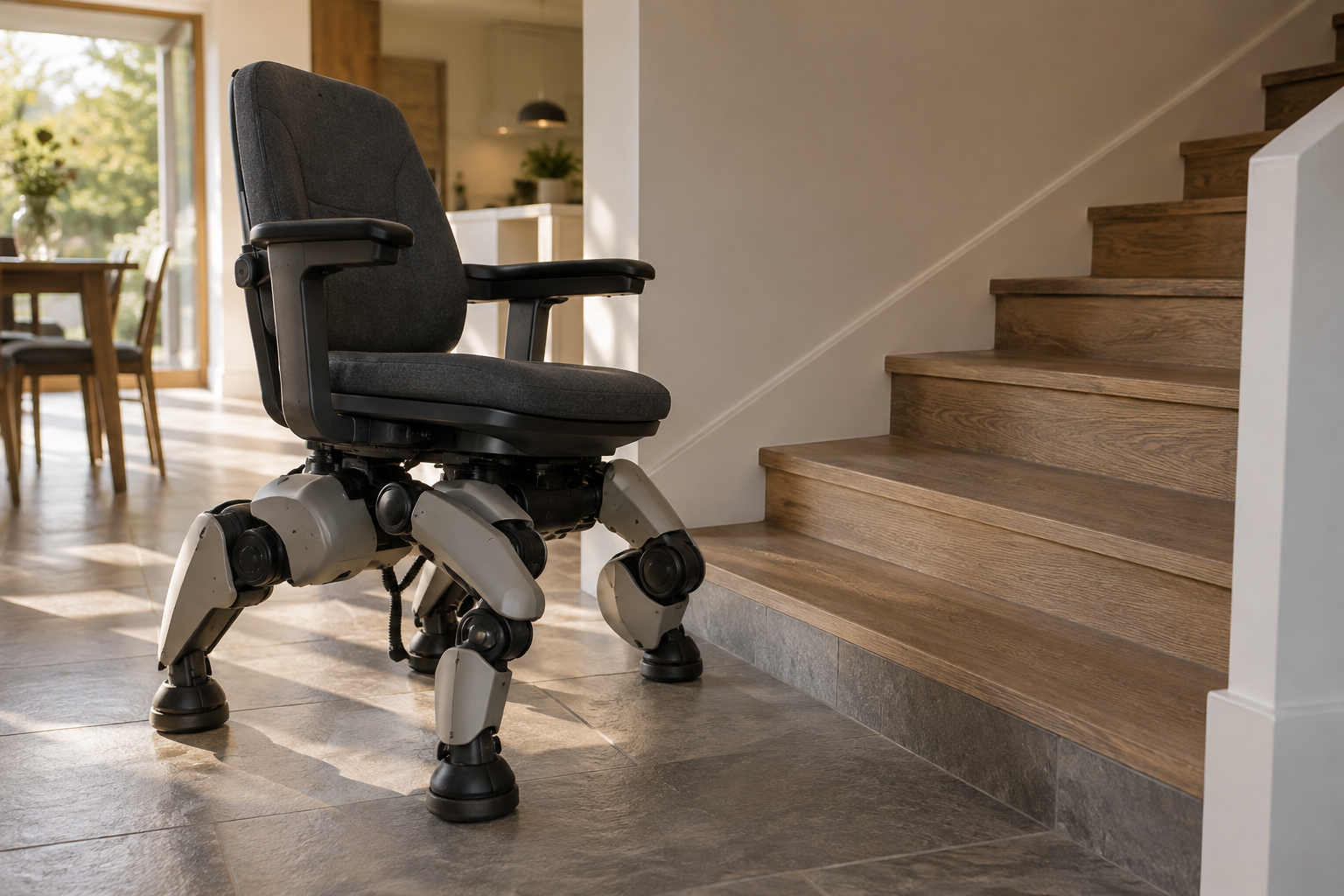
The seat’s movement is central to the design. The legs can lower the chair for boarding and raise it for conversation with standing people, while lateral movement is intended to help negotiate confined spaces. These functions address transfers, social interaction and manoeuvring as well as the more conspicuous challenge of climbing steps.
Red Dot selected walk me for its Luminary distinction from the programme’s Best of the Best winners. This is a concept design award, not evidence of commercial availability or independently established operating limits. No production plans have been announced, so an owner cannot yet treat the chair as equipment available for a residential project.
The background
A conventional wheelchair and a walking mobility machine make different demands on architecture. Wheels generally favour continuous routes, suitable gradients and sufficient turning space; articulated legs could potentially negotiate changes in level without a ramp. That possibility is particularly relevant to existing homes, where altering a staircase or introducing a lift can be a substantial intervention.
The distinction does not make accessible architecture redundant. A house must still support safe transfers, usable bathrooms, adequate circulation and evacuation. Even if a walking chair eventually handles a particular staircase, that would not establish that every resident, visitor or emergency responder could use the same route safely.
Toyota has also treated appearance as part of the accessibility brief. The concept covers its mechanical joints with 3D-knitted fabric and uses a felt-like body, grey seating and housing, and chartreuse legs. The approach places a technically complex machine closer to the visual language of domestic furniture than exposed industrial robotics.
That textile treatment carries a connection to Toyota’s origins in loom manufacturing under Sakichi Toyoda. At the Japan Mobility Show, the company traced its robotics heritage to the Toyoda Automatic Loom Type G. In walk me, however, the fabric conceals a topologically optimised internal frame intended to provide strength without unnecessary weight.
Topology optimisation distributes material according to structural requirements rather than simply preserving a conventional solid shape. Paired with additive manufacturing, it can enable complex structures that are difficult to make through traditional fabrication. Neither technique, by itself, establishes the finished chair’s payload, durability or serviceability; those remain separate engineering questions.
The project also illustrates why artificial intelligence in the home extends beyond conversational assistants. Here, AI is associated with gait control: the physical behaviour of a machine carrying a person. That makes reliable motion and predictable responses more consequential than a persuasive interface or an extensive list of software features.
What people are saying
Toyota positions walk me within its Mobility for All ambition, linking movement with independence and dignity. Its design brief identifies stairs as a psychological barrier as well as a physical obstruction: knowing that a route may be inaccessible can constrain a journey before it begins. The concept responds by attempting to expand the routes available to its occupant.
The company also draws on omotenashi, the Japanese idea of hospitality, to explain the chair’s welcoming posture. Its lowered stance is intended to suggest a bow. In practical domestic terms, that gesture brings the boarding position and the machine’s perceived approachability into the same design decision, rather than treating styling as a separate finishing exercise.
For owners and residential designers, the likely attraction is flexibility within an existing interior. A chair able to manage changes in level could offer another option where a split-level plan complicates circulation. The appropriate reading is a potential addition to an accessibility strategy, however, not an established alternative to lifts or step-free routes.
Integrators are likely to focus on the boundary between the mobile machine and the house. Charging arrangements, storage, assistance during a fault and the space needed for transfers would all require coordination if a production version emerged. There is no announced smart-home interface in the available details, and no basis for assuming integration with KNX or another control platform.
Like Kyushu University’s headset-free VR chair, walk me makes seating an active part of a technological system, rather than a passive accessory. The applications are very different, but both underline a useful specification principle: the occupant’s physical relationship with the equipment deserves as much attention as the underlying electronics.
What happens next
Toyota has supplied no timetable for a saleable walk me chair. Without an announced production programme, there is no confirmed purchasing route or installation schedule for homeowners and their advisers. The immediate significance is recognition of the design direction, rather than a new product entering an accessibility specification.
A meaningful next-stage assessment would need defined stair limits, operating duration, maximum occupant weight and performance on different surfaces. The available information does not establish those figures. Nor does it provide independent evidence showing how the chair behaves when a route becomes obstructed or a step differs from the expected geometry.
Maintenance deserves equal attention. Textile-covered joints create a more domestic appearance, but prospective buyers would need to understand cleaning, inspection and access for repairs. For a device supporting everyday mobility, service arrangements and recovery from a fault would be ownership considerations, not details to resolve after delivery.
Residential teams should therefore continue designing around established access requirements while watching for production specifications and testing. Concept recognition can justify a conversation about future possibilities; it cannot justify reducing the provision of dependable access in a home being designed or refurbished now.
Why this matters
Toyota’s award puts personal mobility robotics into a discussion usually dominated by fixed architectural adaptations. For owners of complex or multilevel homes, the important prospect is greater freedom to use the interior, not simply a more unusual chair. The design opportunity is substantial, but the specification threshold should remain demanding: demonstrated safety, suitable operating limits and dependable support must precede any decision to make a home reliant on walking mobility equipment.
Questions answered
+What is Toyota walk me?
Toyota walk me is a robotic mobility chair concept that replaces wheels with four articulated legs. It is designed to negotiate steps, move sideways and adjust its seating height.
+What award did Toyota walk me win?
Toyota walk me won the 2026 Red Dot: Luminary, the highest honour in the Red Dot Award: Design Concept programme.
+Can Toyota walk me climb stairs?
Stair-climbing is an intended capability of the concept. The available information does not establish specific stair limits or provide independent evidence of its performance across different stair geometries.
+How much does Toyota walk me cost?
Toyota has not announced a price for walk me. It remains a concept rather than an available commercial mobility chair.
+When will Toyota walk me be available?
Toyota has announced neither a release date nor production plans. The concept first appeared at the Japan Mobility Show in 2025.
+Who designed Toyota walk me?
Misako Kawata designed walk me under team lead Takashi Nishimura. Toyota reports that development from idea to working prototype took 10 months.
+Can Toyota walk me replace a stairlift?
It cannot yet be specified as an established alternative. Toyota has not announced a production version, and the available details do not establish the operating limits needed to assess suitability for a particular home.
More in Awards
 Awards
Yacht Intelligence wins Crestron marine award for Valor
The Feadship project takes the above-60-metre installation award, recognising an approach to onboard AV, control and IT centred on discreet operation.
7 October 2026 · 5 min
 Cool Stuff
Tesla Roadster targets 2028 with thrusters and a track-only Rocket
Tesla’s redesigned Roadster promises fan-assisted grip and compressed-gas acceleration, but its aerial flagship is track-only and final prices remain unclear.
16 October 2026 · 5 min
 KNX, Energy & Solar
TSUN brings solar kits and retrofit batteries to UK homes
TSUN’s UK offering combines small-scale solar, DC-side storage and retrofit batteries, with wired export control among the details worth examining.
16 October 2026 · 5 min