Kyushu University’s VR chair removes the headset
A chair-mounted optical system explores headset-free virtual reality, with potential for private entertainment spaces but significant questions over brightness, viewing angle and immersion.
By Priya Raman · · 5 min read
Key facts
- 01Kyushu University presented its headset-free VR chair research at SIGGRAPH Emerging Technologies 2026.
- 02Kyushu’s chair uses a micromirror array to send separate images to each eye.
- 03A built-in gyroscope tracks chair rotation and updates the virtual view without calibration.
- 04Additional mirrors could theoretically expand the effective screen up to six times; achieved measurements are not reported.
- 05Kyushu University is seeking industry partners; no commercial release date or price is given.
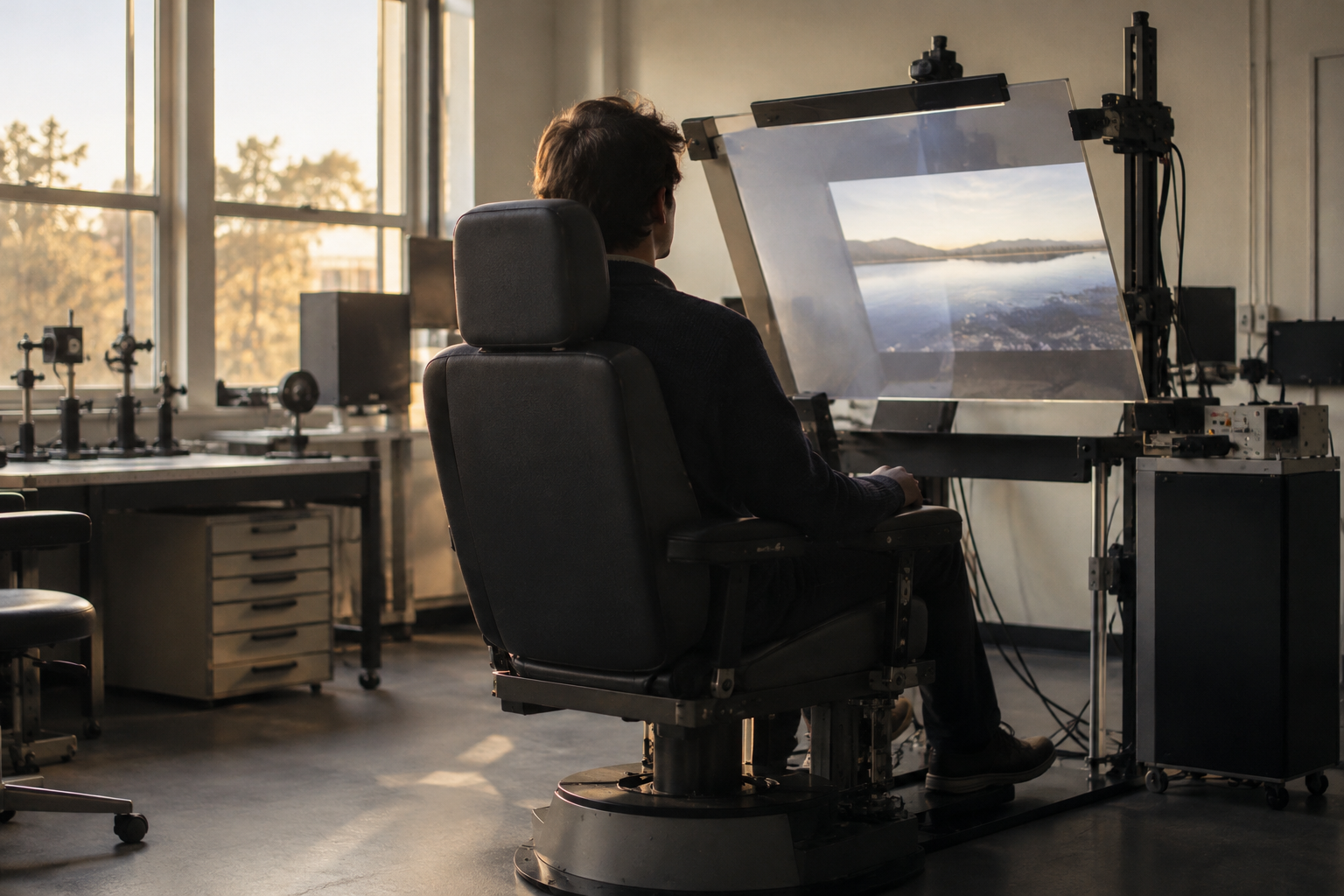
Kyushu University in Japan has demonstrated a chair-mounted virtual-reality system that presents separate images to each eye without requiring a headset. Presented at SIGGRAPH Emerging Technologies 2026, the research combines aerial imaging optics with rotation tracking, suggesting a different approach to immersive seating rather than a product ready for installation in a private cinema.
What happened
The project is led by Shogo Fukushima, an associate professor in Kyushu University’s Faculty of Information Science and Electrical Engineering. Its central change is physical: instead of fastening the viewing optics to the user’s head, the researchers support them on a chair, allowing the occupant to experience a stereoscopic scene without wearing the display hardware.
A micromirror array directs a different image towards each eye. This provides the binocular information used to create an impression of depth, while aerial imaging optics make the picture appear suspended in space rather than located on a conventional screen. The team describes a cinema-like view within an armchair-sized arrangement.
The chair also incorporates a gyroscope to detect rotation. As the occupant turns the chair, the displayed scene changes accordingly, with no calibration required for the reported rotation-tracking arrangement. The demonstrated interaction is therefore tied to the movement of the seat, rather than requiring the user to remain facing a fixed screen.
That distinction needs careful handling. The research describes rotational tracking, not unrestricted movement through a virtual environment, and does not establish that users can look freely through 360 degrees in every direction. For an integrator assessing a future application, this is a seated viewing interface, not evidence of a complete replacement for room-scale VR.
The background
The work addresses a practical compromise in immersive entertainment. Projection rooms and domes can surround viewers with imagery without putting equipment on their heads, but their physical geometry constrains the presentation of depth. Headsets offer a personal stereoscopic view while placing the display, lenses and associated hardware directly on the wearer.
Fukushima’s starting point was a student who spent extended periods in VR and found the headset uncomfortable when trying to rest there. The lab’s response was not simply to reduce headset weight. It reconsidered whether the optical assembly needed to be worn at all, shifting the design problem from wearable equipment to furniture-supported viewing.
That approach is relevant to private entertainment rooms because comfort is not determined by resolution alone. Pressure on the face and loading on the neck can affect willingness to use a system for longer sessions. Moving the optics off the body changes those particular burdens, although the research does not provide comparative comfort measurements.
The optical principle is not itself new: the paper traces the development of this kind of mirror-plate element to around 2006. The contribution is its assembly into a functioning chair-based experience with responsive imagery. This separates the project from a newly invented display material; it is a system-level experiment in how established optical techniques can be used.
For residential AV designers, it also represents a different brief from enlarging a shared screen. The considerations surrounding a 140-inch living-room projection system concern a communal viewing surface. Kyushu’s arrangement instead gives one seated occupant a personal stereoscopic viewpoint, making the seat itself part of the display infrastructure.
What people are saying
The researchers position the chair between projection environments and wearable displays. Their stated advantages are greater freedom in image depth than a dome, together with easier access and improved comfort compared with a headset. Those are the team’s arguments for the architecture, rather than independently established purchasing criteria.
Fukushima also identifies the possibility of reducing VR sickness in future versions. His reasoning is that removing the wearable constraint leaves more scope for larger optical components and moving mechanisms. These could potentially address disagreement between visual motion and bodily sensation, but the current work does not demonstrate a measured reduction in symptoms.
Owners are likely to read the proposal first as a change in the ritual of using VR: sit down rather than put on a display. For a private media room, that could lower the practical barrier to trying an immersive experience. It does not establish whether the resulting experience would hold attention as effectively as a headset.
Integrators have a more immediate reason for caution. The account provides neither numerical field-of-view specifications nor user testing that measures immersion. Without those, it is not possible to judge how much of the occupant’s vision the system fills, or whether its easier physical access compensates for a more restricted visual envelope.
What happens next
The team is seeking industry partners. Proposed applications include in-car workspaces, interactive museum exhibits, remote operation of construction machinery and disaster-response robots. These are possible development directions, not announced deployments, and the information supplied gives no commercial release date, installation price or residential distribution plan.
Brightness is one of the principal engineering questions. The mirror plate absorbs some light, requiring a very bright display to produce the image. A future domestic assessment would therefore need to establish usable contrast under the intended room lighting, rather than assuming that removal of the headset also removes the need for environmental control.
The size of the mirror plate also restricts the field of view. The paper rates both field of view and portability as conditional capabilities, which matters when considering the chair as furniture: a compact overall footprint does not automatically mean a wide visual experience or equipment that can readily be moved between rooms.
One proposed remedy is to add flat mirrors above, below and to either side of the plate. The researchers suggest this could expand the effective screen by as much as six times. A prototype demonstration indicates that extension is possible, but no measurements are reported to establish the achieved increase or the resulting viewing quality.
Installation planning would consequently differ from the familiar questions around motorised home-cinema screens and their control interfaces. Here, the rotating seat and its optical assembly would need to be treated as a combined viewing zone. Clearances, lighting and the occupant’s relationship to the optics would require evaluation before any bespoke room layout was committed.
Fukushima’s longer-term ambition is a shared virtual scene for two people, inspired by the fictional travelling doorway in Doraemon. That remains a research aspiration. The demonstrated single-seat system does not yet establish how two occupants would receive coordinated views, making shared use a separate development question rather than an existing feature.
Why this matters
For luxury-home owners and custom integrators, Kyushu’s work raises a useful specification question: should an immersive display be something a person wears, or something a room supports? Furniture-mounted optics could offer another option for a dedicated entertainment space, but this is research, not installation-ready equipment. Before it belongs in a project specification, designers would need measured viewing angles, brightness performance, comfort evidence and a defined commercial support route—not merely an appealing demonstration of headset-free 3D.
Questions answered
+What is the Kyushu University VR chair?
It is a research system that mounts viewing optics on a chair rather than on the user’s head. A micromirror array and aerial imaging optics provide a headset-free stereoscopic view.
+How does the VR chair work without a headset?
Its micromirror array directs a different image towards each eye, creating an impression of depth. Aerial imaging optics make the picture appear suspended in space rather than on a conventional screen.
+Does the Kyushu VR chair track movement?
A built-in gyroscope detects chair rotation and updates the scene accordingly. The research describes rotational tracking, not unrestricted movement or confirmed viewing through 360 degrees in every direction.
+Can the VR chair reduce motion sickness?
Fukushima identifies this as a possibility for future development, using larger optics and moving mechanisms. The current research does not demonstrate a measured reduction in VR sickness.
+What is the field of view of the Kyushu VR chair?
No numerical field-of-view specification is reported. The mirror plate limits the view, and additional mirrors are proposed as a way to expand the effective screen.
+When can I buy the Kyushu University VR chair?
No commercial release date or price is given. The team is seeking industry partners to develop applications for the technology.
+What could the headset-free VR chair be used for?
The researchers propose in-car workspaces, interactive museum exhibits, remote-controlled construction machinery and disaster-response robots. These are development possibilities rather than announced installations.
More in Latest Tech
 Latest Tech
Lumene Coliseum Silent screens add smarter cinema control
Due in the UK in November, Lumene’s motorised screen range combines revised movement control with five materials for dedicated cinemas and shared living spaces.
7 October 2026 · 5 min
 Cool Stuff
Epson QS100: what a 140-inch living-room system demands
A household evaluation of Epson’s projector and EPV’s rising screen highlights the installation decisions behind convincing large-screen viewing in a shared living room.
7 October 2026 · 5 min
 Latest Tech
Google smart home technology and the question of control
Google’s reach across Nest, Android, cloud computing and AI makes it influential in connected homes, but owners should distinguish platform capability from infrastructure resilience.
8 October 2026 · 5 min