Lumene Coliseum Silent screens add smarter cinema control
Due in the UK in November, Lumene’s motorised screen range combines revised movement control with five materials for dedicated cinemas and shared living spaces.
By Oliver Pembrook · · 5 min read
Key facts
- 01Lumene Coliseum Silent is scheduled to reach the UK through Avoke in November 2026, starting at £1,799.
- 02Coliseum Silent offers five screen materials, with the largest models reaching 180 inches diagonally.
- 03Lumene specifies a 20W DC motor, noise below 50dB and a rating exceeding 20,000 operating cycles.
- 04Coliseum Silent supports RS485, dry contacts, 433MHz RF, infrared and 12V trigger control.
- 05Coliseum Silent Extra Bright UST comes in four sizes from 92–130 inches, priced at £2,149–£3,999.
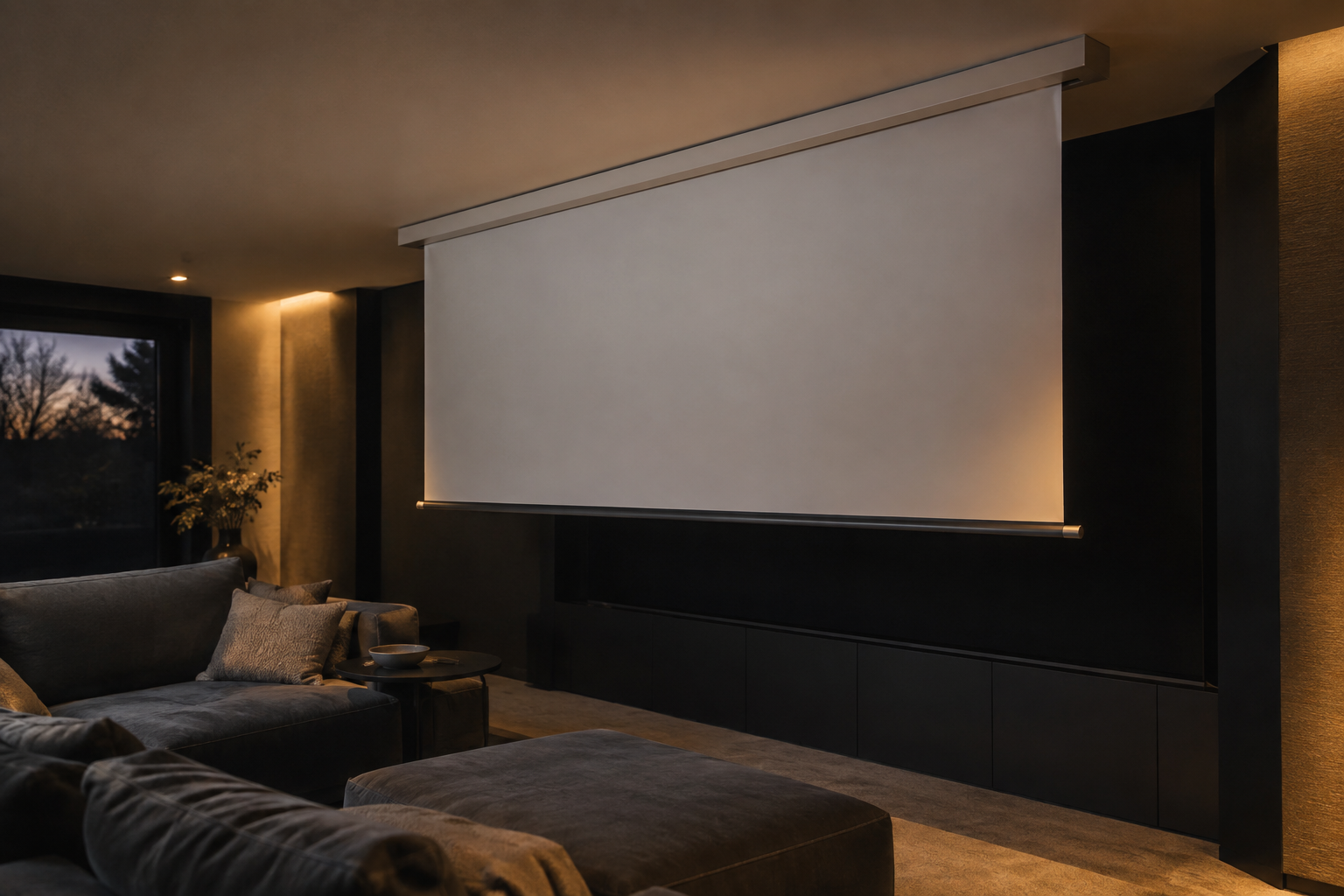
Lumene has introduced Coliseum Silent, a replacement for its motorised projection-screen range, with UK arrival scheduled for November 2026 through distributor Avoke. Prices start at £1,799, with five screen-material options addressing dedicated home cinemas, concealed loudspeaker installations and living rooms using either long-throw or ultra-short-throw projectors.
What happened
The French screen specialist has revised the drive system, control electronics and mounting hardware rather than simply changing the projection surface. A 20W DC motor operates from a universal 110–240V supply without an external transformer. Lumene specifies operating noise below 50dB and a motor rating exceeding 20,000 operating cycles; neither figure should be treated as an independently verified result.
Electronic limit adjustment lets installers set the screen’s stopping position to suit the room. Control connections include RS485, dry contacts and a 12V trigger input, alongside infrared and 433MHz RF operation. These provide several routes into a cinema control scheme, although interface availability alone does not establish compatibility with a particular automation platform.
An S-curve motion algorithm regulates acceleration and deceleration as the screen lowers and retracts. Lumene intends this to reduce abrupt movement and mechanical stress on the fabric, helping it retain its flatness. Electromagnetic shielding is also incorporated into the motor to improve resistance to interference.
The housing has sealed construction and dedicated grounding intended to dissipate static electricity, limit dust attraction and protect the internal electronics. Revised L-shaped brackets support wall or ceiling mounting. Lumene describes these as slimmer and more robust than the previous fittings, potentially useful where the screen must sit discreetly within an architectural scheme.
Material choice creates the most consequential differences within the line-up:
- Coliseum Silent UHD 4K: the conventional home-cinema option has 1.0 gain, quoted 96% colour reproduction and a 160-degree viewing angle. Lumene positions it for projectors rated between 1,500 and 3,000 lumens. Six sizes span 92–180 inches, priced from £1,799 to £4,399.
- Coliseum Silent UHD 4K/8K Platinum: a 1.3-gain surface carries quoted 99% colour reproduction and a 130-degree viewing angle. Aimed at higher-end projection systems, it comes in six sizes from 92–180 inches, costing £1,849–£4,549.
- Coliseum Silent UHD 4K Acoustic: designed for loudspeakers behind the picture, this material uses 92,000 micro-perforations per square metre. Specifications include 0.8 gain, quoted 99% colour reproduction and a 150-degree viewing angle. Five sizes extend to 158 inches, with prices of £2,299–£4,599.
- Coliseum Silent Extra Bright LT: intended for long-throw projection in rooms with ambient light, it combines 1.2 gain with claimed ambient-light rejection above 85%. Quoted colour reproduction is 99%, with a 50-degree viewing angle. Six sizes span 92–180 inches, priced at £2,049–£4,599.
- Coliseum Silent Extra Bright UST: developed for ultra-short-throw projectors, it has 0.5 gain, ceiling-light rejection technology and claimed ambient-light rejection above 88%. Four sizes cover 92–130 inches, costing £2,149–£3,999.
The background
A retractable screen solves an architectural problem as much as an AV one: it allows a large image to disappear when the room has another purpose. The moving assembly consequently becomes part of the daily experience, not merely a support for the picture. Motor sound, the final stopping position and the behaviour of the fabric all warrant attention during commissioning.
Gain describes a screen’s directional brightness relative to a reference surface, rather than an independent increase in projector output. Higher gain can favour viewers in particular positions, making seating geometry important. Lumene’s published viewing angles range from 50 degrees for Extra Bright LT to 160 degrees for the standard UHD 4K material, so choosing by price or projector specification alone would miss a substantial distinction.
Ambient-light rejection also depends on the relationship between incoming light, the projector and the screen surface. It is not a universal substitute for room-light control. The separate LT and UST materials recognise different projection geometries; the latter requires its own specification process, as explored in our examination of the room requirements behind Epson QS100 living-room projection.
The Acoustic option changes the sound-system layout by allowing speakers to sit behind the projected image. That can place dialogue closer to its visible source, but an installer still needs to assess the interaction between speaker position, screen material and available light output. Its 0.8 gain should be considered in the brightness budget rather than assuming the same projector settings will suit every fabric.
More broadly, loudspeaker and room geometry remain inseparable, whether the installation uses a perforated cinema screen or exposed stereo cabinets. Our coverage of PMC Prophecy speakers and room-led placement considers that wider principle. For a concealed cinema arrangement, the practical question is whether the room can accommodate both the required speaker positions and the screen assembly.
What people are saying
Lumene presents the redesign as an improvement in quietness, positioning accuracy and durability. Its explanation links smoother motor movement to lower fabric stress, while the revised housing tackles static and dust. These are manufacturer positions about the engineering intent; the launch information does not establish how the new screens compare with their predecessors in a controlled installation test.
For an integrator, the control-interface list is likely to be more immediately actionable than the range’s name. Dry contacts or a trigger may suit straightforward deployment, while RS485 offers another connection route where supported by the wider system. Before promising a particular user experience, the installer needs to establish the available commands and how screen movement will be coordinated with projector start-up and shutdown.
Owners should read “Silent” as a product name, not a promise of inaudible operation. A noise specification below 50dB does not, by itself, explain how noticeable the motor will be in a quiet room. Listening to a demonstration would be more useful than interpreting the number without information about measurement distance or background noise.
What happens next
The announced UK milestone is November availability through Avoke. With the largest UST model limited to 130 inches, the largest Acoustic model to 158 inches and other materials reaching 180 inches, projects should establish their screen family before fixing the image size. Those limits could affect both room drawings and projector selection.
Several specification questions remain open in the supplied launch details: housing dimensions, installation weight, fabric-flatness tolerances and the conditions behind the quoted performance figures. The colour-reproduction percentages are not accompanied by a measurement standard, so they should not be read as directly comparable colour-gamut coverage claims. Integrators should request the relevant technical documentation before finalising a design.
Why this matters
For owners and designers, Coliseum Silent makes screen selection a decision about room use, seating and control rather than diagonal size alone. The valuable opportunity is to specify the moving mechanism and projection material together, before joinery, lighting and loudspeaker positions become fixed. That approach gives a retractable cinema installation a better chance of working as convincingly when the screen disappears as when the film begins.
Questions answered
+When will Lumene Coliseum Silent be available in the UK?
The range is scheduled to arrive in the UK in November 2026. UK distribution is through Avoke.
+How much does a Lumene Coliseum Silent screen cost?
UK prices start at £1,799 for the standard UHD 4K range. The highest listed price is £4,599, reached by models in the Acoustic and Extra Bright LT ranges.
+What sizes does Lumene Coliseum Silent come in?
The standard UHD 4K, Platinum and Extra Bright LT ranges span 92–180 inches. Acoustic models extend to 158 inches, while Extra Bright UST models span 92–130 inches.
+Is the Lumene Coliseum Silent screen completely silent?
Lumene specifies motor noise below 50dB, not inaudible operation. The supplied launch details do not state measurement distance or background-noise conditions, so a demonstration would help establish suitability for a quiet cinema room.
+Which Lumene Coliseum Silent screen works with a UST projector?
The Extra Bright UST is developed specifically for ultra-short-throw projectors. It has 0.5 gain, ceiling-light rejection technology and claimed ambient-light rejection above 88%.
+Can speakers go behind a Lumene Coliseum Silent screen?
The UHD 4K Acoustic model is designed for that arrangement. Its material has 92,000 micro-perforations per square metre, 0.8 gain and a specified 150-degree viewing angle.
+What control connections does Lumene Coliseum Silent support?
The range supports RS485, dry contacts, 433MHz RF, infrared and 12V trigger inputs. Electronic limit adjustment allows installers to set the stopping position, but compatibility with a particular automation platform still needs checking.
More in Latest Tech
 Cool Stuff
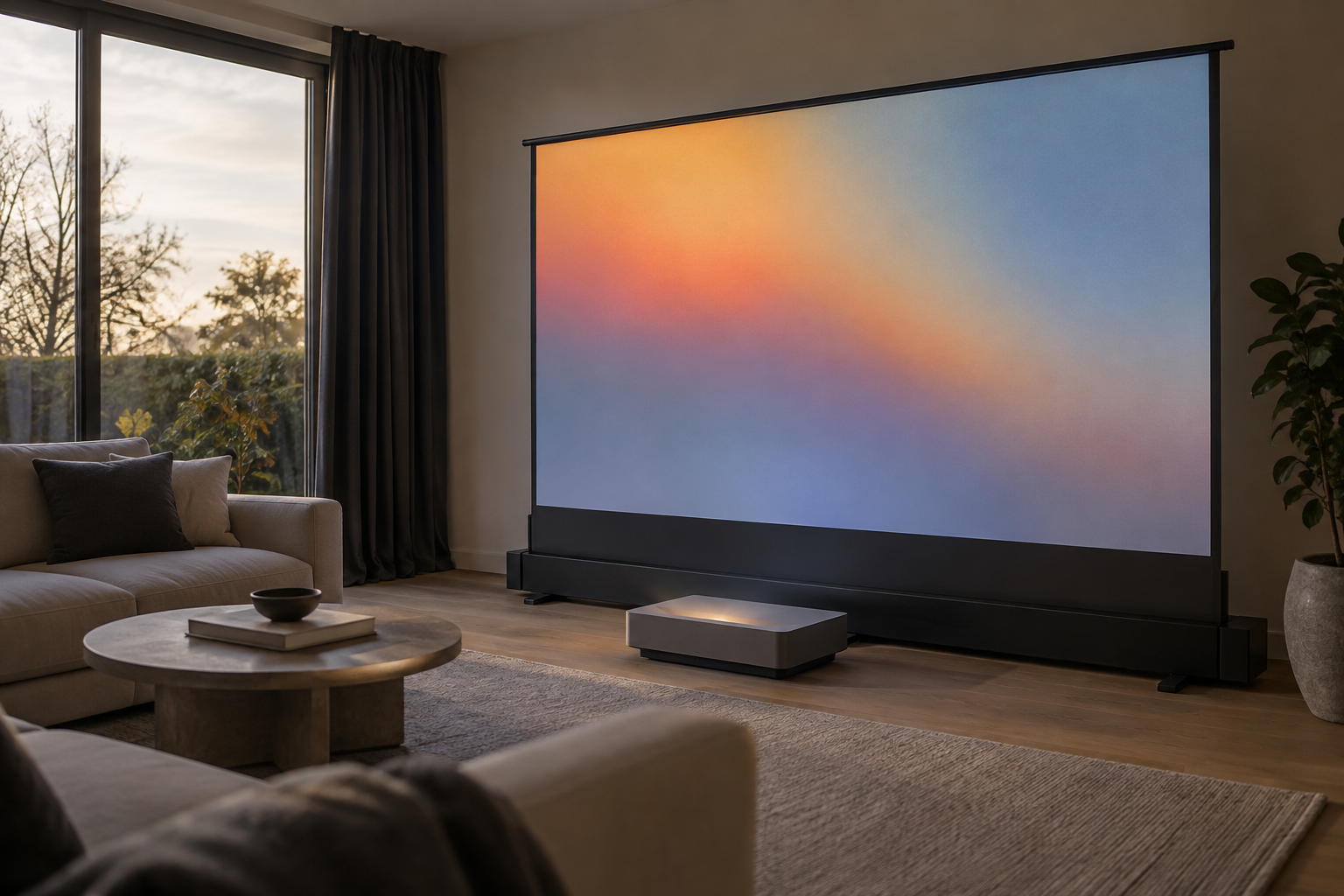
Epson QS100: what a 140-inch living-room system demands
A household evaluation of Epson’s projector and EPV’s rising screen highlights the installation decisions behind convincing large-screen viewing in a shared living room.
7 October 2026 · 5 min
 Cool Stuff
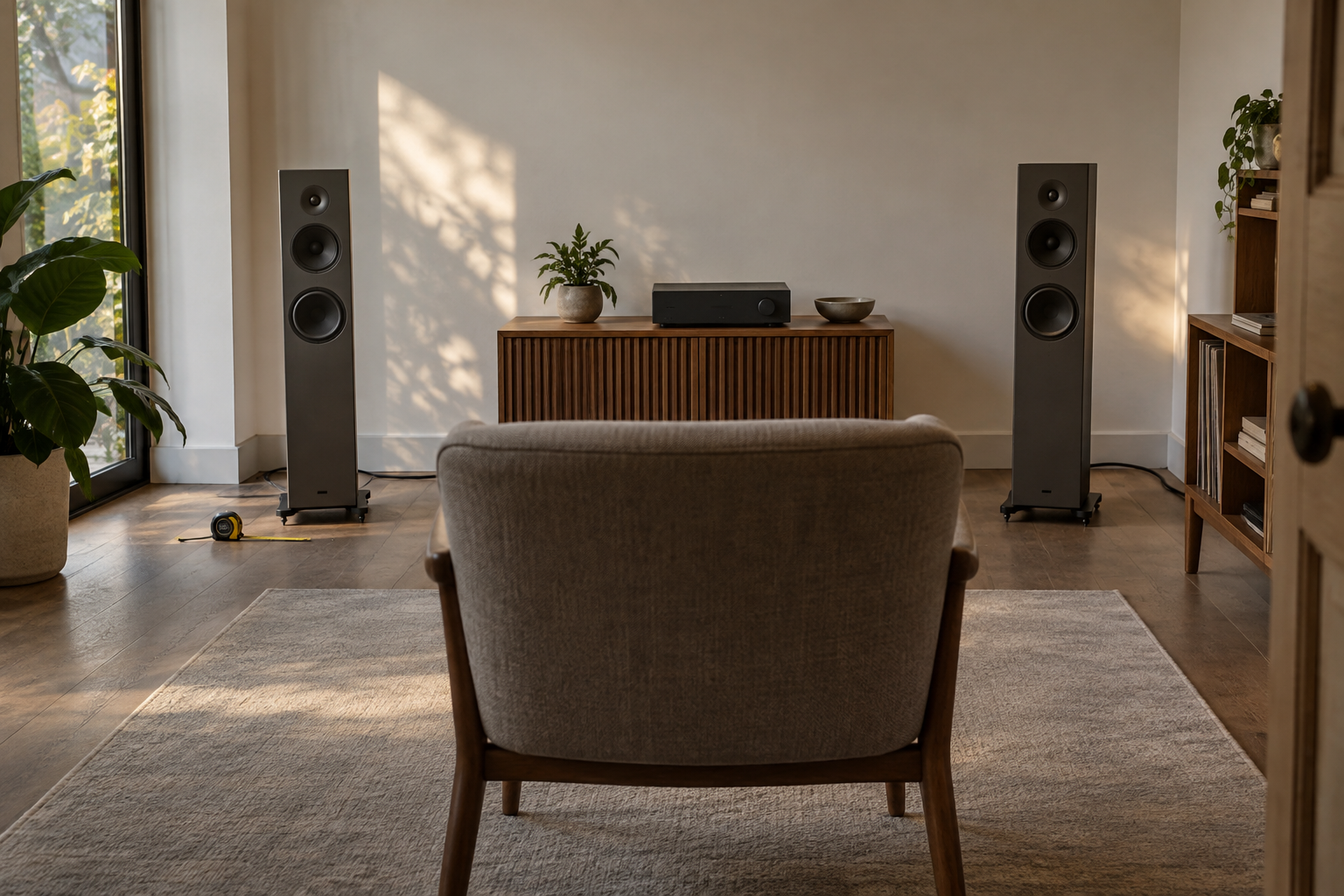
PMC Prophecy speakers put room size before cabinet size
PMC’s replacement for its Twenty 5i range highlights why bass loading, listening distance and placement deserve as much attention as a loudspeaker’s dimensions.
7 October 2026 · 5 min
 Awards
Yacht Intelligence wins Crestron marine award for Valor
The Feadship project takes the above-60-metre installation award, recognising an approach to onboard AV, control and IT centred on discreet operation.
7 October 2026 · 5 min