JBL Summit speakers get a full-line Indianapolis showroom
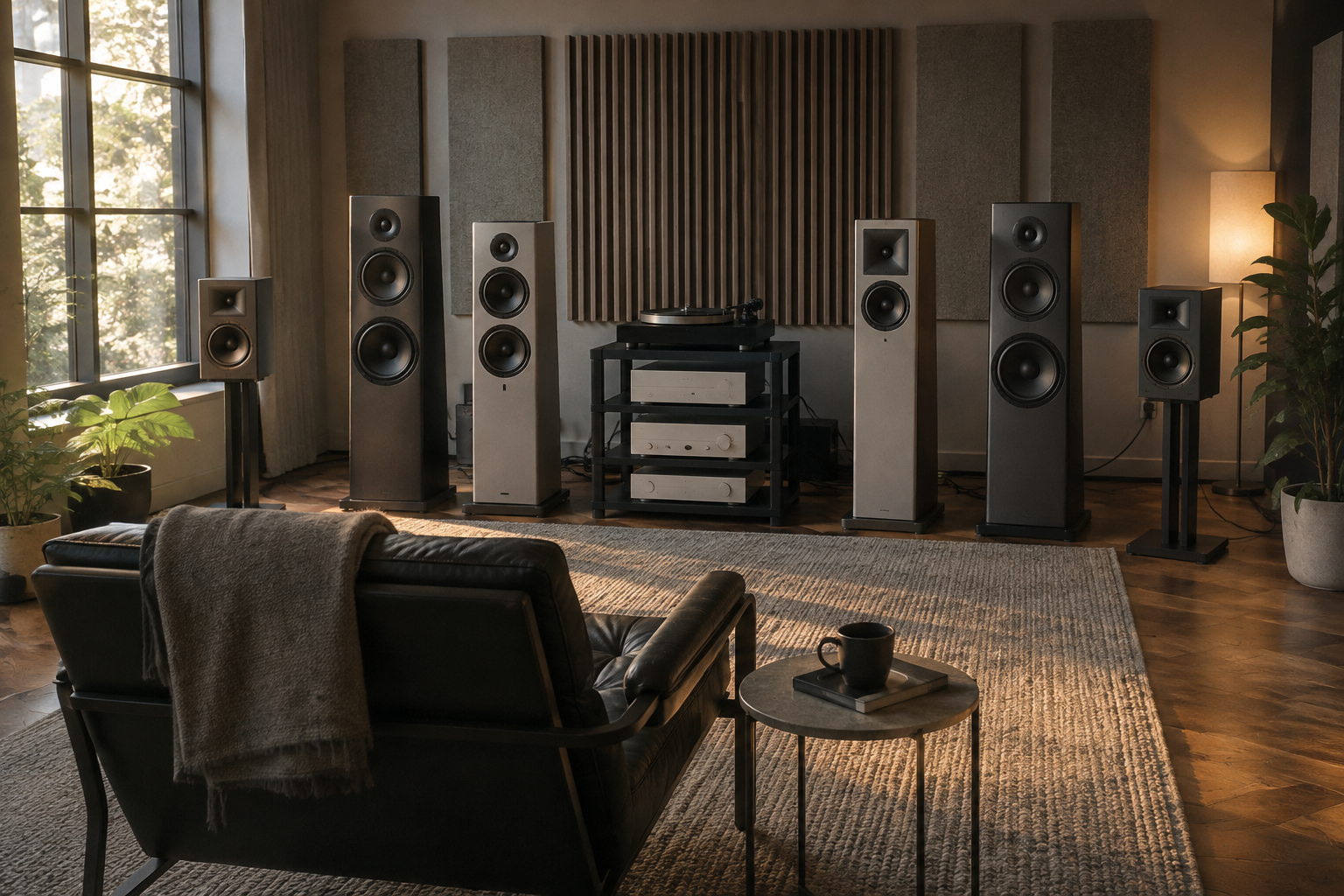
Audio Solutions is displaying all five JBL Summit models, giving buyers a single venue to assess floorstanding and stand-mount options before specifying a listening room.
By Davy Currie · · 5 min read
Key facts
- 01HARMAN Luxury Audio Group announced Audio Solutions’ JBL Summit dealer appointment on 6 October.
- 02Audio Solutions in Indianapolis displays all five JBL Summit models: Everest, K2, Makalu, Pumori and Ama.
- 03Audio Solutions has four dedicated listening rooms and a home cinema.
- 04Audio Solutions says it has sold three Everest generations, beginning with the DD66000.
- 05JBL Summit Ama is a two-way stand-mount; the other four models are floorstanders.
Audio Solutions in Indianapolis now offers auditions of all five JBL Summit loudspeakers, following a dealer appointment announced by HARMAN Luxury Audio Group on 6 October. The family-owned retailer has four dedicated listening rooms and a home cinema, providing a substantial demonstration setting for a range spanning large floorstanders and a two-way stand-mount design.
What happened
The appointment brings Summit Everest, K2, Makalu, Pumori and Ama into the same showroom. Audio Solutions says the speakers are on display and available to hear, making this a change in demonstration access rather than an announcement of a new loudspeaker generation.
Everest occupies the flagship position as a large floorstanding speaker. K2, Makalu and Pumori are also floorstanders, while Ama takes the smaller stand-mount approach. That breadth gives prospective buyers a reason to compare formats before committing to the largest cabinet their budget will accommodate.
Audio Solutions opened in 2000 as a father-and-son business. Its relationship with the Everest name predates the latest appointment: the retailer says it has sold three generations, beginning with the DD66000. The full Summit assortment therefore extends an existing specialist relationship rather than introducing JBL to an unfamiliar dealer.
The announcement does not include independent listening results, prices or delivery lead times. Nor does it establish whether all five models can be compared in the same room with identical electronics. Those distinctions matter: having a complete range available is useful, but the conditions of an audition determine how confidently a buyer can interpret the differences.
The background
JBL’s Project Everest name dates to 1985, giving the flagship a history that extends well beyond this dealership arrangement. For someone familiar with an earlier Everest, staff experience across successive generations can help establish which comparisons are relevant. It cannot, on its own, demonstrate how the current speaker will perform in a different property.
JBL identifies a Sonoglass HDI horn, a three-layer HC4 composite cone, a MultiCap crossover network and IsoAcoustics isolation feet among the technologies shared across the Summit family. These are design features, not a substitute for measured or listening evidence. The announcement supplies no comparative response data from the Indianapolis rooms.
Driver arrangements differ across the range. Ama uses a two-way stand-mount configuration, while the floorstanders provide larger low-frequency sections. In practical terms, a buyer is choosing more than cabinet height: the relationship between bass reproduction, listening distance and available placement space needs to be considered as a system.
Low-frequency performance is especially sensitive to a room’s dimensions and the position of both speaker and listener. A larger speaker may provide greater capability without delivering a more even result at a particular seat. The same distinction underpins the room-size and placement questions raised by PMC Prophecy: physical scale is an incomplete guide to suitability.
A stand-mount also needs to be assessed with its supports and clearance requirements included. Ama’s format does not automatically mean a negligible floor footprint, particularly if the preferred placement brings it away from walls. For a furnished reception room, a plan showing the complete installation is more informative than cabinet dimensions alone.
Summit’s visible cabinets represent a different design choice from architectural audio concealed within a room’s finishes. Projects considering invisible loudspeakers such as Inviye CRBN should settle that aesthetic and installation brief early. A showroom comparison between conventional speakers cannot resolve a fundamental disagreement about whether equipment should be visible at all.
What people are saying
HARMAN sales director Jerry Calder pointed to Audio Solutions’ experience with three Everest generations, starting with the DD66000, when explaining the appointment. His position makes the retailer’s accumulated product knowledge central to the commercial decision, rather than simply its ability to accommodate a large display.
Owner Graham Lundeen presented the current series as a continuation of the Everest lineage. For an existing customer, that framing offers continuity with equipment they may already know. It remains a statement about the range’s heritage, not evidence that every Summit model has the same presentation or suits the same listening priorities.
Owners are likely to find the complete assortment most useful when testing an assumption: whether a flagship is necessary, whether a stand-mount is sufficient, or whether another floorstander better suits the room. Arriving with a defined listening distance, room plan and realistic volume requirements would make that visit more purposeful than an unrestricted tour through increasingly large speakers.
For integrators, four listening rooms create scope for demonstrations in different settings, but also introduce a comparison problem. If models are heard in separate rooms, differences in acoustics and seating become part of the result. Asking the dealer to explain the demonstration setup is therefore as important as asking which amplifier is connected.
Neither company’s comments establish superiority over competing loudspeakers. The defensible significance of the appointment is narrower: Midwest buyers can now investigate the complete Summit family at a retailer with documented experience of its flagship lineage.
What happens next
The immediate next step is already available: Audio Solutions says customers can hear the displayed models in Indianapolis. The announcement gives no timetable for further dealer appointments or additional Summit products, so it should not be read as evidence of a wider distribution expansion.
Before travelling, buyers should confirm which models can be demonstrated during their visit and whether a controlled comparison can be arranged. Matching playback level, music and electronics as closely as practical reduces avoidable variables. A familiar recording is most useful when the listener knows precisely what they want to examine, rather than merely recognising the track.
A shortlisted model then needs to be checked against the intended installation. Amplifier suitability, cable routing, delivery access and the space available around the cabinets are concrete specification questions; none is resolved by the dealer appointment. For a substantial residential project, these checks belong before finishes and furniture layouts are fixed.
UK readers should also separate an American audition opportunity from local procurement. The Indianapolis announcement establishes neither UK stock nor UK pricing, and it provides no information about regional aftercare arrangements. Anyone considering a purchase for a British residence would need those terms confirmed independently.
Why this matters
For owners commissioning a dedicated listening room, the value of this appointment is access to alternatives within one premium loudspeaker family—not an automatic case for buying Everest. Audio Solutions’ full-line display allows the specification process to begin with a meaningful choice of formats; the final brief should still require an agreed placement plan and a method of checking performance in the finished room.
Questions answered
+Where can I hear JBL Summit speakers in Indianapolis?
Audio Solutions says all five JBL Summit models are on display and available for auditions at its Indianapolis showroom. The retailer has four dedicated listening rooms and a home cinema.
+Which speakers are in the JBL Summit series?
The five models are Summit Everest, K2, Makalu, Pumori and Ama. Everest is the flagship floorstander, while Ama is the range’s two-way stand-mount model.
+Is JBL Summit Ama a floorstanding speaker?
No. JBL Summit Ama is a two-way stand-mount speaker. Everest, K2, Makalu and Pumori use floorstanding designs.
+What technology does the JBL Summit series use?
JBL identifies Sonoglass HDI horns, three-layer HC4 composite cones, MultiCap crossover networks and IsoAcoustics isolation feet among the family’s shared technologies. Driver arrangements differ by model.
+How long has Audio Solutions sold JBL Everest speakers?
The announcement does not give a starting year. Audio Solutions says it has sold three Everest generations, beginning with the DD66000.
+How much do JBL Summit speakers cost?
The Audio Solutions dealer announcement does not provide prices or delivery lead times. It also does not establish UK pricing or availability.
More in Hi-Fi
 Hi-Fi
Hi-FiAstell & Kern PD5 brings streaming apps to portable hi-fi
The SR35’s replacement combines expandable local storage, Google Play access and two headphone outputs, with practical implications for listening at home and away.
13 October 2026 · 5 min
 Latest Tech
ChatGPT Health excludes UK from its initial rollout
OpenAI’s dedicated health feature creates a new consideration for connected wellness spaces, but its initial availability excludes the UK and much of Europe.
15 October 2026 · 5 min
 Latest Tech
Google Alphabet ownership and smart-home accountability
Google’s corporate structure explains who controls the business, but owners need product-level commitments before relying on its services throughout a luxury home.
14 October 2026 · 5 min