Superyacht AIS tracking puts privacy law in focus
Owners may have grounds to challenge online publication of vessel movements, but privacy arguments must remain separate from the operation of essential navigation equipment.
By Eleanor Hart · · 5 min read
Key facts
- 01SOLAS requires Class A AIS on yachts of 300 gross tonnage or more engaged on international voyages.
- 02UK GDPR Article 4 can cover AIS information when it relates to an identifiable individual.
- 03UK GDPR Article 6 provides six lawful bases; lack of consent alone does not establish unlawful publication.
- 04UK GDPR Article 5 imposes obligations including data minimisation, purpose limitation and storage limitation.
- 05No AIS-specific court ruling, regulatory exemption or platform policy change is announced.
Superyacht AIS tracking sits at the intersection of maritime safety and personal privacy, with UK data protection law providing potential grounds to challenge online publication of vessel movements. The debate in October 2026 concerns what happens after a safety broadcast leaves the yacht: SOLAS requires Class A AIS on yachts of 300 gross tonnage or more engaged on international voyages, but that requirement does not itself settle how tracking platforms may use the information.
What happened
The legal argument focuses on the transformation of vessel information into information about people. A yacht’s position identifies an asset; combined with a sufficiently strong connection to an owner, habitual user or crew member, it may also reveal the whereabouts of an identifiable individual. That distinction is central to whether data protection law applies.
Online tracking can extend the reach and usefulness of the original transmission. Collecting positions, retaining voyage histories and associating a vessel with a named person creates a different privacy question from a nearby ship receiving a navigation signal. Repeated observations may reveal routines rather than simply one arrival or departure.
For owners, the potential remedy therefore concerns the conduct of whoever processes or publishes the information, rather than an assumed right to disable the transmitter. Switching off required safety equipment is not a general privacy solution. It may create compliance problems and could have insurance consequences if the absence of AIS contributes to a collision.
There is no new AIS-specific court ruling or regulatory exemption announced here. The issue is whether existing legal protections can constrain particular uses of yacht tracking data, with the outcome dependent on identification, purpose, jurisdiction and the competing interests involved.
The background
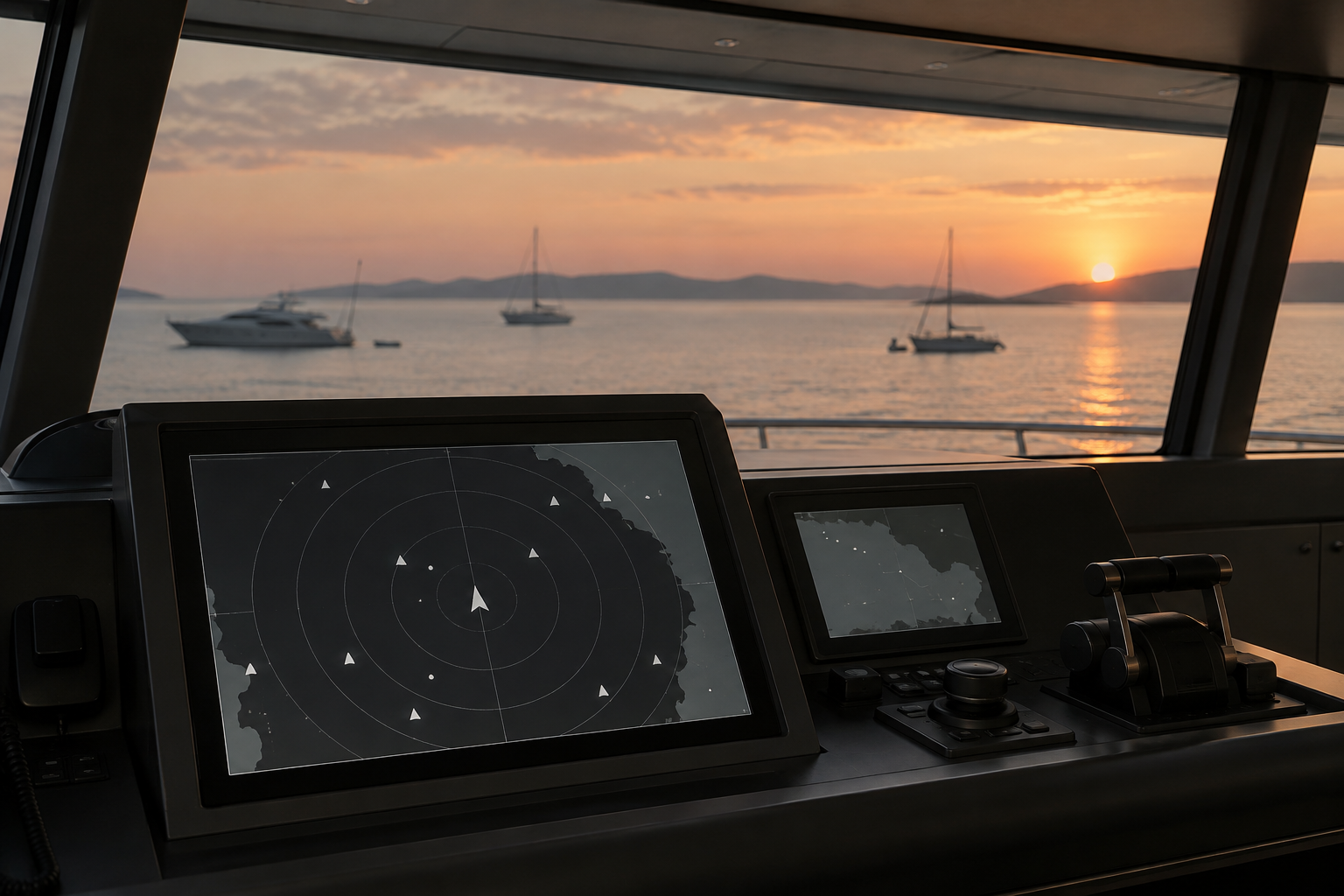
AIS, the Automatic Identification System, broadcasts vessel information by radio to support situational awareness. It complements radar rather than replacing it, and is not affected by some of radar’s familiar difficulties, including clutter. Its usefulness also extends to search and rescue, making uninterrupted safety functionality a practical concern beyond the owner’s vessel.
The carriage requirement comes from Regulation 19 of Chapter V of the International Convention for the Safety of Life at Sea, or SOLAS. The relevant threshold for the yachts discussed here combines size and operation: at least 300 gross tonnage and engagement on international voyages. It should not be reduced to a blanket statement that every leisure craft faces identical requirements.
Under Article 4(1) of UK GDPR, personal data can include location information relating to someone identifiable directly or indirectly. A vessel name alone does not necessarily establish an individual’s presence aboard. Credible information connecting a person to the yacht may, however, make the identification argument considerably stronger.
Article 6 sets out six possible lawful bases for processing personal data: consent, contract, legal obligation, vital interests, public task and legitimate interests. Lack of owner consent is therefore not, by itself, proof that publication is unlawful. A platform relying on another basis would need that basis to fit its actual processing activity.
Legitimate interests is particularly important because it requires consideration of the publisher’s purpose, whether the processing is necessary and how that interest weighs against the individual’s rights. Precise, continuous disclosure of personal movements creates a substantial privacy concern, but the balance cannot responsibly be decided for every service without examining its circumstances.
Article 5 adds separate obligations concerning fairness, transparency, purpose limitation, data minimisation and storage limitation. Establishing a lawful basis does not remove those obligations. A service maintaining a searchable historical record must consider retention and purpose as well as the justification for displaying a current position.
What people are saying
The owner-side argument treats a superyacht as a private living environment, not merely a transport asset. Families, children, guests and crew may be aboard, and the information exposed can concern leisure and domestic life. Celebrity or wealth does not automatically extinguish an individual’s privacy interests.
For captains, the operational distinction is between preserving a navigation function and questioning downstream data use. Treating these as separate workstreams allows the bridge team to retain its safety focus while legal advisers assess publication. A dispute with a website should not become an improvised change to bridge procedures.
Integrators are likely to recognise a wider systems-boundary problem: control over installed equipment does not necessarily mean control over information once it has left that equipment. The overlap between residential and marine work, reflected in Yacht Intelligence’s expansion across yacht and home technology, makes that distinction relevant to firms serving clients in both settings.
The human-rights cases cited in this debate offer context rather than a direct verdict on tracking websites. Uzun v Germany and Shimovolos v Russia concerned state surveillance and movement information. They demonstrate that observation in public can engage private-life protections, but they do not establish that every commercial display of AIS information is unlawful.
UK privacy litigation supplies another possible route. Google v Vidal-Hall recognised misuse of private information as a distinct civil wrong, while Campbell v MGN and Murray v Big Pictures illustrate the importance of context, reasonable expectations and competing interests. None removes the need to assess the particular publication being challenged.
What happens next
No hearing date, enforcement timetable or platform policy change is announced. The unresolved question is how an AIS dispute would apply these established principles to a specific service and identifiable person. An argument about general intrusiveness is not the same as evidence demonstrating why a particular processing activity fails a legal test.
For an owner considering a challenge, the first practical task is to establish what the service actually reveals. Relevant questions include whether it names the individual, how it connects that person to the yacht, whether positions are live or historical, and how extensively past movements can be searched. These details help define the alleged intrusion.
The platform’s purpose and explanation of its processing also matter. A claim based on legitimate interests needs a different examination from one based on a public function or legal obligation. Owners should seek jurisdiction-specific advice rather than assume that UK GDPR supplies an identical remedy against every operator worldwide.
Technology advisers can contribute by explaining the boundary between onboard transmission and external publication. That is a different responsibility from promising anonymity. For businesses with long-standing private-client relationships, such as those discussed in Newland Solutions’ two decades in home technology, setting that expectation is part of defining a credible service brief.
Why this matters
For superyacht owners and their advisers, the useful distinction is between a duty to transmit safety information and a third party’s justification for processing information that identifies people. Protecting privacy need not mean compromising navigation: it may instead require scrutiny of identification, publication and retention outside the vessel. Any challenge should be built around evidence and specialist legal advice, not a promise that an owner can simply disappear from tracking systems.
Questions answered
+What is AIS used for on a superyacht?
AIS broadcasts vessel information by radio to support situational awareness. It complements radar and also assists search and rescue operations.
+Do superyachts have to use AIS?
SOLAS Regulation 19 of Chapter V requires Class A AIS on yachts of 300 gross tonnage or more engaged on international voyages. That threshold should not be treated as an identical rule for every leisure craft.
+Can a yacht owner turn off AIS for privacy?
Privacy is not a general exemption from operating required safety equipment. Disabling AIS may create compliance problems and could have insurance consequences if its absence contributes to a collision.
+Is yacht AIS data personal data under GDPR?
It can be when the information relates to an identifiable person. The strength of the connection between the yacht and an owner, habitual user or crew member is central to that assessment.
+Do AIS tracking websites need an owner's consent?
Not necessarily. Consent is one of six lawful bases under UK GDPR Article 6. A platform relying on another basis must still justify its processing and comply with the applicable data protection principles.
+Can yacht owners challenge online AIS tracking?
They may have grounds under data protection law or misuse of private information. A challenge depends on the specific publication, identification of the person, jurisdiction and competing interests. Specialist legal advice is needed.
More in Luxury
 Luxury
Newland Solutions marks 20 years in luxury home technology
The British custom installation firm reaches its 20th anniversary this October, with work spanning smart home automation, AV, lighting control and energy systems.
7 October 2026 · 2 min
 Luxury
Yacht Intelligence expands Florida team for yacht and home tech
Three appointments strengthen Yacht Intelligence’s Florida operation as the AV and IT specialist builds US refit and residential capabilities alongside European new-build work.
7 October 2026 · 5 min
 KNX, Energy & Solar
KNX and BMS: where luxury homes should draw the control line
As residential heating and cooling grow more complex, the important decision is not which control platform wins, but where responsibility sits.
7 October 2026 · 5 min