Nvidia networking deals and the private-estate IT brief
Nvidia’s expansion into networking helps explain its infrastructure ambitions, but estate and yacht specifications still need evidence at the system level.
By James Whitcombe · · 5 min read
Key facts
- 01Nvidia announced its $6.9 billion deal to acquire Mellanox Technologies on 11 March 2019.
- 02Nvidia announced the acquisition of Cumulus Networks in May 2020.
- 03Cumulus Networks was subsequently absorbed into Nvidia’s networking business alongside Mellanox.
- 04Nvidia’s stated Mellanox rationale was expansion in high-performance computing, not a residential technology launch.
Nvidia’s expansion beyond graphics included a $6.9 billion deal to buy Mellanox Technologies, announced on 11 March 2019 by the Santa Clara, California-headquartered company. In May 2020, Nvidia announced the acquisition of Cumulus Networks, subsequently bringing that business into its networking division alongside Mellanox. These were infrastructure moves, not residential launches, but they provide useful context for owners considering more ambitious computing installations at home or aboard a yacht.
What happened
The Mellanox transaction was intended to broaden Nvidia’s position in high-performance computing. The target was an Israeli company, and the acquisition moved Nvidia further into the infrastructure surrounding accelerated computing rather than simply expanding its graphics business.
Cumulus Networks followed with a complementary networking business. After the acquisition, Cumulus was absorbed into Nvidia’s networking unit alongside Mellanox, placing the businesses within the same organisational structure. The two announcements therefore belong to a wider corporate expansion, rather than a sequence of consumer entertainment launches.
For a residential technology brief, the first distinction is between a supplier’s capabilities and the equipment a particular building requires. Neither acquisition announcement establishes a residential control platform, an estate-network package or a marine support arrangement. Their relevance is to understanding the supplier behind a proposed computing architecture, not to treating enterprise infrastructure as automatically appropriate for a private property.
The dates also matter. These are established transactions from 2019 and 2020, not a new November 2026 offer to homeowners. A consultant invoking them today should explain what practical benefit the resulting networking capabilities bring to the proposed installation, rather than presenting corporate history as evidence of current compatibility.
The background
Nvidia began with graphics for video games and subsequently expanded into artificial intelligence, professional visualisation and supercomputing. Its activities now span graphics processors, systems on chips and software interfaces. That breadth helps explain why networking became strategically relevant: powerful computing components must exchange information with other parts of a system.
In general computing terms, a fast processor cannot eliminate delays elsewhere in the installation. Storage access, data movement and software configuration can constrain a workload even when substantial processing capacity is available. Networking acquisitions address a different layer of the architecture from the one most buyers associate with a graphics supplier.
Nvidia’s investment in CUDA provides the software context. The company invested more than $1 billion in the platform during the early-to-mid 2000s, enabling graphics processors to execute a wider range of parallel computing tasks. Our examination of Nvidia CUDA and home AI procurement considers the application dependencies that can follow from that software ecosystem; the networking question concerns how the surrounding system serves those applications.
A luxury residence may combine entertainment, security, building controls, staff communications and a private workspace. Those functions should not be treated as one undifferentiated computing workload. A proposal for specialist local processing needs to identify which activity requires it, where its data originates and whether it must interact with operational building systems.
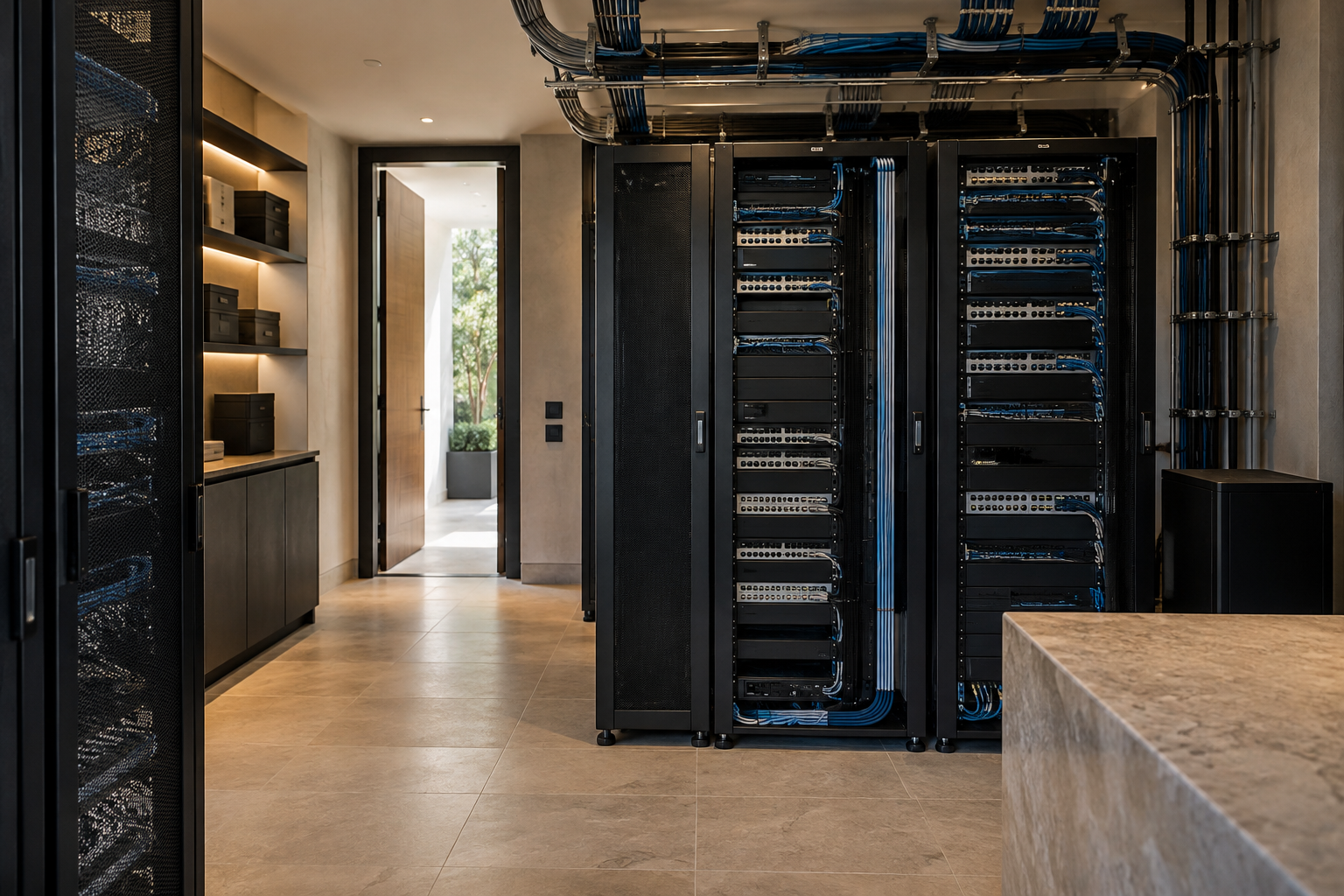
Nor does a high-performance computing pedigree make enterprise design assumptions suitable for occupied rooms. Equipment location, cooling provision and maintenance access are architectural decisions as well as IT decisions. Any benefit from specialist infrastructure must be weighed against the space and servicing requirements it introduces into a finished property.
What people are saying
The stated rationale for Mellanox was expansion in high-performance computing. That is narrower than a claim about better domestic networking, and neither transaction supplies an owner-facing promise about home automation or yacht connectivity. The appropriate reading is therefore strategic: Nvidia was broadening the infrastructure it could provide around demanding computing applications.
Owners are likely to judge such a proposal through outcomes rather than corporate structure. An adviser should be able to name the task being improved, describe its present constraint and explain how success will be measured. A faster result in a defined application is a testable proposition; an assurance that a property will become more advanced through association with Nvidia is not.
For integrators, the organisational consolidation raises a different question: who takes responsibility for the assembled system? A shared corporate parent does not by itself establish one support contract covering software, networking, storage and installation. The service schedule should identify the party responsible for diagnosis when a fault crosses those boundaries.
Captains and yacht managers have an additional reason to separate local infrastructure from external connectivity. Processing aboard a vessel and reaching an internet service are different requirements. The distinction complements our analysis of the yacht connectivity specification for cloud services: improving an onboard computing system cannot, by itself, demonstrate that a remote service will remain accessible underway.
Developers should also distinguish a permanent building provision from an owner-specific computing installation. Providing suitable service space and cable routes can preserve future options without committing every residence to specialist infrastructure. That approach allows a subsequent occupier’s actual workloads to determine the active system rather than allowing a supplier’s acquisition strategy to dictate the building specification.
What happens next
The acquisition history provides no announced residential rollout, marine certification programme or installation timetable. For a current project, the next step is therefore a technical assessment, not waiting for a launch implied by these older transactions. Any proposed Nvidia-based infrastructure needs contemporary documentation for the actual configuration being offered.
Start with a workload schedule. It should record the application, expected users, source data, destination of results and acceptable completion time. This gives the designer a basis for deciding whether the limiting factor is processing, storage, networking or the application itself, before introducing additional infrastructure into the project.
Then request a system diagram showing which services depend on the specialist installation. Building controls should not acquire an undocumented dependency merely because a new computing resource is available. Where systems share infrastructure, the design should explain how maintenance or a failure in one area affects the others.
Acceptance testing should reproduce the intended use rather than rely solely on component specifications. Where appropriate, test concurrent activity, recovery after a restart and operation when an external service is unavailable. The wider principle of smart-home recovery testing is relevant here: commissioning needs to establish how the installation behaves outside its ideal operating condition.
Finally, procurement should include a maintenance and replacement route. Ask which configurations the installer supports, who approves updates and how project records will remain accessible if the original contractor changes. These are contractual questions for the proposed system; Nvidia’s ownership of networking businesses cannot answer them on an installer’s behalf.
Why this matters
Nvidia’s Mellanox and Cumulus acquisitions explain why the company belongs in discussions about computing infrastructure, not just graphics. For a private estate or superyacht, however, the useful procurement boundary is the delivered service: a defined workload, an evidenced design and accountable support. Owners should use the corporate history to ask better questions, while reserving approval for systems whose practical benefits justify their demands on the property and its operating team.
Questions answered
+When did Nvidia announce the Mellanox acquisition?
Nvidia announced the deal to acquire Mellanox Technologies on 11 March 2019.
+How much was Nvidia’s Mellanox deal worth?
The announced Mellanox deal was worth $6.9 billion.
+Why did Nvidia buy Mellanox?
Nvidia’s stated rationale was to expand its position in high-performance computing, broadening its infrastructure business beyond graphics processing.
+When did Nvidia acquire Cumulus Networks?
Nvidia announced the acquisition in May 2020. Cumulus was subsequently absorbed into Nvidia’s networking business alongside Mellanox.
+Did Nvidia’s networking acquisitions launch a smart-home system?
Neither acquisition announcement establishes a residential control platform or estate-network package. Their relevance is to Nvidia’s broader computing infrastructure strategy.
+What should homeowners check before buying specialist computing infrastructure?
The project should define its workloads, document system dependencies, test the intended configuration and assign responsibility for maintenance, updates and fault diagnosis.
More in Latest Tech
 Latest Tech
Nvidia leadership change puts home-tech continuity in focus
Colette Kress is named interim chief executive following Jensen Huang’s reported resignation, raising questions about continuity rather than immediate changes to residential technology.
12 November 2026 · 5 min
 Latest Tech
AMD World Labs deal puts spatial AI on the home-tech agenda
AMD’s announced $8.2 billion acquisition targets spatial intelligence, but its relevance to private homes depends on applications, privacy safeguards and integration tools still to be detailed.
13 November 2026 · 5 min
 Latest Tech
Rako Controls adds Dubai office for Middle East lighting projects
The British lighting-control manufacturer’s Business Bay office will support Middle East projects from specification through commissioning and after-sales care.
13 November 2026 · 5 min