Nvidia macOS drivers and the home-studio support gap
Nvidia’s historic macOS driver dispute offers a practical lesson for private studios: hardware compatibility depends on software permissions, not simply processing power.
By James Whitcombe · · 5 min read
Key facts
- 01Nvidia said in September and October 2018 that Apple controlled approval of its macOS graphics drivers.
- 02The dispute concerned macOS Mojave, version 10.14, and support for existing Nvidia graphics configurations.
- 03Apple’s Mojave list included some Nvidia hardware, but not every Metal-compatible configuration working under High Sierra.
- 04By January 2019, the enabling Nvidia web drivers had not appeared in the historical account.
In September and October 2018, California-based Nvidia said it could not release graphics drivers for macOS Mojave without Apple’s approval, leaving some users without the software needed for their existing graphics configurations. The macOS 10.14 episode remains a useful case study for premium home studios and integrated workspaces: a capable component does not, by itself, establish compatibility with an operating-system upgrade.
What happened
The issue surfaced publicly in May 2018, when an Nvidia user-forum discussion asked when updated web drivers would become available for older Apple computers. These drivers were needed to enable graphics acceleration and multiple-display capabilities, making their availability consequential for installations built around more than a basic desktop screen.
Apple’s Mojave guidance identified Metal-compatible graphics hardware as a requirement and listed supported options, including some from Nvidia. However, that list did not include every Metal-compatible Nvidia configuration that worked under macOS High Sierra using Nvidia’s own web drivers. Meeting a graphics technology requirement and appearing on an operating system’s supported list were therefore different tests.
Nvidia’s September response placed responsibility for macOS driver approval with Apple and said its engineers were willing to help deliver drivers for Mojave. In October, Nvidia made its position more explicit: it could not release a driver unless Apple approved it. These were statements about the release process, not a delivery commitment.
By January 2019, the enabling web drivers had still not appeared in the account available. That chronology matters when interpreting the episode today: this is a historical support case, not a newly announced withdrawal or evidence of a current Nvidia–Apple compatibility change. It does not establish the status of any present-day configuration.
The background
Nvidia began in 1993 with a focus on graphics processing and subsequently expanded into professional visualisation, scientific computing and artificial intelligence. Its presence across those markets helps explain why a graphics supplier’s reputation can carry considerable weight in a workstation purchase. That reputation cannot settle questions controlled by another company’s operating system.
A graphics driver is the software layer through which an operating system uses graphics hardware. For an owner, its absence can be more important than a component’s theoretical performance: an application may lack the acceleration or display behaviour on which the installation was designed to depend. The relevant procurement unit is consequently the working configuration, not the component in isolation.
The Mojave case also illustrates why compatibility language needs careful reading. Metal compatibility described support for a graphics framework; it did not automatically mean that every existing driver arrangement would carry forward. In a project specification, an umbrella term should therefore be accompanied by the operating-system version, driver version and applications actually tested.
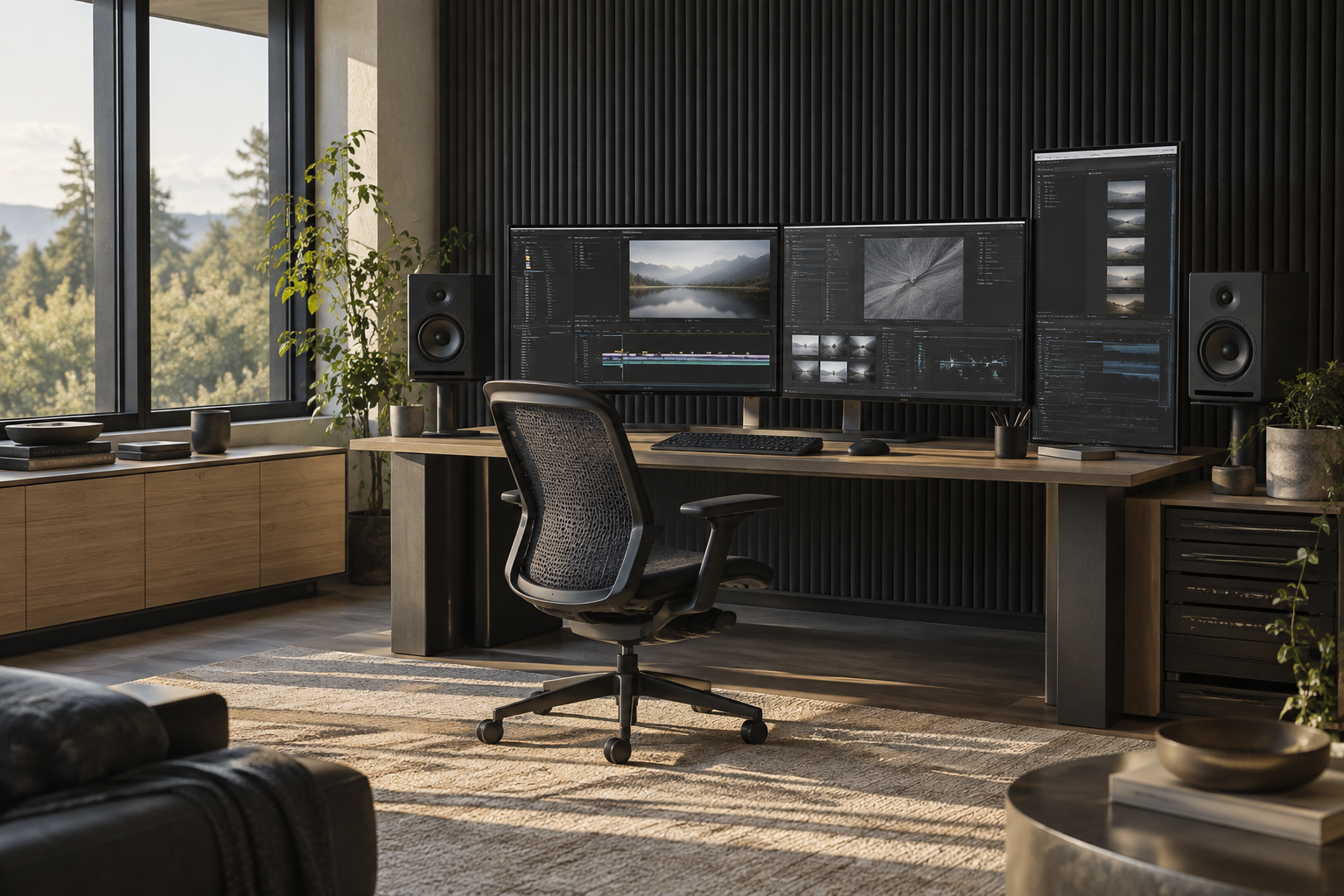
For a private editing suite, music room with visual production facilities, or home office with several displays, those distinctions affect the commissioning brief. An integrator should establish which screen arrangements and accelerated tasks the client expects before accepting a workstation as complete. A successful start-up proves much less than a completed representative workflow.
This sits alongside the broader distinction between supplier scale and installation assurance explored in our examination of service-level evidence for smart-home procurement. A recognisable supplier can provide one important part of a system while having no unilateral authority to maintain another part of it.
What people are saying
Nvidia’s public position in 2018 was that its engineering team was prepared to assist, but Apple controlled the permission required for release. The distinction is important: willingness to develop software is not the same as being able to distribute an approved version. Buyers should not read a statement of readiness as a promised support date.
Apple’s published compatibility guidance addressed a different question: which graphics options it identified for Mojave. The material available does not include an Apple explanation resolving Nvidia’s approval complaint. It would therefore be unwarranted to turn the episode into a definitive account of either company’s motives or of discussions between them.
For owners, the likely concern is the availability of a working room rather than responsibility for an inter-company disagreement. A studio that cannot perform its agreed tasks imposes a practical cost even when every supplier can accurately describe the limits of its own role. The project contract should identify who investigates a failure spanning those boundaries.
For integrators, the case points towards separating contractual support from upstream dependencies. A service provider may undertake testing, recovery and replacement work without being able to compel a platform company to approve a driver. Explaining that boundary before handover is more useful than discovering it during a failed upgrade.
The same reasoning underlies the need to scrutinise software-support promises across Android-based home systems. Although the platforms differ, the procurement question is comparable: which organisation controls the software change, and what can the installer actually guarantee?
What happens next
The historical account contains no subsequent driver-release commitment that can be presented as an upcoming milestone. For an existing installation, the next step is therefore verification rather than an assumed update: identify its current software state and obtain support information specific to the intended destination version. An old controversy is neither a current compatibility certificate nor a blanket reason to reject a supplier.
Before authorising an upgrade, the project team should record the installed operating system, graphics driver, principal applications and display arrangement. That record provides a reproducible baseline for diagnosis. It also prevents a service engineer from having to reconstruct the last working configuration from an owner’s recollection.
Acceptance testing should use the client’s actual work. Depending on the room, that might mean opening an established editing project, checking a multi-display workspace or completing a representative export. The objective is to detect a workflow failure that a generic benchmark or a brief desktop demonstration could miss.
Our discussion of browser testing for smart-home interfaces makes a related commissioning point: software should be evaluated where it is used. For a studio, tests belong on the installed signal path and working display arrangement, rather than only on a supplier’s separate demonstration machine.
A recovery plan should specify who can restore the previous environment and how project files will be protected. Retaining an older operating system also needs an explicit review of application and security support; avoiding an upgrade is not automatically a sustainable maintenance policy. Where replacement becomes necessary, the decision should follow documented workflow requirements rather than brand preference.
Why this matters
For owners investing in a carefully integrated private studio, the Nvidia–Mojave episode exposes an often-overlooked boundary between ownership and control: buying hardware does not confer authority over the software approvals that keep it useful. The appropriate safeguard is a documented, tested installation with clear responsibility for upgrades and recovery—not an assumption that component capability guarantees continued platform support.
Questions answered
+What was the Nvidia macOS Mojave driver issue?
Some existing Nvidia graphics configurations needed updated web drivers for macOS Mojave. Nvidia said in September and October 2018 that it could not release those drivers without Apple’s approval.
+Did macOS Mojave support Nvidia graphics?
Apple’s Mojave compatibility guidance included some Nvidia graphics options. It did not include every Metal-compatible Nvidia configuration that worked under High Sierra with Nvidia’s web drivers.
+Why did Nvidia need Apple’s approval for macOS drivers?
Nvidia said Apple controlled macOS driver approval and that a release required Apple’s permission. The available account does not establish the underlying approval criteria or resolve the companies’ discussions.
+Does Metal compatibility guarantee Mojave support?
No. In this historical case, some Metal-compatible Nvidia configurations working under High Sierra were absent from Apple’s Mojave support list. Framework compatibility and operating-system support were separate checks.
+Why do graphics drivers matter for a home studio?
Graphics drivers enable the operating system to use graphics hardware. The Nvidia web drivers at issue provided graphics acceleration and multiple-display capabilities, both relevant to a studio’s working configuration.
+What should I check before upgrading a home-studio computer?
Record the operating system, graphics driver, principal applications and display arrangement. Verify support for the proposed upgrade, test representative client workflows and establish a recovery plan before changing the working installation.
+Is this a new Nvidia macOS support announcement?
No. This article examines events from 2018 and early 2019. It does not report a new withdrawal of support or establish compatibility for current Nvidia and Apple configurations.
More in Latest Tech
 Latest Tech
Nvidia leadership change puts home-tech continuity in focus
Colette Kress is named interim chief executive following Jensen Huang’s reported resignation, raising questions about continuity rather than immediate changes to residential technology.
12 November 2026 · 5 min
 Latest Tech
Artificial intelligence in smart homes: from words to control
Advances in AI reasoning sharpen a practical distinction for luxury homes: understanding a request is not the same as safely carrying it out.
14 November 2026 · 5 min
 Latest Tech
AMD’s manufacturing split and the home-tech supplier chain
AMD’s evolution from chip manufacturer to semiconductor designer offers a useful distinction for residential technology buyers: component pedigree is not the same as system accountability.
14 November 2026 · 5 min